03 — ARTWORK
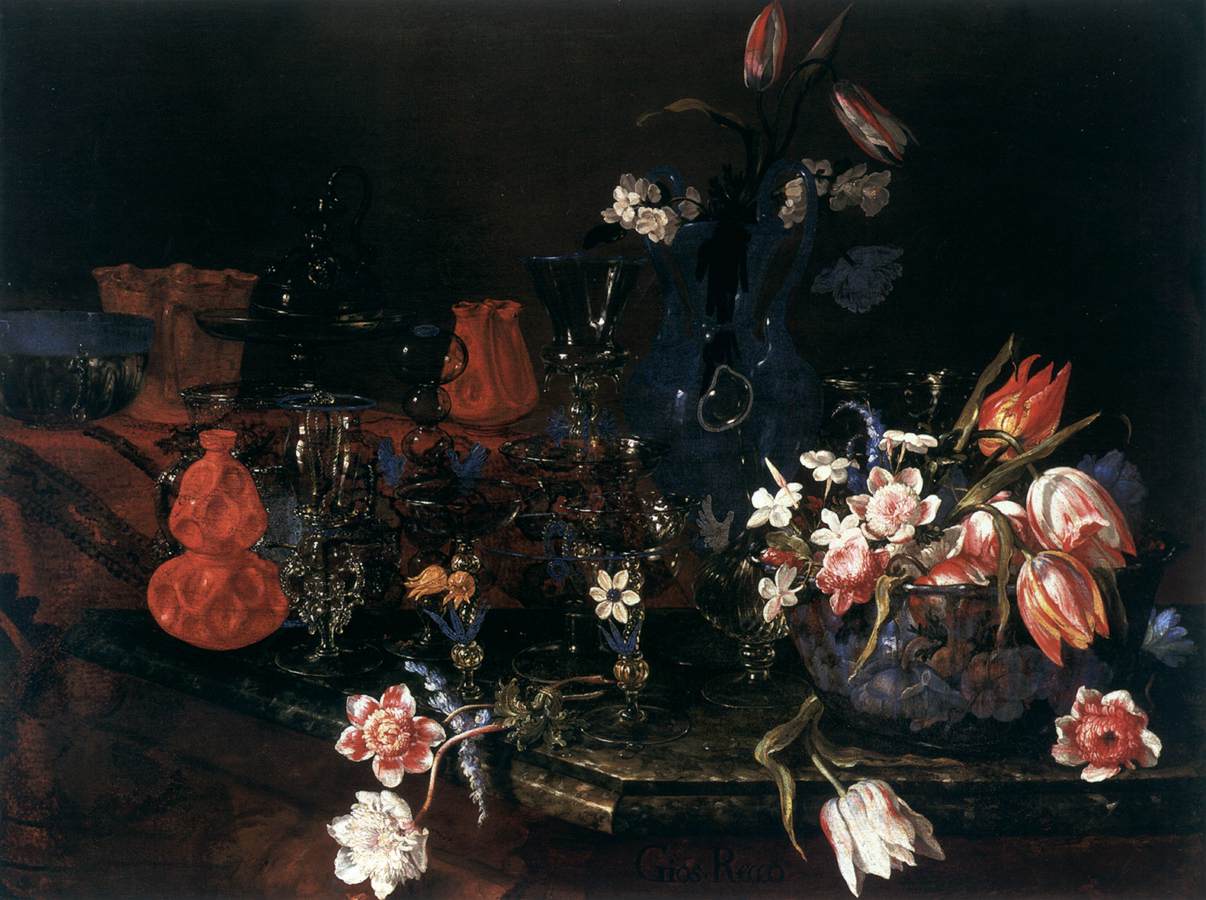
Glassware on a Marble Table
- MEDIUM
- Oil on canvas, 89 x 113 cm
- TYPE
- Still-Life
PALETTE
HOVER OR TAP A SWATCH FOR NAME, SHARE AND HEX. SAMPLED FROM THE IMAGE — INDICATIVE, NOT A PIGMENT ANALYSIS.
DEVELOPMENT BUILD — NOT FOR PUBLIC USE. CONTRIBUTE ON GITHUB.
03 — ARTWORK
PALETTE
HOVER OR TAP A SWATCH FOR NAME, SHARE AND HEX. SAMPLED FROM THE IMAGE — INDICATIVE, NOT A PIGMENT ANALYSIS.
COMMENTARY
UNDERLINED TERMS ARE DEFINED IN THE GLOSSARY.
Giuseppe Recco had a very extensive high-quality production, characterized by marked cultural eclecticismA nineteenth and twentieth-century architectural style in which a single piece of work incorporates a mixture of elements from previous historical styles to create something that is new and original. ranging from the Spanish still-life genreIn a broad sense, the term is used to mean a particular branch or category of art; landscape and portraiture, for example, are genres of painting, and the essay and the short story are genres of literature. to those of Northern Europe and Rome, and by uncommon iconographic versatility. After kitchen still-lifes, compositions with fish and shellfish, bouquets and underbrush paintings, assemblies of fruit and game, tables laid with food and sweets, and vanitasA painting (or element in painting) that acts as a reminder of the inevitabiliry of death, and the pointlessness of earthly ambitions and achievements. Common vanitas-symbols include skulls, guttering candles, hour-glasses and clocks, overturned vessels, and even flowers (which will soon fade). The vanitas theme became popular during the Baroque, with the vanitas still life flourishing in Dutch art. paintings, in the 1670s he tried his hand at a distinctive, extremely original and sophisticated genre: displays of archeological findings, ceramics, earthenwareA ceramic product invented in England around 1720, which belongs to the category of fine stoneware. The porous white bodies are made of fired raw materials containing clay and kaolin as well as quartz, feldspar, and talc. A transparent glaze is applied upon the first or second firing. Earthenware, which is suitable for everyday use, is distinguished by its light, creamy surface. The most famous example of this category is made by the English firm of Wedgwood (since 1780). and, above all, glassware and crystal. The canvasA woven cloth used as a support for painting. The best-quality canvas is made of linen; other materials used are cotton, hemp, and jute. It is now so familiar a material that the word 'canvas' has become almost a synonym for an oil painting, but it was not until around 1500 that it began to rival the wooden panel (which was more expensive and took longer to prepare) as the standard support for movable paintings (the transition came later in Northern Europe than in Italy). Canvas is not suitable for painting on until it has been coated with a ground, which isolates the fabric from the paint; otherwise it will absorb too much paint, only very rough effects will be obtainable, and parts of the fabric may be rotted by the pigments. It must also be made taut on a stretcher or by some other means. in Warsaw is one of the finest examples of the latter genre.
Displayed on a beveled grey marbleloosely applied to any hard limestone that can be sawn into thin slabs and will take a good polish so that it is suitable for decorative work; more strictly, it refers to metamorphosed limestones whose structure has been recrystallized by heat or pressure. Marbles are widely disseminated and occur in a great variety of colours and patterns, but certain types have been particularly prized by sculptors. The most famous of Greek white marbles in the ancient world was the close-grained Pentelic, which was quarried at Mount Pentelicon in Attica. The Elgin Marbles are carved in Pentelic. Widely used also were the somewhat coarser-grained translucent white marbles from the Aegean islands of Paros and Naxos. Parian marble was used for the celebrated Mausoleum at Halicarnassus. The pure white Carrara marble, quarried at Massa, Carrara, and Pietra Santa in Tuscany from the 3rd century BC, is the most famous of all sculptors' stones. It was used for the Apollo Belvedere, and was much favoured in the Renaissance, particularly by Michelangelo, who often visited the quarries to select material for his work. Neoclassical sculptors also favoured Carrara marble because of its ability to take a smooth, sleek surface, but it can look rather 'dead' compared with some of the finest Greek marbles. table is a collection of valuable Murano, Catalonian and "façon de Venise" glassware in different shapes and sizes. The delicate goblets, cups, vases, cruets and fruit stands are portrayed with lucid realismRealism (with an upper case "R"), also known as the Realist school, denotes a mid-nineteenth century art movement and style in which artists discarded the formulas of Neoclassicism and the theatrical drama of Romanticism to paint familiar scenes and events as they actually looked. Typically it involved some sort of sociopolitical or moral message, in the depiction of ugly or commonplace subjects. One of the main representatives and spokesmen was the painter Gustave Courbet. In the dispute about ways to represent reality, Realism rebelled against the idealistic and classicist tendencies in painting. and impeccable accuracy.
@online{wga-r3594155df98af0,
  author       = {Krén, Emil and Marx, Daniel},
  title        = {Glassware on a Marble Table by RECCO, Giuseppe},
  organization = {{Web Gallery of Art}},
  date         = {2026-09-13},
  url          = {https://beta.wga.hu/artists/recco-giuseppe-r94f450ae83b2e5/glassware-on-a-marble-table-r3594155df98af0},
  urldate      = {2026-09-13},
  langid       = {english}
}
ACCESSED 2026-09-13. REPLACE THE AUTHOR FIELD WITH THE COMMENTARY AUTHOR WHERE ONE IS NAMED.


