03 — ARTWORK
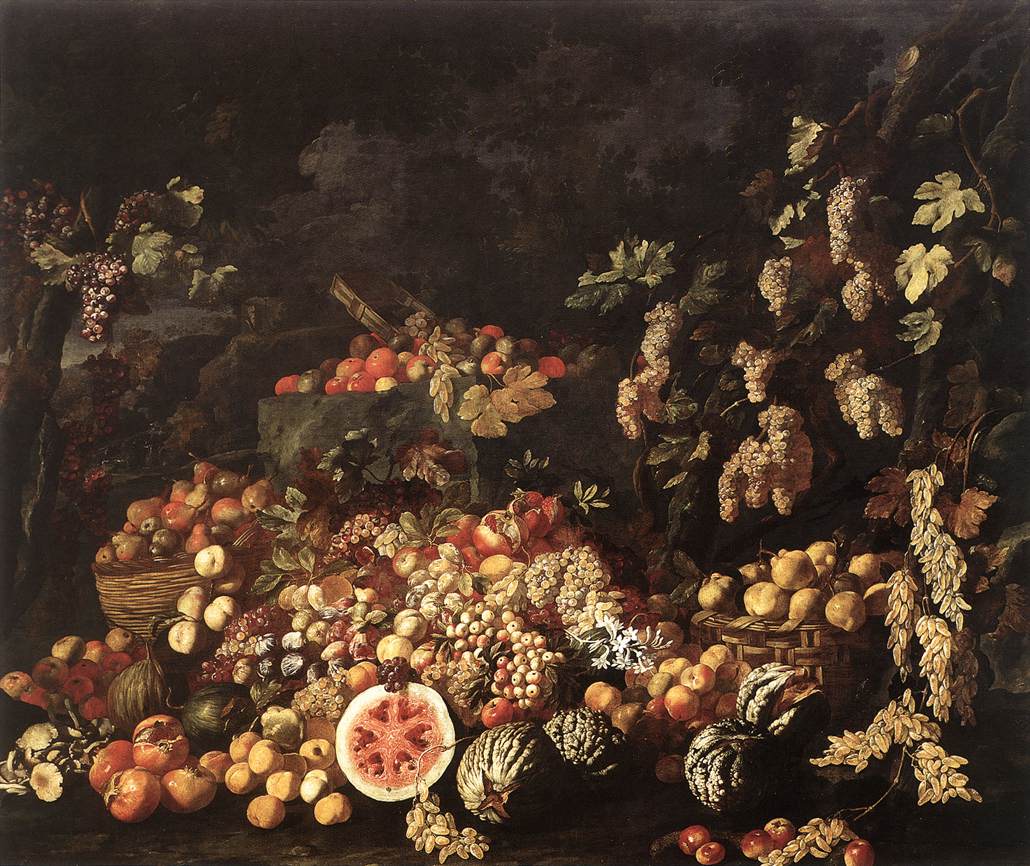
Still-Life with Fruit and Flowers
- MEDIUM
- Oil on canvas, 255 x 301 cm
- TYPE
- Still-Life
PALETTE
HOVER OR TAP A SWATCH FOR NAME, SHARE AND HEX. SAMPLED FROM THE IMAGE — INDICATIVE, NOT A PIGMENT ANALYSIS.
DEVELOPMENT BUILD — NOT FOR PUBLIC USE. CONTRIBUTE ON GITHUB.
03 — ARTWORK
PALETTE
HOVER OR TAP A SWATCH FOR NAME, SHARE AND HEX. SAMPLED FROM THE IMAGE — INDICATIVE, NOT A PIGMENT ANALYSIS.
COMMENTARY
UNDERLINED TERMS ARE DEFINED IN THE GLOSSARY.
Still-Life with Fruit and Flowers c. 1670 Oil on canvasA woven cloth used as a support for painting. The best-quality canvas is made of linen; other materials used are cotton, hemp, and jute. It is now so familiar a material that the word 'canvas' has become almost a synonym for an oil painting, but it was not until around 1500 that it began to rival the wooden panel (which was more expensive and took longer to prepare) as the standard support for movable paintings (the transition came later in Northern Europe than in Italy). Canvas is not suitable for painting on until it has been coated with a ground, which isolates the fabric from the paint; otherwise it will absorb too much paint, only very rough effects will be obtainable, and parts of the fabric may be rotted by the pigments. It must also be made taut on a stretcher or by some other means., 255 x 301 cm Museo Nazionale di Capodimonte, Naples
Giuseppe Recco came from a family of painters that specialised in still-lifes. He started painting in the tradition of his father Giacomo and his uncle Giovanni Battista who still cultivated the close-up assemblages of objects, presented on a table. Giuseppe developed his bravura style in still-lifes of fish, later he turned increasingly to the decorative BaroqueThe period in art history from about 1600 to about 1750. In this sense the term covers a wide range of styles and artists. In painting and sculpture there were three main forms of Baroque: (1) sumptuous display, a style associated with the Catholic Counter Reformation and the absolutist courts of Europe (Bernini, Rubens); (2) dramatic realism (Caravaggio); and (3) everyday realism, a development seen in particular in Holland (Rembrandt, Vermeer). In architecture, there was an emphasis on expressiveness and grandeur, achieved through scale, the dramatic use of light and shadow, and increasingly elaborate decoration. In a more limited sense the term Baroque often refers to the first of these categories. The development of the Baroque reflects the period's religious tensions (Catholic versus Protestant); a new and more expansive world view based on science and exploration; and the growth of absolutist monarchies. flower piece.
This monumental still-life, placed in a landscape with rich vegetation, is a late work of the artist. <P> <TABLE ALIGN=LEFT CELLPADDING=5 BORDER=1 WIDTH=320 BGCOLOR="#99CCCC"> <TR VALIGN=MIDDLE><TD><IMG SRC="/support/gif/listen.gif" BORDER=0 VALIGN=MIDDLE> Suggested listening (streaming mp3, 7 minutes):<BR><A HREF="#" onClick="w=window.open ('/music1/19_cent/tchaikovsky_nutcracker_waltz.html', 'newWin', 'scrollbars=yes,status=no,dependent=yes,screenX=0,screenY=0,width=350,height=350');w.opener=this;w.focus();return true"><B>Piotr Ilyich Tchaikovsky: The Nutcracker, ballet suite, op. 71, Waltz of the Flowers</B></A> </TD></TR></TABLE>
@online{wga-rc960b36af911b8,
  author       = {Krén, Emil and Marx, Daniel},
  title        = {Still-Life with Fruit and Flowers by RECCO, Giuseppe},
  organization = {{Web Gallery of Art}},
  date         = {2026-09-13},
  url          = {https://beta.wga.hu/artists/recco-giuseppe-r94f450ae83b2e5/still-life-with-fruit-and-flowers-rc960b36af911b8},
  urldate      = {2026-09-13},
  langid       = {english}
}
ACCESSED 2026-09-13. REPLACE THE AUTHOR FIELD WITH THE COMMENTARY AUTHOR WHERE ONE IS NAMED.


