03 — ARTWORK
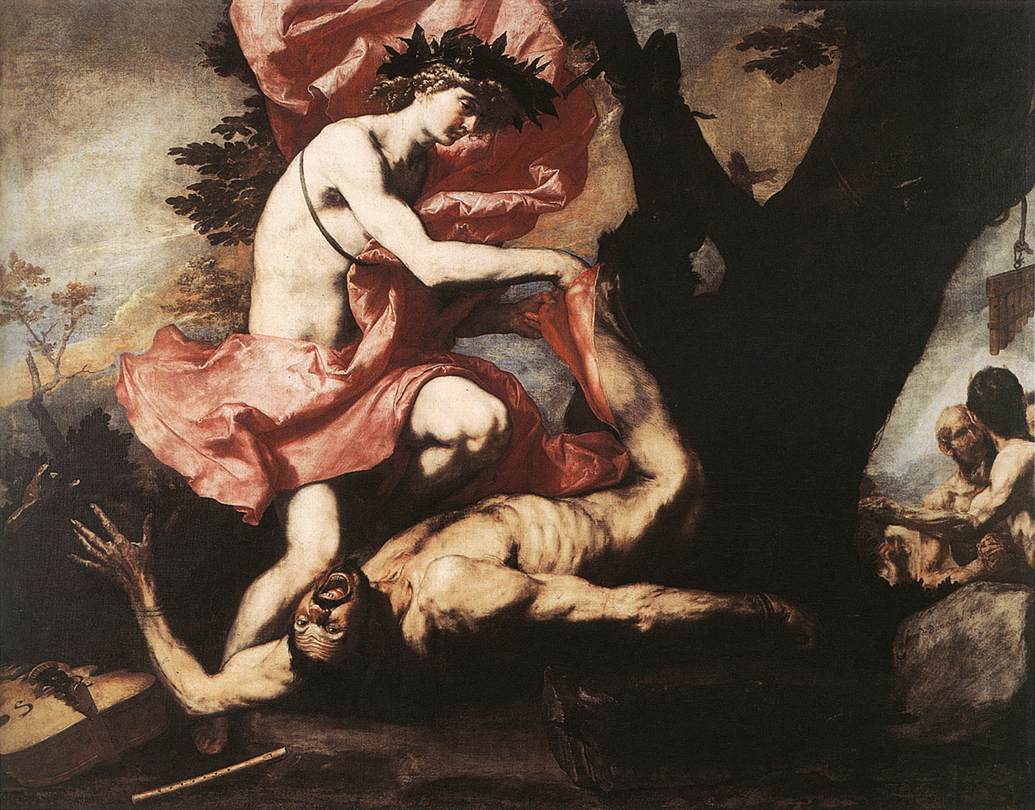
Apollo Flaying Marsyas
- MEDIUM
- Oil on canvas, 202 x 255 cm
- TYPE
- Mythological
PALETTE
HOVER OR TAP A SWATCH FOR NAME, SHARE AND HEX. SAMPLED FROM THE IMAGE — INDICATIVE, NOT A PIGMENT ANALYSIS.
DEVELOPMENT BUILD — NOT FOR PUBLIC USE. CONTRIBUTE ON GITHUB.
CURRENT LOCATION · Musées Royaux des Beaux-Arts
03 — ARTWORK
PALETTE
HOVER OR TAP A SWATCH FOR NAME, SHARE AND HEX. SAMPLED FROM THE IMAGE — INDICATIVE, NOT A PIGMENT ANALYSIS.
COMMENTARY
UNDERLINED TERMS ARE DEFINED IN THE GLOSSARY.
"Oh, what is my repentance ! Oh, a flute is not worth all that ! Despite his cries, his skin is torn off his whole body; (..) his naked muscles become visible; a convulsive movement trembles the veins, lacking their covering of skin." (Ovid: Metamorphoses, Book VI, verses 386-390). This is how Apollo punishes Marsyas, the satyrIn Greek mythology, human-like woodland deities with the ears, legs and horns of a goat. Often depicted as the attendant of the Bacchus, the god of wine. who dared to question the superiority of the melody of the divine lyre over the worldly sensuality of his flute.
This masterpieceA term now loosely applied to the finest work by a particular artist or to any work of art of acknowledged greatness or of preeminence in its field. Originally it meant the piece of work by which a craftsman, having finished his training, gained the rank of'master' in his guild. by Jusepe de Ribera was painted in 1637, when his style had reached maturity. The passage from Ovid's Metamorphoses depicted here is the fruit of the aesthetic atmosphere that prevailed at Naples, considered the capitalThe head or crowning feature of a column or pillar. Structurally, capitals broaden the area of a column so that it can more easily bear the weight of the arch or entablature it supports. of painting of the time. It is in this context that the painter highlights the confrontation between the divine and the earthly, with the form of representation underlining the content. From his Caravaggesque beginnings, Rivera preserved the expressiveness and the modelling provided by chiaroscuroIn painting, the modelling of form (the creation of a sense of three-dimensionality in objects) through the use of light and shade. The introduction of oil paints in the 15th century, replacing tempera, encouraged the development of chiaroscuro, for oil paint allowed a far greater range and control of tone. The term chiaroscuro is used in particular for the dramatic contrasts of light and dark introduced by Caravaggio. When the contrast of light and dark is strong, chiaroscuro becomes an important element of composition.. But the contrasts characterising this manifestation of Neapolitan BaroqueThe period in art history from about 1600 to about 1750. In this sense the term covers a wide range of styles and artists. In painting and sculpture there were three main forms of Baroque: (1) sumptuous display, a style associated with the Catholic Counter Reformation and the absolutist courts of Europe (Bernini, Rubens); (2) dramatic realism (Caravaggio); and (3) everyday realism, a development seen in particular in Holland (Rembrandt, Vermeer). In architecture, there was an emphasis on expressiveness and grandeur, achieved through scale, the dramatic use of light and shadow, and increasingly elaborate decoration. In a more limited sense the term Baroque often refers to the first of these categories. The development of the Baroque reflects the period's religious tensions (Catholic versus Protestant); a new and more expansive world view based on science and exploration; and the growth of absolutist monarchies. are no longer limited to the clashes of light. De Ribera goes further, achieving a sense of the tragic through every item in the canvasA woven cloth used as a support for painting. The best-quality canvas is made of linen; other materials used are cotton, hemp, and jute. It is now so familiar a material that the word 'canvas' has become almost a synonym for an oil painting, but it was not until around 1500 that it began to rival the wooden panel (which was more expensive and took longer to prepare) as the standard support for movable paintings (the transition came later in Northern Europe than in Italy). Canvas is not suitable for painting on until it has been coated with a ground, which isolates the fabric from the paint; otherwise it will absorb too much paint, only very rough effects will be obtainable, and parts of the fabric may be rotted by the pigments. It must also be made taut on a stretcher or by some other means.. Like Caravaggio, he made use of popular sources and of real life situations in order to represent the expression of faith. In this way his paintings of figures who, like Marsyas, could have come from the alleyways of Naples, had already achieved renown right across Europe.
The figure of the god is marked by the classicism which was then in fashion in Naples. His anatomical perfection, his youth and his idealised beauty are surrounded by flowing, airy draperies which accentuate the diagonal thrust of the composition. In the spirit of the baroque, the roughness of Marsyas' body and the shape of the tree contrast with this classicism. As in his famous depictions of martyrs, Ribera places the victim foreshortened in the foreground. The structure is balanced by a group of forest inhabitants who watch on powerless as the god bears down on his victim.
@online{wga-r75799d64495387,
  author       = {Krén, Emil and Marx, Daniel},
  title        = {Apollo Flaying Marsyas by RIBERA, Jusepe de},
  organization = {{Web Gallery of Art}},
  date         = {2026-09-13},
  url          = {https://beta.wga.hu/artists/ribera-jusepe-de-r2d1c510b430ea5/apollo-flaying-marsyas-r75799d64495387},
  urldate      = {2026-09-13},
  langid       = {english}
}
ACCESSED 2026-09-13. REPLACE THE AUTHOR FIELD WITH THE COMMENTARY AUTHOR WHERE ONE IS NAMED.


