03 — ARTWORK
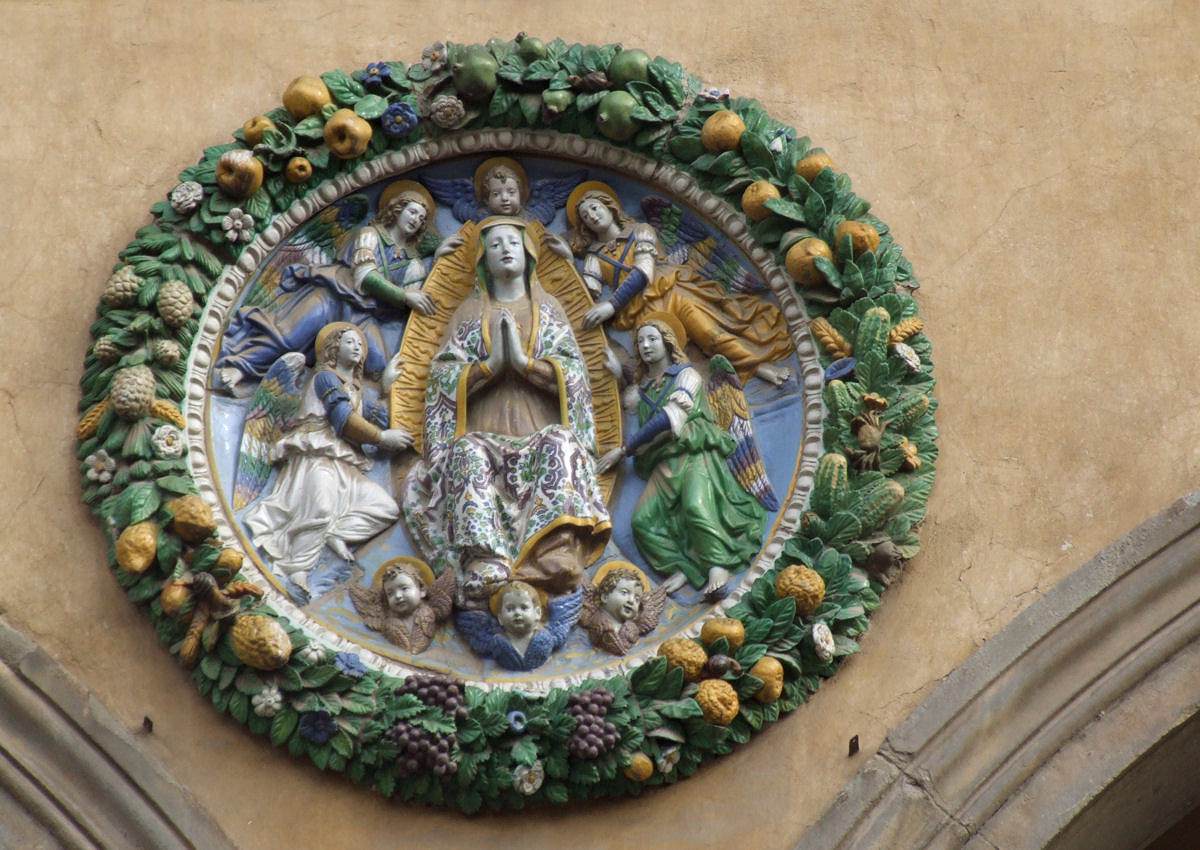
Virgin in Glory
ROBBIA, Giovanni della · 1525 →
- MEDIUM
- Glazed terracotta
- TYPE
- Religious
PALETTE
HOVER OR TAP A SWATCH FOR NAME, SHARE AND HEX. SAMPLED FROM THE IMAGE — INDICATIVE, NOT A PIGMENT ANALYSIS.
DEVELOPMENT BUILD — NOT FOR PUBLIC USE. CONTRIBUTE ON GITHUB.
03 — ARTWORK
ROBBIA, Giovanni della · 1525 →
PALETTE
HOVER OR TAP A SWATCH FOR NAME, SHARE AND HEX. SAMPLED FROM THE IMAGE — INDICATIVE, NOT A PIGMENT ANALYSIS.
COMMENTARY
UNDERLINED TERMS ARE DEFINED IN THE GLOSSARY.
Giovanni della Robbia worked in the hospital of the Ceppo in Pistoia in the 1520s in collaboration with Santi Buglioni, pupil and relative of Benedetto Buglioni. Santi Buglioni produced there the friezea horizontal band of architectural decoration; in a classical entablature, the horizontal member band between the architrave and the cornice. that runs along the entire length of the loggiaA gallery or room open on one or more sides, its roof supported by columns. Loggias in Italian Renaissance buildings were generally on the upper levels. Renaissance loggias were also separate structure, often standing in markets and town squares, that could be used for public ceremonies. of the hospital, representing the Seven Acts of Mercy, while Giovanni della Robbia executed the tondoes on the façadethe front or principal face of a building, especially one elaborately constructed; a blind façade is a façade that is purely decorative and does not relate to the structure of the building. depicting the Annunciationthe term for the event described in the Gospel according to St. Luke, when the Angel Gabriel brings the Virgin Mary the news that she is to bear her son, Jesus Christ. The Annunciation was among the most widespread pictorial subjects of European art during the Middle Ages and the Renaissance., the Virgin in Glory(1) The supernatural radiance surrounding a holy person. (2) To have the distinction of one's deeds recognized in life and to be revered for them posthumously: this was glory. The nature of true gloria was much discussed, whether it must be connected with the public good, whether the actions that led to it must conform with Christian ethics, how it differed from notoriety. The concept did not exclude religious figures (the title of the church of the Frari in Venice was S. Maria Gloriosa), but it was overwhelmingly seen in terms of secular success and subsequent recognition, as determining the lifestyles of the potent and the form of their commemoration in literature, in portraits and on tombs. As such, it has been taken as a denial of medieval religiosity ('sic transit gloria mundi'), and thus a hallmark of Renaissance individual ism; as a formidable influence on cultural patronage; and as spurring on men of action, as well as writers and artists, to surpass their rivals - including their counterparts in antiquity., the Visitation, and the Medici coat of arms.
@online{wga-r1303fa76d0ca9c,
  author       = {Krén, Emil and Marx, Daniel},
  title        = {Virgin in Glory by ROBBIA, Giovanni della},
  organization = {{Web Gallery of Art}},
  date         = {2026-09-13},
  url          = {https://beta.wga.hu/artists/robbia-giovanni-della-r3804e283d6b4b1/virgin-in-glory-r1303fa76d0ca9c},
  urldate      = {2026-09-13},
  langid       = {english}
}
ACCESSED 2026-09-13. REPLACE THE AUTHOR FIELD WITH THE COMMENTARY AUTHOR WHERE ONE IS NAMED.


