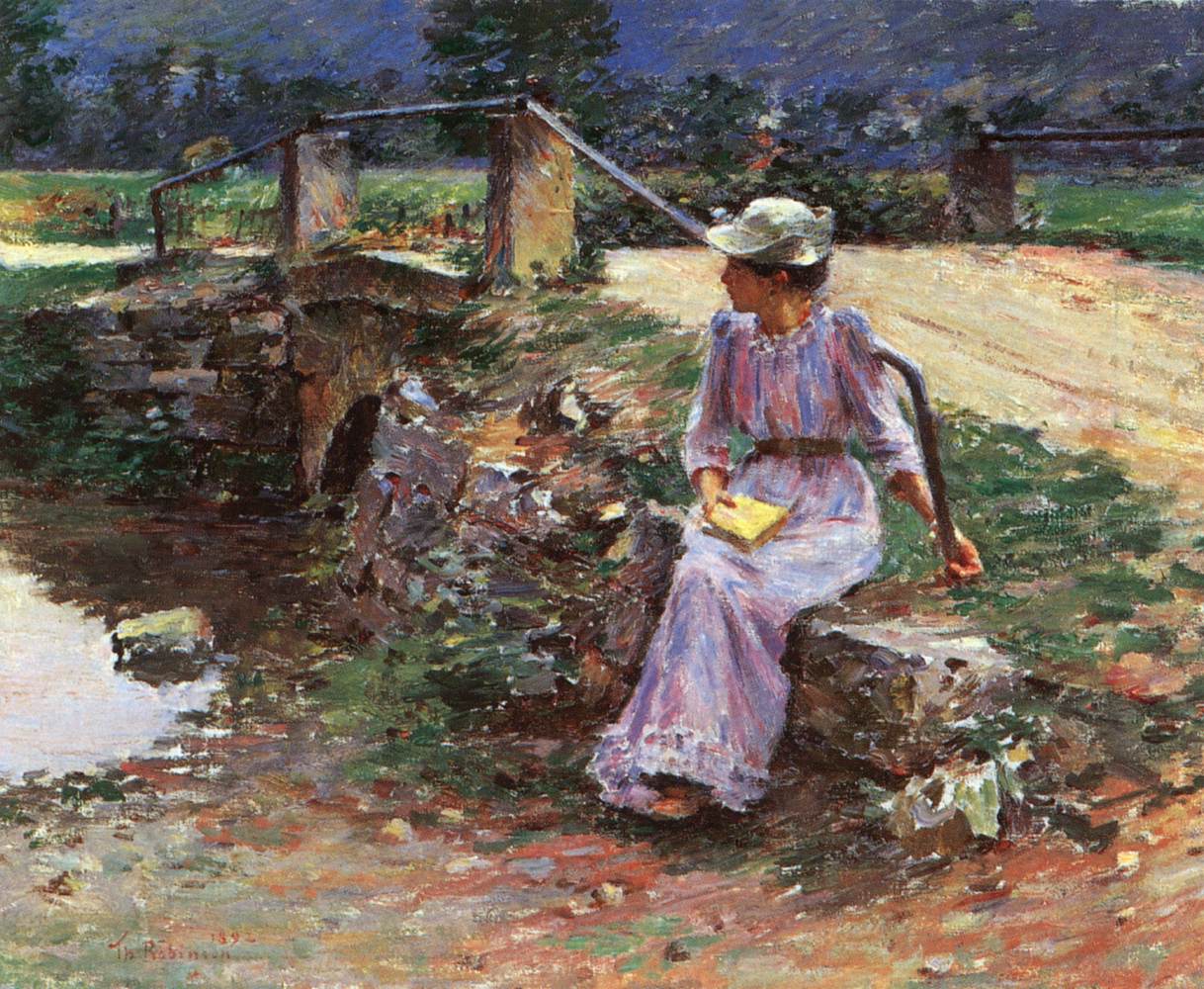
03 — ARTWORK
La débácle
- MEDIUM
- Oil on canvas, 46 x 56 cm
- TYPE
- Genre
PALETTE
HOVER OR TAP A SWATCH FOR NAME, SHARE AND HEX. SAMPLED FROM THE IMAGE — INDICATIVE, NOT A PIGMENT ANALYSIS.
DEVELOPMENT BUILD — NOT FOR PUBLIC USE. CONTRIBUTE ON GITHUB.
03 — ARTWORK
PALETTE
HOVER OR TAP A SWATCH FOR NAME, SHARE AND HEX. SAMPLED FROM THE IMAGE — INDICATIVE, NOT A PIGMENT ANALYSIS.
COMMENTARY
UNDERLINED TERMS ARE DEFINED IN THE GLOSSARY.
In 1887 a small group of North American artists — John Leslie Breck, William Blair Bruce, Willard Metcalf, Louis Ritter, Theodore Robinson, Henry Fitch Taylor, and Theodore Wendel — settled in Giverny for the summer season. Some appear to have been previously unaware of Monet's presence in the village, but at least two of them, Robinson and Metcalf, had visited during earlier summers. They set up their easels along the streams or on the hillside and became acquainted with their newly adopted village from a distance. At first they avoided depicting the village itself, preferring more familiar landscape motifs. Gradually, artists in Giverny began to experiment with ImpressionismA style of painting that became prominent in the last quarter of the 19th century as a reaction to the ossified doctrine of the Academy and the content-oriented atelier, historical, and genre painting. The name is derived from the 1872 painting Impression, Sunrise by Claude Monet, and first was used by art critics as a mocking description for a group of artists excluded from the official Salon, but who had their own first group exhibition in 1874 at the salon of the Parisian photographer Nadar. Impressionism, as a new type of naturalism, negated classical pictorial methods; based on contemporary theories of physics, it indicated the natural object in a revolutionary fashion - entirely as a manifestation of colour. Their supreme principle was "plein-air" or open-air painting, through which the painters tried to capture a direct, spontaneous impression of what they saw., inspired by Monet and also by the region's dramatic light. Within a few years, many began to employ the more luminous, high-keyed palette and looser brushwork characteristic of impressionism.
In the work of Robinson, North America made its own first influential contribution to Impressionism. Though a good friend of Monet from 1886 on, he never became dependent on the Frenchman's style. The years Robinson spent at Giverny before finally returning to the US in 1892 fell into two stylistic periods. In the first, he painted figures in landscape settings as well as pure landscapes. (La débácle represents this style.) In the second phase the individual features were dissolved into highlights of colour that were stripped of contoura line around a shape in a work of art, its nature depending on the artist's concept and intention. In medieval painting, contours were initially regular, flat outlines; in the course of the 14th century they acquired more sense of spatial effect, and appear to be alternately more and less emphatic. Later, the effect of contour in painting and graphic art became particularly important to artistic movements in which line and draughtsmanship was a prominent factor. or detail. The Wedding March, painted in 1982 for the wedding of the American artist Theodore Earl Butler and Suzanne Hoschedé-Monet, Monet's stepdaughter, is a fine example of this phase.
@online{wga-r587bd389cd3a0f,
  author       = {Krén, Emil and Marx, Daniel},
  title        = {La débácle by ROBINSON. Theodore},
  organization = {{Web Gallery of Art}},
  date         = {2026-09-13},
  url          = {https://beta.wga.hu/artists/robinson-theodore-r3ad2c4469a447f/la-dbcle-r587bd389cd3a0f},
  urldate      = {2026-09-13},
  langid       = {english}
}
ACCESSED 2026-09-13. REPLACE THE AUTHOR FIELD WITH THE COMMENTARY AUTHOR WHERE ONE IS NAMED.
The archive catalogues no further works by this artist.
TRY SAME COLLECTION →
