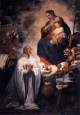
Spanish painter of Flemish origin. He was a native of Flanders but his entire documented career took place in Spain, where he played a major role in the transition from Mannerist to BaroqueGLOSSARYThe period in art history from about 1600 to about 1750. In this sense the term covers a wide range of styles and artists. In painting and sculpture there were three main forms of Baroque: (1) sumptuous display, a style associated with the Catholic Counter Reformation and the absolutist courts of Europe (Bernini, Rubens); (2) dramatic realism (Caravaggio); and (3) everyday realism, a development seen in particular in Holland (Rembrandt, Vermeer). In architecture, there was an emphasis on expressiveness and grandeur, achieved through scale, the dramatic use of light and shadow, and increasingly elaborate decoration. In a more limited sense the term Baroque often refers to the first of these categories. The development of the Baroque reflects the period's religious tensions (Catholic versus Protestant); a new and more expansive world view based on science and exploration; and the growth of absolutist monarchies. painting. He is one of the most important Spanish painters of the early 17th century; his work was extremely popular in his own time. He is sometimes called the Spanish Tintoretto; there are stylistic analogies between the two. His innovative style introduced the spirit of the early Baroque into painting in Seville at the beginning of the 17th century.
His paintings are naturalistic but have a transcendental quality, and his figures are endowed with an expressive vitality that contrasts with the physical and spiritual immobility of contemporary painting. Roelas used light, loose brushstrokes, with heavy, warm tonalities that contrast with the cool, chromatic tones, derived from MannerismGLOSSARYA movement in Italian art from about 1520 to 1600. Developing out of the Renaissance, Mannerism rejected Renaissance balance and harmony in favor of emotional intensity and ambiguity. In Mannerist painting, this was expressed mainly through severe distortions of perspective and scale; complex and crowded compositions; strong, sometimes harsh or discordant colors; and elongated figures in exaggerated poses. In architecture, there was a playful exaggeration of Renaissance forms (largely in scale and proportion) and the greater use of bizarre decoration. Mannerism gave way to the Baroque. Leading Mannerists include Pontormo, Bronzino, Parmigianino, El Greco and Tintoretto., that were favoured by his colleagues. In Seville he was first to combine realismGLOSSARYRealism (with an upper case "R"), also known as the Realist school, denotes a mid-nineteenth century art movement and style in which artists discarded the formulas of Neoclassicism and the theatrical drama of Romanticism to paint familiar scenes and events as they actually looked. Typically it involved some sort of sociopolitical or moral message, in the depiction of ugly or commonplace subjects. One of the main representatives and spokesmen was the painter Gustave Courbet. In the dispute about ways to represent reality, Realism rebelled against the idealistic and classicist tendencies in painting. and mysticism, an approach prevalent in 17th-century Spain.
He came from an aristocratic family, and his father was an admiral in the Spanish Navy. He held the office of chaplain throughout his life. He began his artistic training in Seville but may have completed it in Italy, as his work suggests an Italian influence. His paintings are in some cases derived directly from the late 16th-century Venetian school, in particular the work of the Bassano family. Roelas is documented in 1597 in Valladolid and worked in the city again when Philip III's court was there. In 1603 he moved to Olivares, near Seville, acting as chaplain in the collegiate church. He must soon have left Olivares for Seville, where he was a priest in the church of El Salvador. During the next ten years he became a commanding figure in the art world, executing significant commissions for the cathedralGLOSSARYThe principal church of a province or diocese, where the throne of the bishop is placed. For reasons lost to time and tradition, a cathedral always faces west - toward the setting sun. The altar is placed at the east end. The main body, or nave, of the cathedral is usually divided into one main and two side aisles. These lead up to the north and south transepts, or arms of the cross, the shape in which a cathedral is usually formed. and several local churches.
Between 1604 and 1606 he executed part of the paintings for the main reredos of the Jesuit church (now the university church) in Seville. He painted the Circumcision in the central canvasGLOSSARYA woven cloth used as a support for painting. The best-quality canvas is made of linen; other materials used are cotton, hemp, and jute. It is now so familiar a material that the word 'canvas' has become almost a synonym for an oil painting, but it was not until around 1500 that it began to rival the wooden panel (which was more expensive and took longer to prepare) as the standard support for movable paintings (the transition came later in Northern Europe than in Italy). Canvas is not suitable for painting on until it has been coated with a ground, which isolates the fabric from the paint; otherwise it will absorb too much paint, only very rough effects will be obtainable, and parts of the fabric may be rotted by the pigments. It must also be made taut on a stretcher or by some other means. of this reredos, filled with large figures and a celestial scene, as well as the right-hand panelGLOSSARYTerm in painting for a support of wood, metal, or other rigid substance, as distinct from canvas. Until the adoption of canvas in the 15th century nearly all the movable paintings of Europe were executed on wood, and even up to the beginning of the 17th century it is probable that as much painting was done on the one support as on the other. Painters who worked on a small scale often used copper panels (Elsheimer is a leading example), and in the colonial art of South America copper and tin and even lead and zinc were used. On a larger scale, slate has occasionally been used as a support, notably by Rubens for his altarpiece for Sta Maria in Vallicella (the Chiesa Nuova) in Rome; the picture he originally painted was said to reflect the light unpleasantly and slate was used for the replacement to produce a more matt finish. For wood panels the Italian masters of the Renaissance preferred white poplar, while oak was the most common wood used in northern Europe. Many other types were used, however; analysis of the contents of art galleries has yielded a long list, including beech, cedar, chestnut, fir, larch, linden, mahogany, olive, and walnut. In the 20th century cedar, teak, and dark walnut are favourites, and modern painters have also used plywood, fibre-board, and other synthetic materials as supports., the Adoration of the Shepherds, which is a more naturalistic work; he also painted a St John the Baptist and a St John the Evangelist, both situated in the upper part of the reredos. In 1608 Roelas contracted to paint the TriumphGLOSSARYWith growing interest from the early 14th century in the history of ancient Rome came a fascination with the city's conquests, the wars by which they were won - and the ceremony which marked their success: the victor's triumph. The knowledge that the privilege of being commemorated by one of these enormous and costly processions of warriors, loot and prisoners was given sparingly, only to the sole commander of a major victory over a foreign army of whom at least 5000 were slain, added to the glamour of the triumph. Its centrepiece was the chariot of the victor himself. Dante gave one to Beatrice in Purgatorio XXIX: 'Rome upon Africanus ne'er conferred / Nor on Augustus's self, a car so brave'. But it was tentatively with the relief carvings on the Triumphal Arch (1452-66) at Castelnuovo in Naples commemorating Alfonso the Magnanimous, and finally with Mantegna's superb Triumph of Caesar cartoons (Hampton Court), that the visual reconstruction of a Roman triumph became complete. Meanwhile, in an age which did not like the idea of large numbers of victory-flushed soldiers parading through its streets, the military triumph became sublimated, as it were, into a number of less controversial forms. This was largely under the influence of Petrarch's 'Trionfi' - poems describing the processions commemorating the triumphs of love, chastity, death; fame, time and eternity. Disseminated soon after his death, they soon appeared in illuminated manuscripts, and the triumph scene became a popular one for woodcuts, decorated marriage chests and other paintings, most beautifully of all on the backs of Piero della Francesca's portraits of Federigo da Montefeltro and his wife, Battista Sforza. Other 'triumphs' were invented: of the seasons, of virtues and of the arts. Nor was the theme allowed to be simply a profane one. Just before his death Savonarola published his 'Triumph of the Cross', in which the reader was invited to imagine 'a four-wheeled chariot on which is seated Christ as Conqueror.' Before it go the apostles, patriarchs and prophets, beside it the army of martyrs, behind it, after 'a countless number of virgins, of both sexes', come the prisoners: 'the serried ranks of the enemies of the Church of Christ.' This aspect of the theme was magnificently realized in Titian's great woodcut 'The Triumph of the Faith'. of St Gregory for the English JesuitsGLOSSARYThe Society of Jesus, a Roman Catholic teaching order founded by St. Ignatius Loyola in 1534. The express purpose of the Jesuits was to fight heresy within the Church (they played a leading role in the Counter Reformation), and to spread the faith through missionary work in the many parts of the world recently discovered by Western explorers and colonists. in Seville (University of Durham), also a St James at the Battle of Clavijo and a PietàGLOSSARYA depiction of the Virgin Mary with the crucified body of Jesus across her lap. Developing in Germany in the 14th century, the Pietà became a familiar part of Renaissance religious imagery. One of the best-known examples is Michelangelo's "Pietà" (1497-1500) in St. Peter's, Rome. (both 1609; Seville Cathedral). Two important works are known to date from 1612: the Vision of St Bernard (Seville, S Andrés) and St Peter Released from Prison (Seville, S Pedro). His masterpieceGLOSSARYA term now loosely applied to the finest work by a particular artist or to any work of art of acknowledged greatness or of preeminence in its field. Originally it meant the piece of work by which a craftsman, having finished his training, gained the rank of'master' in his guild. is perhaps the huge Martyrdom of St Andrew (1609, Museo de Bellas Artes, Seville).
In 1617 Roelas decided to try his luck at the court and applied for a position as royal painter. His application failed, but he lingered in Madrid until 1621, the date he returned to his chaplaincy at Olivares, where he died in 1625.