03 — ARTWORK
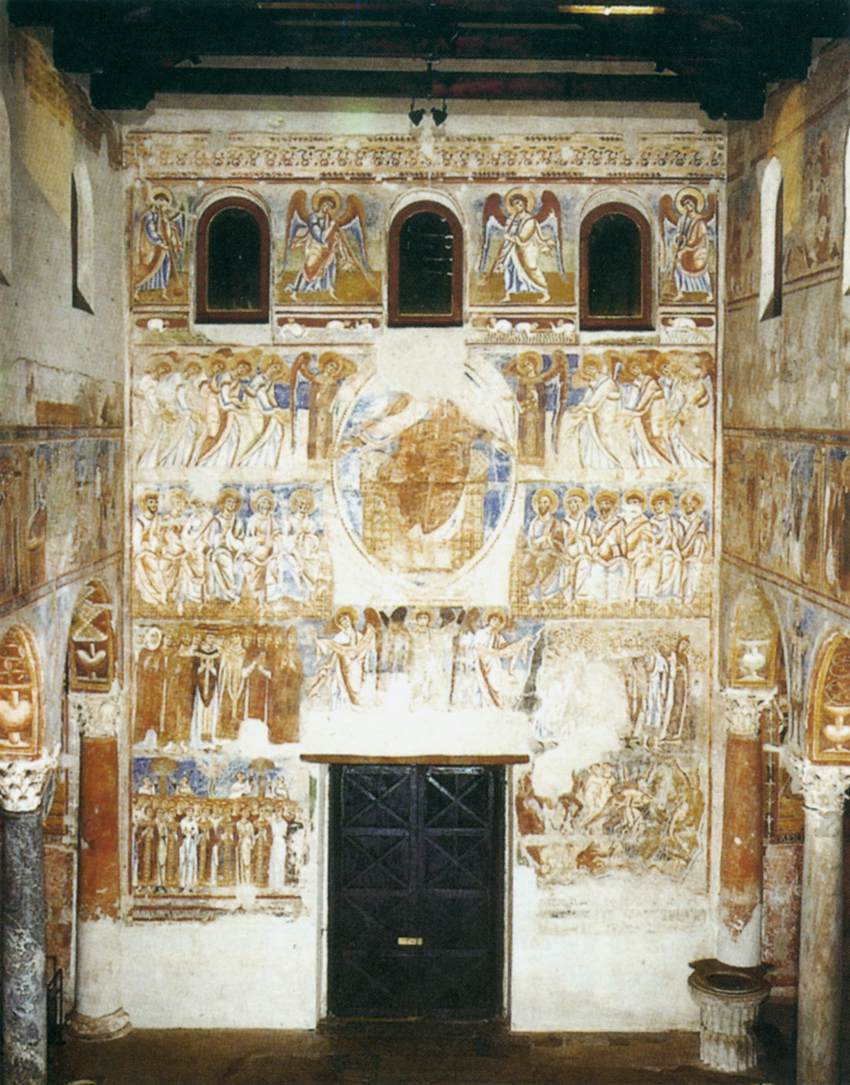
Last Judgment
ROMANESQUE PAINTER, Italian · 1080 →
- MEDIUM
- Fresco
- TYPE
- Religious
PALETTE
HOVER OR TAP A SWATCH FOR NAME, SHARE AND HEX. SAMPLED FROM THE IMAGE — INDICATIVE, NOT A PIGMENT ANALYSIS.
DEVELOPMENT BUILD — NOT FOR PUBLIC USE. CONTRIBUTE ON GITHUB.
03 — ARTWORK
ROMANESQUE PAINTER, Italian · 1080 →
PALETTE
HOVER OR TAP A SWATCH FOR NAME, SHARE AND HEX. SAMPLED FROM THE IMAGE — INDICATIVE, NOT A PIGMENT ANALYSIS.
COMMENTARY
UNDERLINED TERMS ARE DEFINED IN THE GLOSSARY.
The Last Judgment on the western wall of the church Sant'Angelo in Formis is painted in the Byzantine tradition and refer back to the formal ideal of ClassicalRelating to the culture of ancient Greece and Rome (classical Antiquity). The classical world played a profoundly important role in the Renaissance, with Italian scholars, writers, and artists seeing their own period as the rebirth (the "renaissance") of classical values after the Middle Ages. The classical world was considered the golden age for the arts, literature, philosophy, and politics. Concepts of the classical, however, changed greatly from one period to the next. Roman literature provided the starting point in the 14th century, scholars patiently finding, editing and translating a wide range of texts. In the 15th century Greek literature, philosophy and art - together with the close study of the remains of Roman buildings and sculptures-expanded the concept of the classical and ensured it remained a vital source of ideas and inspiration. antiquity. Group compositions as defined by isocephaly, that is the arrangement heads all at the same level, is a specific characteristic of Ancient and Byzantine artThe art ofthe Byzantine Empire, which had its capital in Constantinople (Byzantium), from the 5th century to the fall of Constantinople to the Turks in 1453. Based largely on Roman and Greek art, Byzantine art also absorbed a wide of influences, notable from Syria and Egypt. Byzantine art was essentially a spiritual and religious art, its forms highly stylized, hieratic and unchanging (central images were thought to derive from original portraits). It also served to glorify the emperor. Among its most distinctive products were icons, mosaics, manuscript illuminations, and work in precious metals. The strong influence of the Byzantine style on medieval Italian painting can be seen in the works of Cimabue, Duccio, and Giotto..
@online{wga-rcf74eed8147b24,
  author       = {Krén, Emil and Marx, Daniel},
  title        = {Last Judgment by ROMANESQUE PAINTER, Italian},
  organization = {{Web Gallery of Art}},
  date         = {2026-09-09},
  url          = {https://beta.wga.hu/artists/romanesque-painter-italian-rea699218a9aca1/last-judgment-rcf74eed8147b24},
  urldate      = {2026-09-09},
  langid       = {english}
}
ACCESSED 2026-09-09. REPLACE THE AUTHOR FIELD WITH THE COMMENTARY AUTHOR WHERE ONE IS NAMED.


