03 — ARTWORK
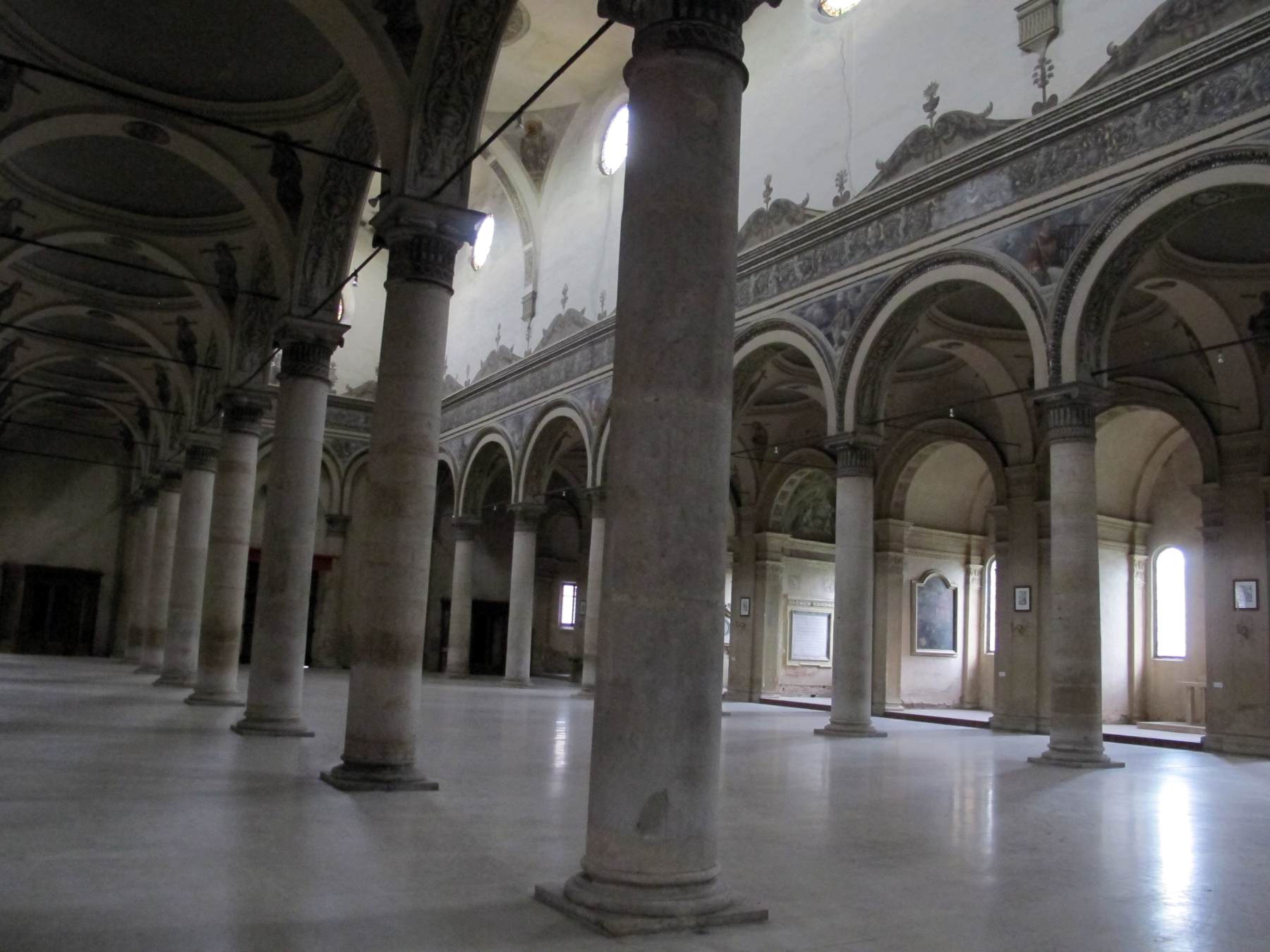
Interior view
- MEDIUM
- Photo
- TYPE
- Other
PALETTE
HOVER OR TAP A SWATCH FOR NAME, SHARE AND HEX. SAMPLED FROM THE IMAGE — INDICATIVE, NOT A PIGMENT ANALYSIS.
DEVELOPMENT BUILD — NOT FOR PUBLIC USE. CONTRIBUTE ON GITHUB.
03 — ARTWORK
PALETTE
HOVER OR TAP A SWATCH FOR NAME, SHARE AND HEX. SAMPLED FROM THE IMAGE — INDICATIVE, NOT A PIGMENT ANALYSIS.
COMMENTARY
UNDERLINED TERMS ARE DEFINED IN THE GLOSSARY.
San Francesco in Ferrara was built on a pre-existing building, already used by the FranciscansA Roman Catholic order of mendicant friars founded by St. Francis of Assisi (given papal approval in 1223). Committed to charitable and missionary work, they stressed the veneration of the Holy Virgin, a fact that was highly significant in the development of images of the Madonna in Italian art. In time the absolute poverty of the early Franciscans gave way to a far more relaxed view of property and wealth, and the Franciscans became some of the most important patrons of art in the early Renaissance., in 1494, during the Erculean Addition patronized by Ercole I d'Este. The project is among the best achievements of Biagio Rossetti.
The façadethe front or principal face of a building, especially one elaborately constructed; a blind façade is a façade that is purely decorative and does not relate to the structure of the building. has typically Renaissance lines, with volutes, inspired by Leon Battista Alberti, and the marbleloosely applied to any hard limestone that can be sawn into thin slabs and will take a good polish so that it is suitable for decorative work; more strictly, it refers to metamorphosed limestones whose structure has been recrystallized by heat or pressure. Marbles are widely disseminated and occur in a great variety of colours and patterns, but certain types have been particularly prized by sculptors. The most famous of Greek white marbles in the ancient world was the close-grained Pentelic, which was quarried at Mount Pentelicon in Attica. The Elgin Marbles are carved in Pentelic. Widely used also were the somewhat coarser-grained translucent white marbles from the Aegean islands of Paros and Naxos. Parian marble was used for the celebrated Mausoleum at Halicarnassus. The pure white Carrara marble, quarried at Massa, Carrara, and Pietra Santa in Tuscany from the 3rd century BC, is the most famous of all sculptors' stones. It was used for the Apollo Belvedere, and was much favoured in the Renaissance, particularly by Michelangelo, who often visited the quarries to select material for his work. Neoclassical sculptors also favoured Carrara marble because of its ability to take a smooth, sleek surface, but it can look rather 'dead' compared with some of the finest Greek marbles. pilasters that stand out on the walls. The interior with three naves has a Latin crossa cross whose main longitudinal arm is longer than the transverse arms. plan and eight chapels on each side.
View the <a href="#" onClick="w=window.open ('/support/plans/r/rossett/francesco.html', 'newWin', 'scrollbars=yes,status=no,dependent=yes,screenX=0,screenY=0,width=400,height=600');w.opener=this;w.focus();return false">ground plan</a> of the church.
@online{wga-r8aa3a2680a1327,
  author       = {Krén, Emil and Marx, Daniel},
  title        = {Interior view by ROSSETTI, Biagio},
  organization = {{Web Gallery of Art}},
  date         = {2026-09-13},
  url          = {https://beta.wga.hu/artists/rossetti-biagio-reedf87ed31dcaa/interior-view-r8aa3a2680a1327},
  urldate      = {2026-09-13},
  langid       = {english}
}
ACCESSED 2026-09-13. REPLACE THE AUTHOR FIELD WITH THE COMMENTARY AUTHOR WHERE ONE IS NAMED.


