03 — ARTWORK
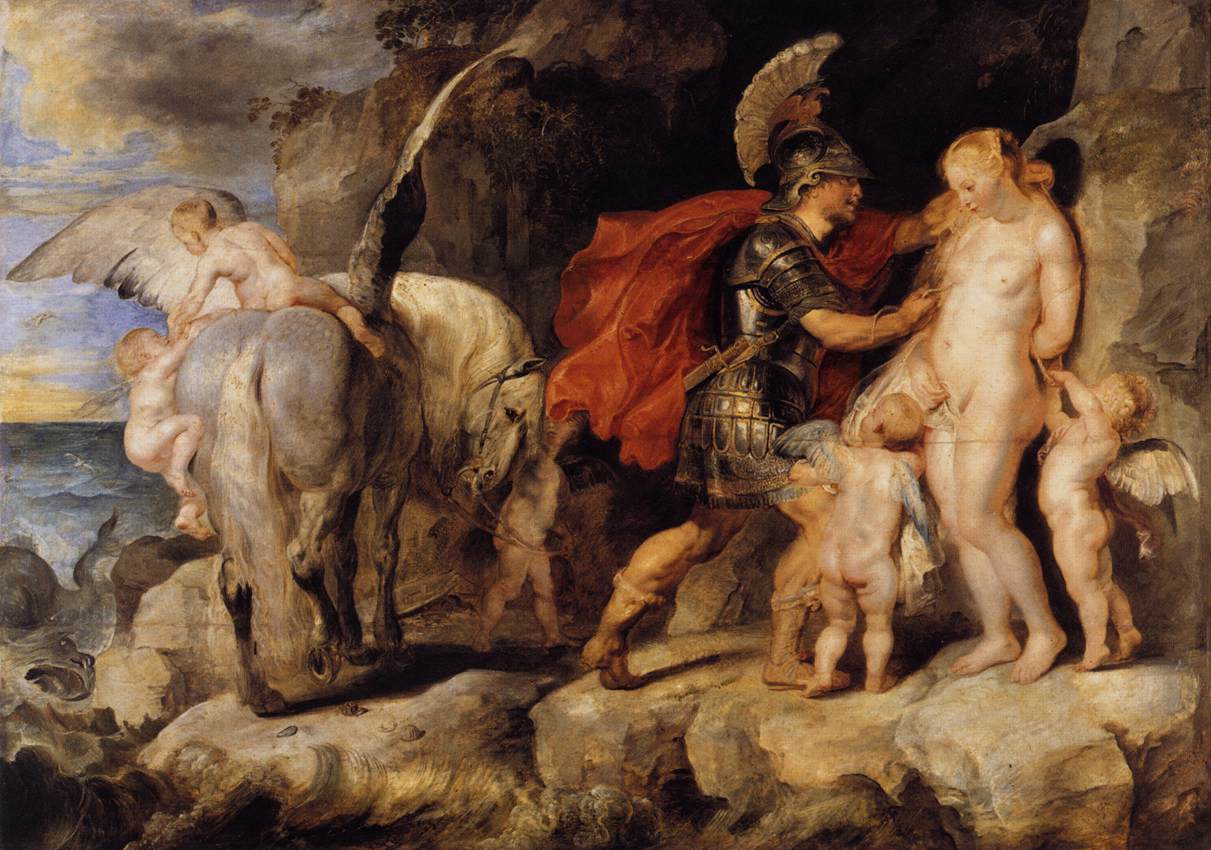
Perseus Freeing Andromeda
- MEDIUM
- Oil on oak panel, 100 x 139 cm
- TYPE
- Mythological
PALETTE
HOVER OR TAP A SWATCH FOR NAME, SHARE AND HEX. SAMPLED FROM THE IMAGE — INDICATIVE, NOT A PIGMENT ANALYSIS.
DEVELOPMENT BUILD — NOT FOR PUBLIC USE. CONTRIBUTE ON GITHUB.
CURRENT LOCATION · Staatliche Museen (Berlin)
03 — ARTWORK
PALETTE
HOVER OR TAP A SWATCH FOR NAME, SHARE AND HEX. SAMPLED FROM THE IMAGE — INDICATIVE, NOT A PIGMENT ANALYSIS.
COMMENTARY
UNDERLINED TERMS ARE DEFINED IN THE GLOSSARY.
Perseus Freeing Andromeda c. 1622 Oil on oak panelTerm in painting for a support of wood, metal, or other rigid substance, as distinct from canvas. Until the adoption of canvas in the 15th century nearly all the movable paintings of Europe were executed on wood, and even up to the beginning of the 17th century it is probable that as much painting was done on the one support as on the other. Painters who worked on a small scale often used copper panels (Elsheimer is a leading example), and in the colonial art of South America copper and tin and even lead and zinc were used. On a larger scale, slate has occasionally been used as a support, notably by Rubens for his altarpiece for Sta Maria in Vallicella (the Chiesa Nuova) in Rome; the picture he originally painted was said to reflect the light unpleasantly and slate was used for the replacement to produce a more matt finish. For wood panels the Italian masters of the Renaissance preferred white poplar, while oak was the most common wood used in northern Europe. Many other types were used, however; analysis of the contents of art galleries has yielded a long list, including beech, cedar, chestnut, fir, larch, linden, mahogany, olive, and walnut. In the 20th century cedar, teak, and dark walnut are favourites, and modern painters have also used plywood, fibre-board, and other synthetic materials as supports., 100 x 139 cm Staatliche Museen, Berlin
Chained to a rock, Andromeda, daughter of the King of Ethiopia, was to be sacrificed to a sea-monster. The king had been ordered to make this sacrifice, in order to make amends for the arrogance of his wife, Cassiopeia. As Perseus, who had vanquished the dreaded Gorgon MedusaIn Greek mythology, a Gorgon, the daughter of Phorkys and Kreto. A mortal monster with serpents in her hair and a gaze that turned people to stone. When Perseus cuts off her head, Chrysaor and Pegasos spring from her body. Her head features on Minerva's shield, supposedly to petrify her enemies., was returning home on his winged horse, Pegasus, he caught sight of the chained Andromeda and delivered her from the threat of the monster. Overcome by the beauty of the young princess, her liberator confessed his love: 'Oh, thou deservest not chains such as these but only the bonds that unite passionate lovers' (Ovid).
Rubens knew how to translate the popular, widely-known poetry of Ovid into his own special language. On a sea-girt spur of rock Perseus steps towards the royal princess. Dressed in gleaming armour and in the red cloak of the conqueror, he loosens the chains binding the naked maiden, who stands with downcast eyes. Two putti, who, to the best of their ability, are lending a hand, also seem not uninterested in the human side of the encounter; three others are attending to the winged, dapple-grey horse, which is impatiently pawing the rock with its hoof. In the depths of the blue sea the winding coils of the monster appear.
Many pictorial themes in Flemish BaroqueThe period in art history from about 1600 to about 1750. In this sense the term covers a wide range of styles and artists. In painting and sculpture there were three main forms of Baroque: (1) sumptuous display, a style associated with the Catholic Counter Reformation and the absolutist courts of Europe (Bernini, Rubens); (2) dramatic realism (Caravaggio); and (3) everyday realism, a development seen in particular in Holland (Rembrandt, Vermeer). In architecture, there was an emphasis on expressiveness and grandeur, achieved through scale, the dramatic use of light and shadow, and increasingly elaborate decoration. In a more limited sense the term Baroque often refers to the first of these categories. The development of the Baroque reflects the period's religious tensions (Catholic versus Protestant); a new and more expansive world view based on science and exploration; and the growth of absolutist monarchies. painting, particularly that of the humanist and diplomat Rubens, are by no means confined to depicting events. The story of Andromeda, for example, was also given political significance, and this kind of material, as an allegoryA work of art which represents some abstract quality or idea, either by means of a single figure (personification) or by grouping objects and figures together. Renaissance allegories make frequent allusions both to both Greek and Roman legends and literature, and also to the wealth of Christian allegorical stories and symbols developed during the Middle Ages. of oppression and liberation in the struggle against enemy powers, was open to a great variety of interpretations. Indeed, the Berlin picture was painted at practically the same time as Rubens' most important work in the field of political allegory, the great cycle of wall-paintings commissioned by Marie de Medicis in Paris in 1622.
Rubens treated the same theme in a picture of similar size and design, now in the Hermitage in St. Petersburg.
@online{wga-r130867b053a93b,
  author       = {Krén, Emil and Marx, Daniel},
  title        = {Perseus Freeing Andromeda by RUBENS, Peter Paul},
  organization = {{Web Gallery of Art}},
  date         = {2026-09-13},
  url          = {https://beta.wga.hu/artists/rubens-peter-paul-r5af483e07d2c6c/perseus-freeing-andromeda-r130867b053a93b},
  urldate      = {2026-09-13},
  langid       = {english}
}
ACCESSED 2026-09-13. REPLACE THE AUTHOR FIELD WITH THE COMMENTARY AUTHOR WHERE ONE IS NAMED.


