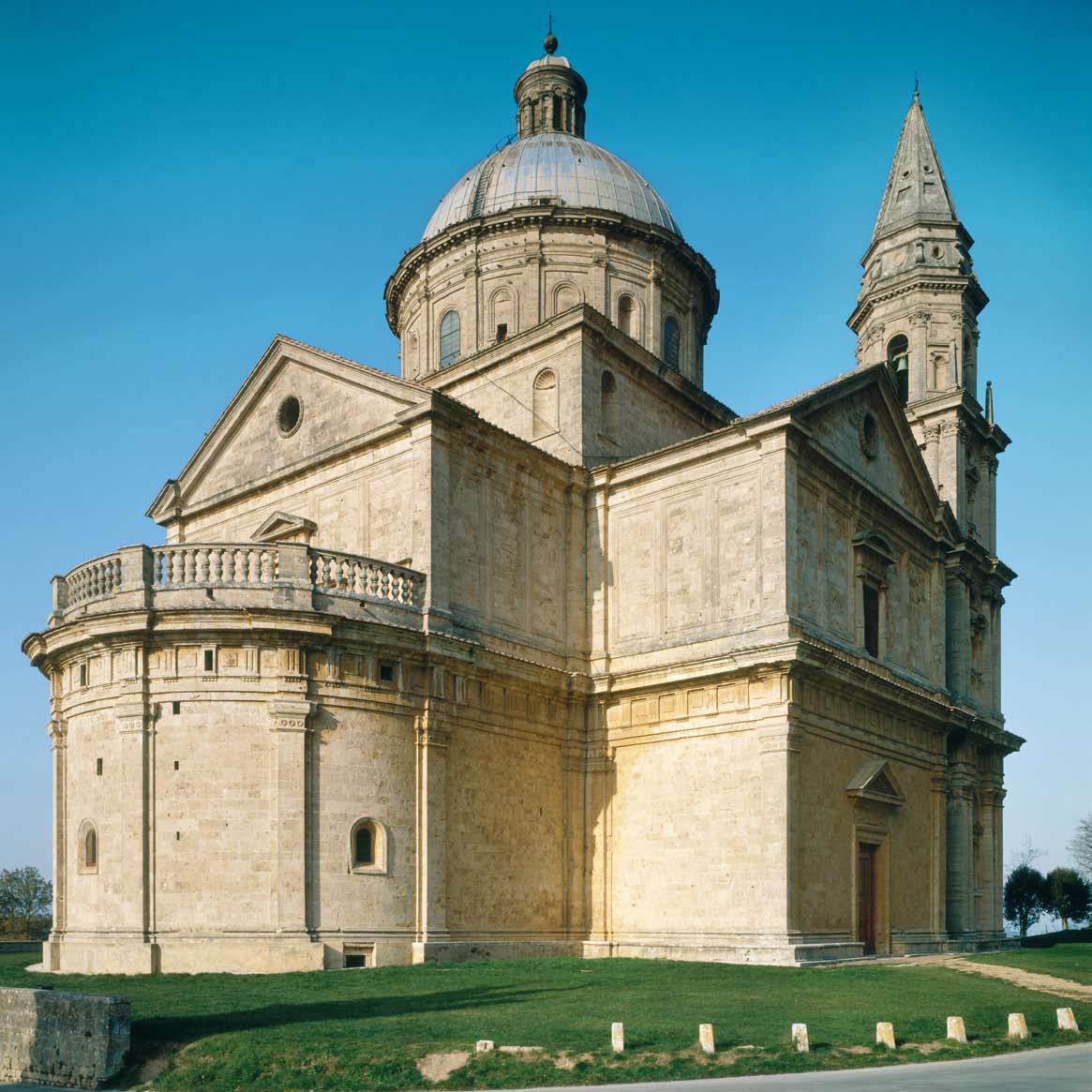
03 — ARTWORK
Exterior view
SANGALLO, Antonio da, the Elder · 1534 →
- MEDIUM
- Photo
- TYPE
- Religious
PALETTE
HOVER OR TAP A SWATCH FOR NAME, SHARE AND HEX. SAMPLED FROM THE IMAGE — INDICATIVE, NOT A PIGMENT ANALYSIS.
DEVELOPMENT BUILD — NOT FOR PUBLIC USE. CONTRIBUTE ON GITHUB.
CURRENT LOCATION · Madonna di San Biagio
03 — ARTWORK
SANGALLO, Antonio da, the Elder · 1534 →
PALETTE
HOVER OR TAP A SWATCH FOR NAME, SHARE AND HEX. SAMPLED FROM THE IMAGE — INDICATIVE, NOT A PIGMENT ANALYSIS.
COMMENTARY
UNDERLINED TERMS ARE DEFINED IN THE GLOSSARY.
In 1518, Antonio da Sangallo the Elder accepted one of the major commissions of the period, the pilgrimage church of the Madonna di San Biagio at Montepulciano. The church was built to commemorate a miracle that took place on one of the slopes surrounding the city, and thus Antonio had a site in the midst of a magnificent landscape with no preexisting constructions.
The church, on which he worked from 1518 until his death in 1534, was the most ambitious church building of the period with the exception of St. Peter's in Rome. Antonio chose a Greek-cross plan crowned with a domein architecture, hemispherical structure evolved from the arch, usually forming a ceiling or roof.. He eschewed the typically Florentine elegant surface with marbleloosely applied to any hard limestone that can be sawn into thin slabs and will take a good polish so that it is suitable for decorative work; more strictly, it refers to metamorphosed limestones whose structure has been recrystallized by heat or pressure. Marbles are widely disseminated and occur in a great variety of colours and patterns, but certain types have been particularly prized by sculptors. The most famous of Greek white marbles in the ancient world was the close-grained Pentelic, which was quarried at Mount Pentelicon in Attica. The Elgin Marbles are carved in Pentelic. Widely used also were the somewhat coarser-grained translucent white marbles from the Aegean islands of Paros and Naxos. Parian marble was used for the celebrated Mausoleum at Halicarnassus. The pure white Carrara marble, quarried at Massa, Carrara, and Pietra Santa in Tuscany from the 3rd century BC, is the most famous of all sculptors' stones. It was used for the Apollo Belvedere, and was much favoured in the Renaissance, particularly by Michelangelo, who often visited the quarries to select material for his work. Neoclassical sculptors also favoured Carrara marble because of its ability to take a smooth, sleek surface, but it can look rather 'dead' compared with some of the finest Greek marbles. incrustation, however, and largely constructed his church of blocks of travertine that confer upon the building an unexpected massiveness. The main façadethe front or principal face of a building, especially one elaborately constructed; a blind façade is a façade that is purely decorative and does not relate to the structure of the building. was to be flanked by free-standing towers, but only one was built.
View the ground plan and section of the church.
@online{wga-rf4d94ade17ed36,
  author       = {Krén, Emil and Marx, Daniel},
  title        = {Exterior view by SANGALLO, Antonio da, the Elder},
  organization = {{Web Gallery of Art}},
  date         = {2026-09-13},
  url          = {https://beta.wga.hu/artists/sangallo-antonio-da-the-elder-r4d38fee433e889/exterior-view-rf4d94ade17ed36},
  urldate      = {2026-09-13},
  langid       = {english}
}
ACCESSED 2026-09-13. REPLACE THE AUTHOR FIELD WITH THE COMMENTARY AUTHOR WHERE ONE IS NAMED.


