03 — ARTWORK
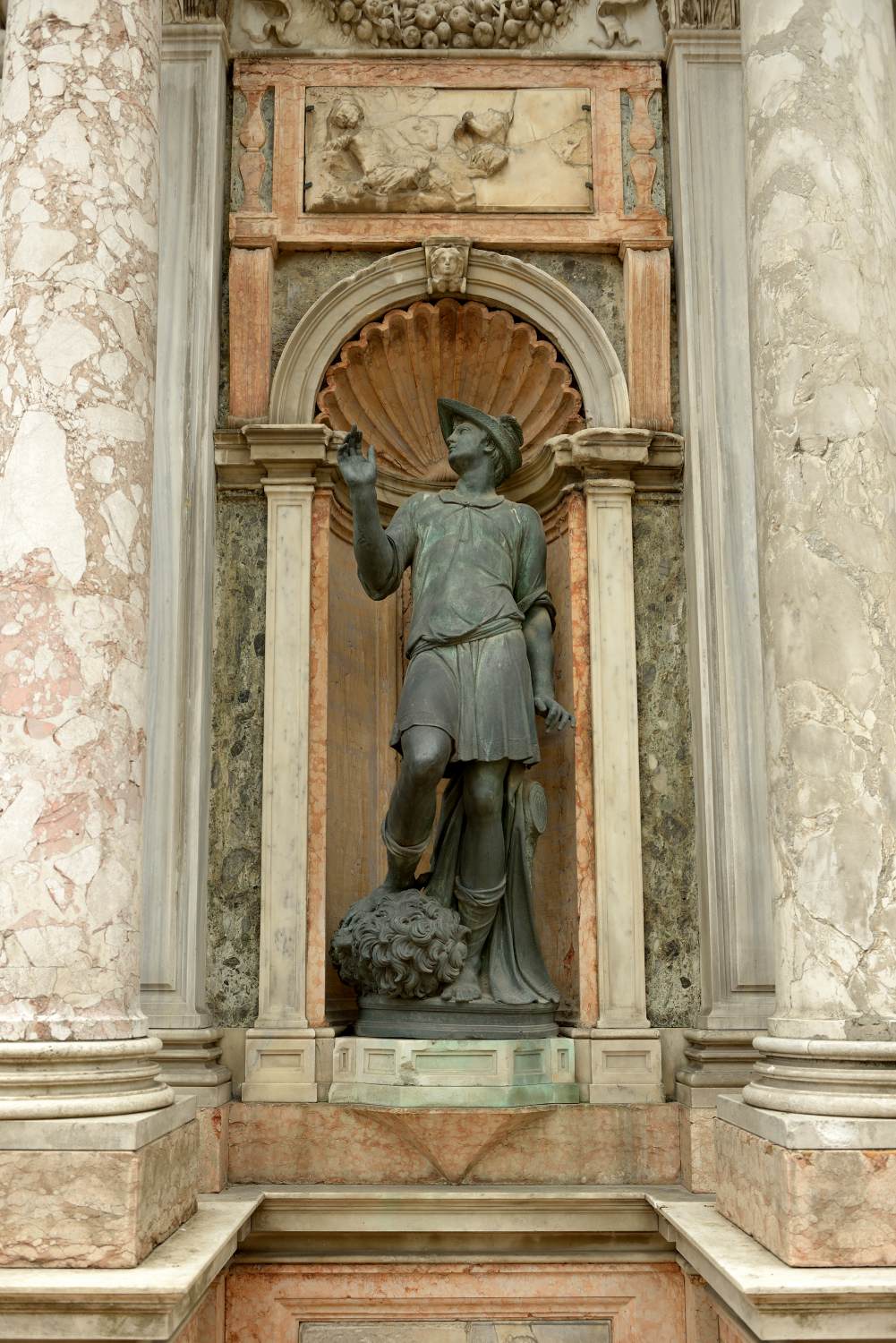
Mercury on the Loggetta
- MEDIUM
- Bronze
- TYPE
- Mythological
PALETTE
HOVER OR TAP A SWATCH FOR NAME, SHARE AND HEX. SAMPLED FROM THE IMAGE — INDICATIVE, NOT A PIGMENT ANALYSIS.
DEVELOPMENT BUILD — NOT FOR PUBLIC USE. CONTRIBUTE ON GITHUB.
03 — ARTWORK
PALETTE
HOVER OR TAP A SWATCH FOR NAME, SHARE AND HEX. SAMPLED FROM THE IMAGE — INDICATIVE, NOT A PIGMENT ANALYSIS.
COMMENTARY
UNDERLINED TERMS ARE DEFINED IN THE GLOSSARY.
The figures of gods on the LoggettaSmall loggia: open arcaded walkway supported by columns or pillars. - Pallas, Mercury, Apollo and Peace - were intended by the sculptor as an allegoryA work of art which represents some abstract quality or idea, either by means of a single figure (personification) or by grouping objects and figures together. Renaissance allegories make frequent allusions both to both Greek and Roman legends and literature, and also to the wealth of Christian allegorical stories and symbols developed during the Middle Ages. of the government of Venice. Pallas was depicted as alert and fully armed because the wisdom of the Venetian senators was without peer. Mercury symbolized eloquence, and the part it played in the Venetian state. Apollo represented the freedom of the Venetian constitution, and, through the analogy of music, the harmony with which it was administered, while Peace was the condition which had transformed the city into the metropolis of Italy. The figures were planned as a coherent plastic scheme, with the Apollo and Mercury orientated on the entrance, and the Pallas and Peace turning their backs on the two archways at the sides.
The Loggetta gods are attenuated, slightly androgynous figures; they have a self-consciously artificial manner not unlike Giambologna's small bronzes. More than any other works these statues determined the form of the bronzeAn alloy of copper (usually about 90 per cent) and tin, often also containing small amounts of other metals such as lead or zinc. Since antiquity it has been the metal most commonly used in cast sculpture because of its strength, durability, and the fact that it is easily workable - both hot and cold - by a variety of processes. It is easier to cast than copper because it has a lower melting-point, and its great tensile strength makes possible the protrusion of unsupported parts - an advantage over marble sculpture. The colour of bronze is affected by the proportion of tin or other metals present, varying from silverish to a rich, coppery red, and its surface beauty can be enhanced when it acquires a patina. statuettes that were turned out in Venice in the later sixteenth century.
The picture shows the statue of Mercury on the Loggetta.
@online{wga-rc54a0f70c9e486,
  author       = {Krén, Emil and Marx, Daniel},
  title        = {Mercury on the Loggetta by SANSOVINO, Jacopo},
  organization = {{Web Gallery of Art}},
  date         = {2026-09-09},
  url          = {https://beta.wga.hu/artists/sansovino-jacopo-r0c8d6b16f326bd/mercury-on-the-loggetta-rc54a0f70c9e486},
  urldate      = {2026-09-09},
  langid       = {english}
}
ACCESSED 2026-09-09. REPLACE THE AUTHOR FIELD WITH THE COMMENTARY AUTHOR WHERE ONE IS NAMED.


