03 — ARTWORK
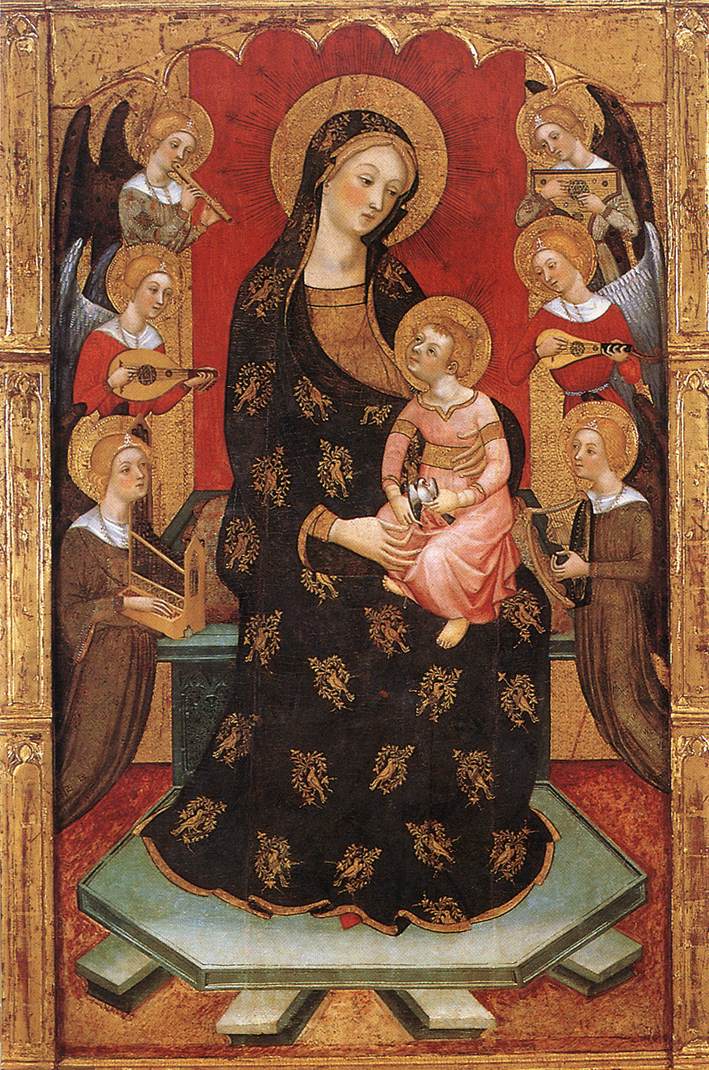
Madonna with Angels Playing Music
- MEDIUM
- Panel, 196 x 130 cm
- TYPE
- Religious
PALETTE
HOVER OR TAP A SWATCH FOR NAME, SHARE AND HEX. SAMPLED FROM THE IMAGE — INDICATIVE, NOT A PIGMENT ANALYSIS.
DEVELOPMENT BUILD — NOT FOR PUBLIC USE. CONTRIBUTE ON GITHUB.
03 — ARTWORK
PALETTE
HOVER OR TAP A SWATCH FOR NAME, SHARE AND HEX. SAMPLED FROM THE IMAGE — INDICATIVE, NOT A PIGMENT ANALYSIS.
COMMENTARY
UNDERLINED TERMS ARE DEFINED IN THE GLOSSARY.
The Italo-GothicGothic, which may well have originated with Alberti as a derogatory term and which certainly corresponds to Vasari's 'maniera tedesca' ('German style'), is properly the descriptive term for an artistic style which achieved its first full flowering in the Ile de France and the surrounding areas in the period between c. 1200 and c. 1270, and which then spread throughout northern Europe. It is characterized by the hitherto unprecedented integration of the arts of sculpture, painting, stained glass and architecture which is epitomized in the great cathedrals of Chartres, Amiens, and Reims or in the Sainte Chapelle in Paris. In all the arts the predominantly planar forms of the Romanesque are replaced by an emphasis on line. There is a transcendental quality, whether in the soaring forms of the pointed arches or in the new stress on the humanity of Christ, which similarly distinguishes it from the preceding Romanesque style. In thinking of Nicola (d. c. 1284) or Giovanni Pisano (d. after 1314) there is same danger of forgetting what had happened in French sculpture half a century or more earlier, and likewise it is hard to remember that the spectacular achievements of early Renaissance art are a singularly localized eddy in the continuing stream of late gothic European art. By northern European standards few Italian works of art can be called gothic without qualification, and the story of 13th and 14th century Italian architecture is as much one of resistance to the new style as of its reception, whether directly from France or through German or central European intermediaries. In sculpture and in painting, the Italian reluctance to distort the human figure, conditioned by a never wholly submerged awareness of the omnipresent antique heritage, gives a special quality to the work of even those artists such as Giovanni Pisano or Simone Martini who most closely approached a pure gothic style. Nevertheless, the vitalizing role of Northern gothic art throughout the early Renaissance and the period leading up to it should never be underestimated. The artistic, like the cultural and commercial, interaction was continuous and much of the Italian achievement is incomprehensible if seen in isolation. It is not merely at the level of direct exchanges between one artist and another, or the influence of one building; painting, manuscript or piece of sculpture upon another, that the effects are to be felt. The streaming quality of line which is so characteristic of Brunelleschi's early Renaissance architecture surely reflects a sensitivity to the gothic contribution which is entirely independent of, and lies much deeper than, the superficial particularities of form. The counterflow of influence and inspiration from South to North must likewise not be underrated. In particular, the contribution of Italian painters from Duccio and Simone Martini onwards is central to the evolution of the so-called International Gothic style developing in Burgundy, Bohemia and north Italy in the late 14th and early 15th centuries. style, which arose in Catalonia during the second quarter of the fourteenth century, is characterized by balanced forms and grave mannerismA movement in Italian art from about 1520 to 1600. Developing out of the Renaissance, Mannerism rejected Renaissance balance and harmony in favor of emotional intensity and ambiguity. In Mannerist painting, this was expressed mainly through severe distortions of perspective and scale; complex and crowded compositions; strong, sometimes harsh or discordant colors; and elongated figures in exaggerated poses. In architecture, there was a playful exaggeration of Renaissance forms (largely in scale and proportion) and the greater use of bizarre decoration. Mannerism gave way to the Baroque. Leading Mannerists include Pontormo, Bronzino, Parmigianino, El Greco and Tintoretto.. Figures are painted against monochromePainted in a single color; a painting executed in a single color. or gold backgrounds in a formula that barely hints at a third dimension. The style was introduced by Ferrer Bassa of Barcelona, a miniaturist and painter in the service of Alfonso IV and Pedro IV of Aragon. His known works cover the period from 1324 to his death in 1348. Most important are the murals of St Michael's Chapela small separate place for worship, either part of a large church or a separate building. in the monasterythe complex of buildings used by a community of monks. Among the main elements of the complex are the church, cloister, chapter house (used by the governing body), refectory (dining room) and dormitory (sleeping quarters). of Pedralbes (Barcelona). Though clearly in the Gothic tradition, he departs from earlier practice by placing greater emphasis on the distribution of masses than on the play of lines. The rythm that animates his forms is slow and restrained.
Bassa's style was fully developed by his own son, Arnaldo, and by Ramon Destorrents. Italo-Gothic was popularized by the Serra brothers, Jaume and Pere, who dominated the Barcelona school during the second half of the fourteenth century. Working singly or together, they executed many fine retables, placing their somewhat shallow but not ungraceful lyricism at the service of the Gothic narrative. One of their nephews, Francisco Serra, established himself in Valencia, bringing with him the family style.
On this Madonna of Serra the influence of the Sienese masters is obvious, however, the Serra brothers learnt this style not in Siena but in AvignonThe decision to move the Papacy here was made in August 1308 by Pope Clement V, who had been residing in France since 1305. The actual move was made in 1309. Six pontificates later, in 1377, the Papacy was brought back to Rome by Gregory XI. All the popes elected at Avignon were French, as were 113 of the 134 cardinals appointed during this time. Yet though the period has been called one of 'captivity' to France, the Avignonese residence was not one of uninterrupted truckling to French kings. The city was not on French territory: it belonged to the Angevin princes of Naples. 'Captivity', like Petrarch's 'unholy Babylon', which he likened to the harlot of the Apocalypse 'full of abominations and the filth of her fornication', was mainly a term of abuse directed at a Papacy that had acquired security enough to revive its legal and financial pretensions and to build lavishly and live well. Between 1100 and 1309 the popes had only spent 82 years in Rome. Avignon gave them a long breathing space to assemble the machinery and the values which characterized the Renaissance Papacy after its final resettlement in Rome. where the Papal Court was the most important northern centre of the late Gothic Italian painting.
@online{wga-r2098fc1de29ec1,
  author       = {Krén, Emil and Marx, Daniel},
  title        = {Madonna with Angels Playing Music by SERRA, Pere},
  organization = {{Web Gallery of Art}},
  date         = {2026-09-13},
  url          = {https://beta.wga.hu/artists/serra-pere-rcfec46a98c8087/madonna-with-angels-playing-music-r2098fc1de29ec1},
  urldate      = {2026-09-13},
  langid       = {english}
}
ACCESSED 2026-09-13. REPLACE THE AUTHOR FIELD WITH THE COMMENTARY AUTHOR WHERE ONE IS NAMED.
The archive catalogues no further works by this artist.
TRY SAME COLLECTION →