03 — ARTWORK
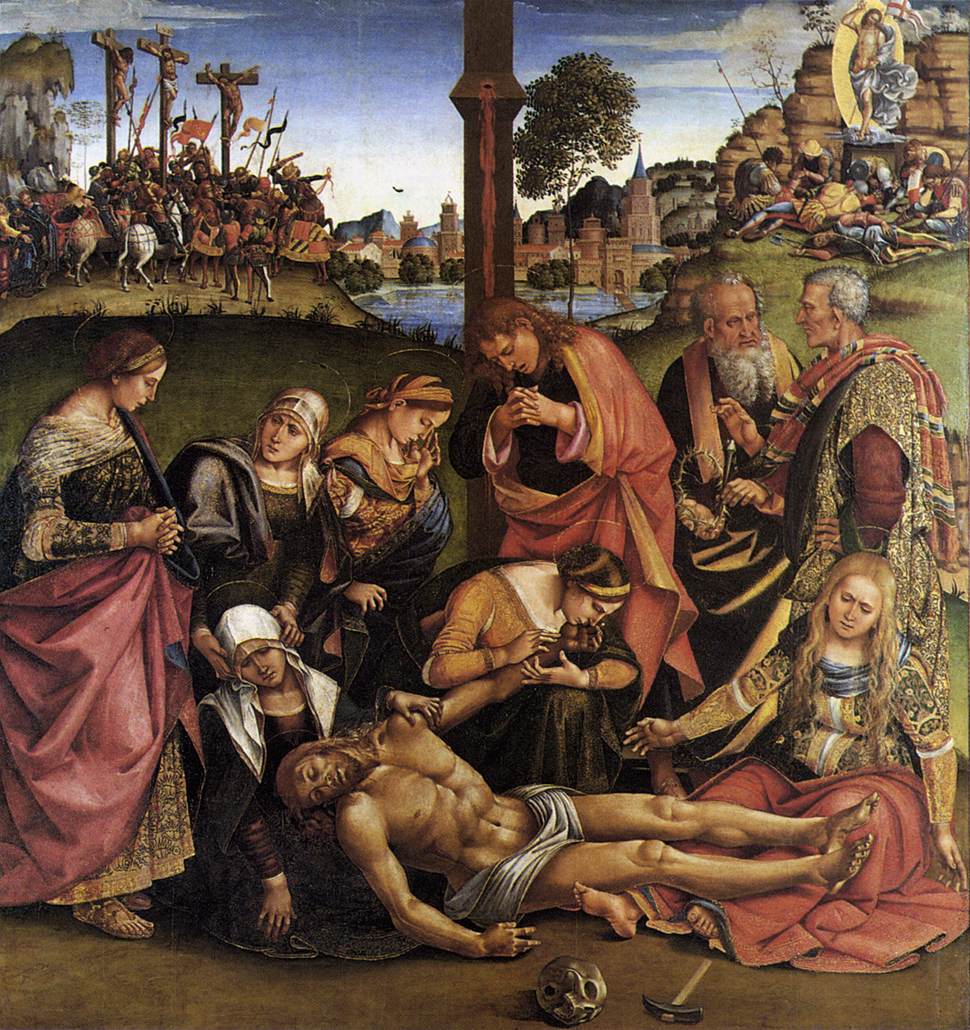
Lamentation over the Dead Christ
- MEDIUM
- Wood, 270 x 240 cm
- TYPE
- Religious
PALETTE
HOVER OR TAP A SWATCH FOR NAME, SHARE AND HEX. SAMPLED FROM THE IMAGE — INDICATIVE, NOT A PIGMENT ANALYSIS.
DEVELOPMENT BUILD — NOT FOR PUBLIC USE. CONTRIBUTE ON GITHUB.
03 — ARTWORK
PALETTE
HOVER OR TAP A SWATCH FOR NAME, SHARE AND HEX. SAMPLED FROM THE IMAGE — INDICATIVE, NOT A PIGMENT ANALYSIS.
COMMENTARY
UNDERLINED TERMS ARE DEFINED IN THE GLOSSARY.
The static pose of the figures, which are seen in a moment of frozen drama, reveals strong links with popular religious plays. An account of Vasari says that Signorelli wanted to represent in the figure of the naked Christ his own son, who died of plaguePlague, which had been extinct in Italy from the 8th century, returned along eastern trade routes to strike the peninsula, and thereafter all Europe, in October 1347. During 1348 the Black Death, comprising the bubonic and still more deadly septicaemic and pneumonic forms of the disease, swept town and countryside in a series of attacks whose horror was strikingly portrayed by Boccaccio in his preface to the Decameron. Thenceforward, though in less widespread, more sporadic outbreaks, plague recurred periodically until the 18th century. Thirty per cent of the population of Venice died in the outbreak of 1575-7, for instance, which was commemorated by Palladio's church of the Redentore. Preventive measures included the boarding up of infected families, the isolation of sufferers in plague hospitals, the burning of 'infected' clothing, but none worked or mitigated the feeling of hopelessness. The plague's social effects are an object of controversy. It seems probable, however, that during the second half of the 14th century plague reduced the population of Italy by a half and at certain centres, such as Florence and Genoa, sharply accentuated an economic depression which had already set in during the 1340s. In the 15th century, despite regional variations, it is unlikely that population began to rise significantly before the 1470s. Large claims have been made in the field of the arts and of human sensibility for the influence of plague. In Florence and Siena from 1348 to 1380, religious feeling and the art which mirrors it seem to assume more sombre forms and to reflect less the human and more the divine, transcendent and threatening aspects of faith. Yet the black rat and its plague-bearing flea could find a more hospitable environment in the hovels of the poor than in the stone-built houses of wealthy patrons of the arts (who, moreover, were often able to remove themselves from areas where plague had broken out). For this reason, perhaps, it is difficult to find, outside Tuscany, evidence of cultural change which could be attributed to plague, and in the Italy of the 15th and 16th centuries the main effect of the disease in art is to be found only in the frequent portrayal of the plague saints, Rocco and Sebastian. It is none the less interesting to recall that it was against a stark background of continual menace from plague that the human achievements of the Renaissance came into being. in 1502.
The Lamentation, a work done entirely the artist alone, reveals all the poetry of the painter even in the context of an unrefined style which may seem declamatory, scenic and rhetorical. It strikes the observer with great power and energy on account of its dimensions, the liveliness of its colour and the strong statuesque attitude of the figures. The central characters are expressive and are painted in an attitude of pain. In the background two lively scenes contrast with the stillness of the central group of characters. In the middle, there is an unreal landscape, clear and clean, but interrupted by the tragic image of the blood flowing down the wood of the cross.
@online{wga-r8ee82cf1bd1646,
  author       = {Krén, Emil and Marx, Daniel},
  title        = {Lamentation over the Dead Christ by SIGNORELLI, Luca},
  organization = {{Web Gallery of Art}},
  date         = {2026-09-09},
  url          = {https://beta.wga.hu/artists/signorelli-luca-r927364050b0622/lamentation-over-the-dead-christ-r8ee82cf1bd1646},
  urldate      = {2026-09-09},
  langid       = {english}
}
ACCESSED 2026-09-09. REPLACE THE AUTHOR FIELD WITH THE COMMENTARY AUTHOR WHERE ONE IS NAMED.


