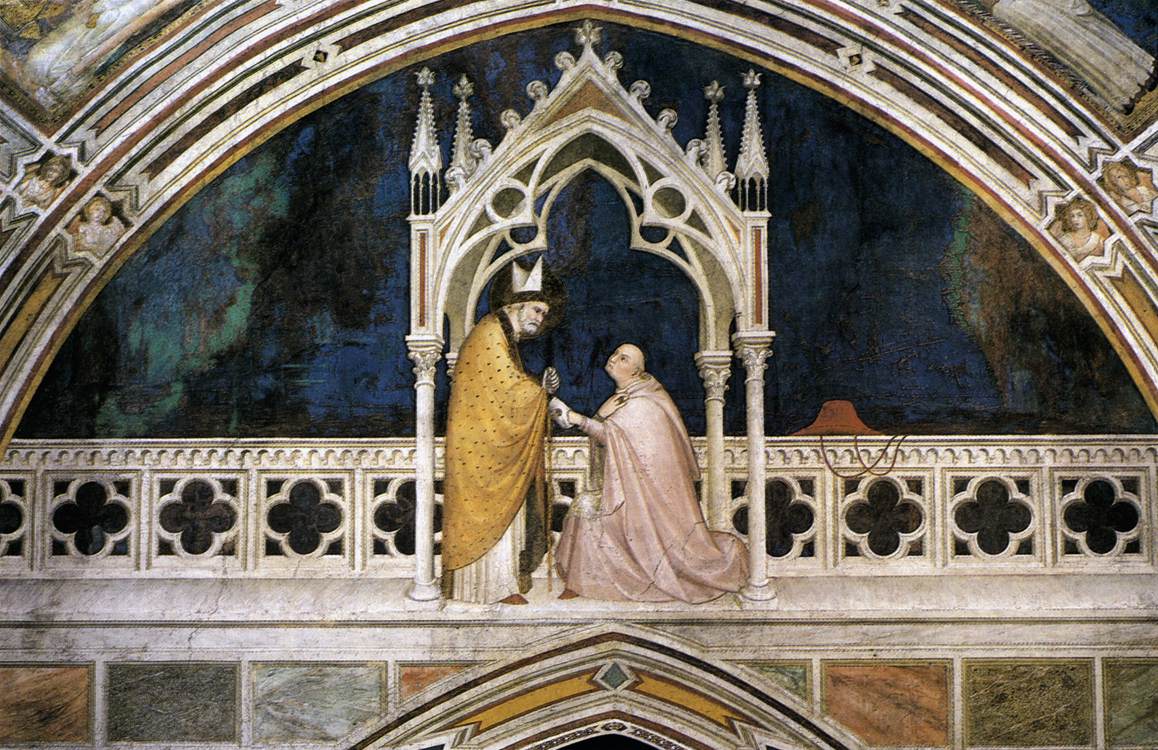
03 — ARTWORK
Consecration of the Chapel
- MEDIUM
- Fresco, 330 x 700 cm
- TYPE
- Religious
PALETTE
HOVER OR TAP A SWATCH FOR NAME, SHARE AND HEX. SAMPLED FROM THE IMAGE — INDICATIVE, NOT A PIGMENT ANALYSIS.
DEVELOPMENT BUILD — NOT FOR PUBLIC USE. CONTRIBUTE ON GITHUB.
03 — ARTWORK
PALETTE
HOVER OR TAP A SWATCH FOR NAME, SHARE AND HEX. SAMPLED FROM THE IMAGE — INDICATIVE, NOT A PIGMENT ANALYSIS.
COMMENTARY
UNDERLINED TERMS ARE DEFINED IN THE GLOSSARY.
Next to the eightGroup of American painters who exhibited together only once, in New York City in 1908, but who established one of the main currents in 20th-century American painting. The original Eight included Robert Henri, leader of the group, Everett Shinn, John Sloan, Arthur B. Davies, Ernest Lawson, Maurice Prendergast, George Luks, and William J. Glackens. George Bellows later joined them. The group’s determination to bring art into closer touch with everyday life greatly influenced the course of American art. saints on the underside of the archThe pointed arch is widely regarded as the main identifiable feature of Gothic architecture (distinct from the round arch of the Romanesque period). The three most common Gothic arches are the Equilateral, Lancet and Tudor., on the entrance wall inside the chapela small separate place for worship, either part of a large church or a separate building. we find the scene of the Consecration of the Chapel. A mood of deep humility pervades the whole scene and provides the psychological link between the two characters: Cardinal Gentile is shown in humble adoration at the feet of St Martin who is gently helping him to get up. The very ecclesiastical setting, depicted in a perspectiveThe method of representing three-dimensional objects on a flat surface. Perspective gives a picture a sense of depth. The most important form of perspective in the Renaissance was linear perspective (first formulated by the architect Brunelleschi in the early 15th century), in which the real or suggested lines of objects converge on a vanishing point on the horizon, often in the middle of the composition (centralized perspective). The first artist to make a systematic use of linear perspective was Masaccio, and its principles were set out by the architect Alberti in a book published in 1436. The use of linear perspective had a profound effect on the development of Western art and remained unchallenged until the 20th century. seen from below consists of a splendid ciboriumA term applied to both a liturgical vessel used for holding the consecrated Host and an altar canopy supported on columns, popular particularly in Italy in the Romanesque and Gothic periods. In the latter sense the word is not easily distinguished from baldacchino., a GothicGothic, which may well have originated with Alberti as a derogatory term and which certainly corresponds to Vasari's 'maniera tedesca' ('German style'), is properly the descriptive term for an artistic style which achieved its first full flowering in the Ile de France and the surrounding areas in the period between c. 1200 and c. 1270, and which then spread throughout northern Europe. It is characterized by the hitherto unprecedented integration of the arts of sculpture, painting, stained glass and architecture which is epitomized in the great cathedrals of Chartres, Amiens, and Reims or in the Sainte Chapelle in Paris. In all the arts the predominantly planar forms of the Romanesque are replaced by an emphasis on line. There is a transcendental quality, whether in the soaring forms of the pointed arches or in the new stress on the humanity of Christ, which similarly distinguishes it from the preceding Romanesque style. In thinking of Nicola (d. c. 1284) or Giovanni Pisano (d. after 1314) there is same danger of forgetting what had happened in French sculpture half a century or more earlier, and likewise it is hard to remember that the spectacular achievements of early Renaissance art are a singularly localized eddy in the continuing stream of late gothic European art. By northern European standards few Italian works of art can be called gothic without qualification, and the story of 13th and 14th century Italian architecture is as much one of resistance to the new style as of its reception, whether directly from France or through German or central European intermediaries. In sculpture and in painting, the Italian reluctance to distort the human figure, conditioned by a never wholly submerged awareness of the omnipresent antique heritage, gives a special quality to the work of even those artists such as Giovanni Pisano or Simone Martini who most closely approached a pure gothic style. Nevertheless, the vitalizing role of Northern gothic art throughout the early Renaissance and the period leading up to it should never be underestimated. The artistic, like the cultural and commercial, interaction was continuous and much of the Italian achievement is incomprehensible if seen in isolation. It is not merely at the level of direct exchanges between one artist and another, or the influence of one building; painting, manuscript or piece of sculpture upon another, that the effects are to be felt. The streaming quality of line which is so characteristic of Brunelleschi's early Renaissance architecture surely reflects a sensitivity to the gothic contribution which is entirely independent of, and lies much deeper than, the superficial particularities of form. The counterflow of influence and inspiration from South to North must likewise not be underrated. In particular, the contribution of Italian painters from Duccio and Simone Martini onwards is central to the evolution of the so-called International Gothic style developing in Burgundy, Bohemia and north Italy in the late 14th and early 15th centuries. construction with a trefoiled ogival arch and corner pinnacles, and a polychrome marbleloosely applied to any hard limestone that can be sawn into thin slabs and will take a good polish so that it is suitable for decorative work; more strictly, it refers to metamorphosed limestones whose structure has been recrystallized by heat or pressure. Marbles are widely disseminated and occur in a great variety of colours and patterns, but certain types have been particularly prized by sculptors. The most famous of Greek white marbles in the ancient world was the close-grained Pentelic, which was quarried at Mount Pentelicon in Attica. The Elgin Marbles are carved in Pentelic. Widely used also were the somewhat coarser-grained translucent white marbles from the Aegean islands of Paros and Naxos. Parian marble was used for the celebrated Mausoleum at Halicarnassus. The pure white Carrara marble, quarried at Massa, Carrara, and Pietra Santa in Tuscany from the 3rd century BC, is the most famous of all sculptors' stones. It was used for the Apollo Belvedere, and was much favoured in the Renaissance, particularly by Michelangelo, who often visited the quarries to select material for his work. Neoclassical sculptors also favoured Carrara marble because of its ability to take a smooth, sleek surface, but it can look rather 'dead' compared with some of the finest Greek marbles. balustradeA rail supported by a row of small posts or open-work panels. in the background.
@online{wga-r30da8f171430f1,
  author       = {Krén, Emil and Marx, Daniel},
  title        = {Consecration of the Chapel by SIMONE MARTINI},
  organization = {{Web Gallery of Art}},
  date         = {2026-09-09},
  url          = {https://beta.wga.hu/artists/simone-martini-r98befbdf9e7c79/consecration-of-the-chapel-r30da8f171430f1},
  urldate      = {2026-09-09},
  langid       = {english}
}
ACCESSED 2026-09-09. REPLACE THE AUTHOR FIELD WITH THE COMMENTARY AUTHOR WHERE ONE IS NAMED.


