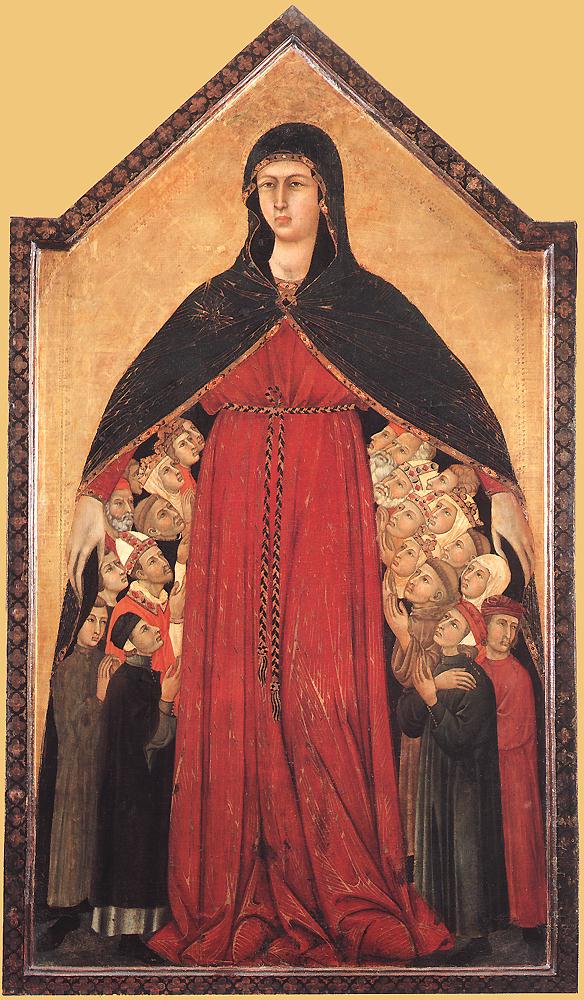
03 — ARTWORK
Madonna of Mercy
- MEDIUM
- Tempera on wood, 154 x 84 cm
- TYPE
- Religious
PALETTE
HOVER OR TAP A SWATCH FOR NAME, SHARE AND HEX. SAMPLED FROM THE IMAGE — INDICATIVE, NOT A PIGMENT ANALYSIS.
DEVELOPMENT BUILD — NOT FOR PUBLIC USE. CONTRIBUTE ON GITHUB.
CURRENT LOCATION · Pinacoteca Nazionale (Siena)
03 — ARTWORK
PALETTE
HOVER OR TAP A SWATCH FOR NAME, SHARE AND HEX. SAMPLED FROM THE IMAGE — INDICATIVE, NOT A PIGMENT ANALYSIS.
COMMENTARY
UNDERLINED TERMS ARE DEFINED IN THE GLOSSARY.
The Madonna of Mercy from Vertine is a splendid temperaA method of painting in which the pigments are mixed with an emulsion of water and egg yolks or whole eggs (sometimes glue or milk). Tempera was widely used in Italian art in the 14th and 15th centuries, both for panel painting and fresco, then being replaced by oil paint. Tempera colors are bright and translucent, though because the paint dried very quickly there is little time to blend them, graduated tones being created by adding lighter or darker dots or lines of color to an area of dried paint. painting only recently attributed (and not unanimously) to Simone. Here, we can still clearly see the influence of Duccio, especially in the positioning and typologyA system of classification. In Christian thought, the drawing of parallels between the Old Testament and the New. Typological studies were based on the assumption that Old Testament figures and events prefigured those in the New, e.g. the story of Jonah and the whale prefigured Christ's death and resurrection. Such typological links were frequently used in both medieval and Renaissance art. of the characters sheltered under Mary's cloak. But a new spirit prevails: a sense of real space between the heads and a feeling of life and movement in the imposing figure of the Virgin (the drapery folds do not conceal the position of her legs and she is quite noticeably turning in order to embrace all her protégés) are evidence of the evolution of the artist's more archaic ideas towards new forms of expression.
The effect of rich and precious ornamentation (a striking feature of the Maestà) is reproduced in the use of gold and silver, colourful gems set in the surface, and transparent varnishes. Although we cannot be sure that this Madonna was actually painted by Simone, no one can deny the analogies, both in technique and style, with Madonna no. 583.
@online{wga-rd7a9509110d4c5,
  author       = {Krén, Emil and Marx, Daniel},
  title        = {Madonna of Mercy by SIMONE MARTINI},
  organization = {{Web Gallery of Art}},
  date         = {2026-09-13},
  url          = {https://beta.wga.hu/artists/simone-martini-r98befbdf9e7c79/madonna-of-mercy-rd7a9509110d4c5},
  urldate      = {2026-09-13},
  langid       = {english}
}
ACCESSED 2026-09-13. REPLACE THE AUTHOR FIELD WITH THE COMMENTARY AUTHOR WHERE ONE IS NAMED.


