03 — ARTWORK
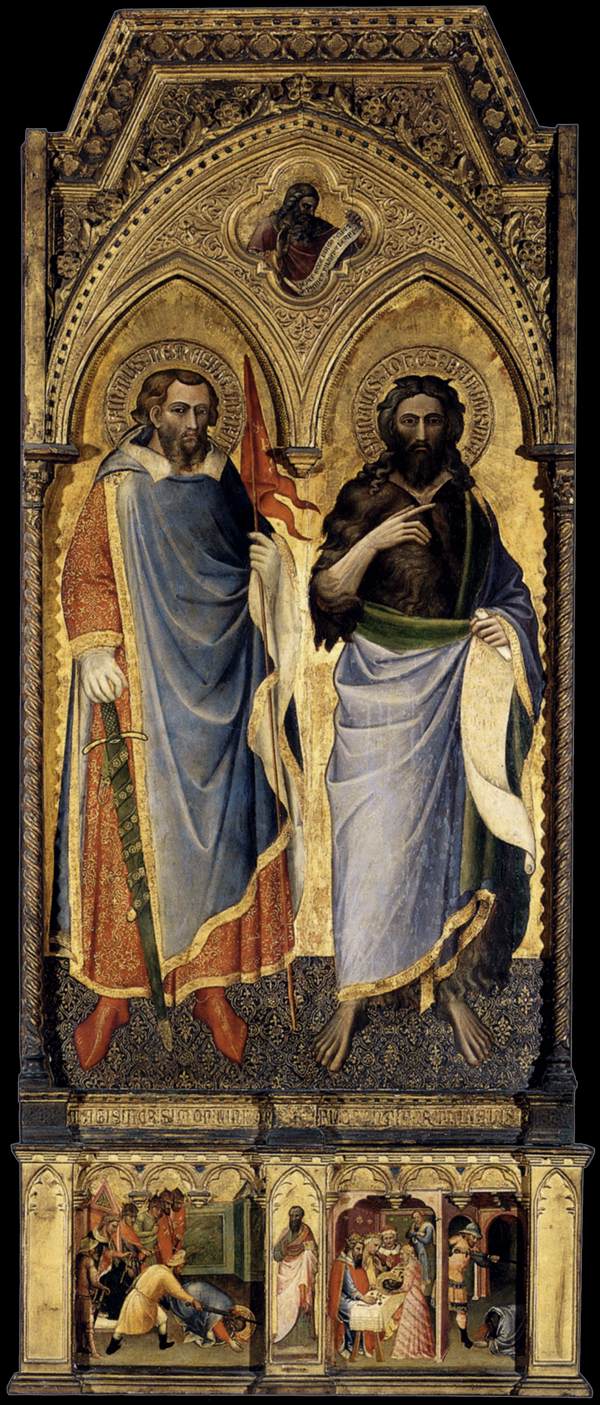
St Nemesius and St John the Baptist
- MEDIUM
- Tempera on panel, 194 x 95 cm
- TYPE
- Religious
PALETTE
HOVER OR TAP A SWATCH FOR NAME, SHARE AND HEX. SAMPLED FROM THE IMAGE — INDICATIVE, NOT A PIGMENT ANALYSIS.
DEVELOPMENT BUILD — NOT FOR PUBLIC USE. CONTRIBUTE ON GITHUB.
03 — ARTWORK
PALETTE
HOVER OR TAP A SWATCH FOR NAME, SHARE AND HEX. SAMPLED FROM THE IMAGE — INDICATIVE, NOT A PIGMENT ANALYSIS.
COMMENTARY
UNDERLINED TERMS ARE DEFINED IN THE GLOSSARY.
The painting was the left panelTerm in painting for a support of wood, metal, or other rigid substance, as distinct from canvas. Until the adoption of canvas in the 15th century nearly all the movable paintings of Europe were executed on wood, and even up to the beginning of the 17th century it is probable that as much painting was done on the one support as on the other. Painters who worked on a small scale often used copper panels (Elsheimer is a leading example), and in the colonial art of South America copper and tin and even lead and zinc were used. On a larger scale, slate has occasionally been used as a support, notably by Rubens for his altarpiece for Sta Maria in Vallicella (the Chiesa Nuova) in Rome; the picture he originally painted was said to reflect the light unpleasantly and slate was used for the replacement to produce a more matt finish. For wood panels the Italian masters of the Renaissance preferred white poplar, while oak was the most common wood used in northern Europe. Many other types were used, however; analysis of the contents of art galleries has yielded a long list, including beech, cedar, chestnut, fir, larch, linden, mahogany, olive, and walnut. In the 20th century cedar, teak, and dark walnut are favourites, and modern painters have also used plywood, fibre-board, and other synthetic materials as supports. of the triptychA painting in three sections, usually an altarpiece, consisting of a central panel and two outer panels, or wings. In many medieval triptychs the two outer wings were hinged so that could be closed over the center panel. Early triptychs were often portable. made for the cloisterquadrilateral enclosure surrounded by covered walkways, the centre of activity for the inhabitants of a monastery. of Santa Maria Nuova at the Forum Romanum in Rome. The other two panels are in the Fogg Art Museum in Cambridge, Mass. St John the Baptist is readily recognizable by the camel hair cloak, by the bare feet, the unfolded parchmentWriting material made from the skins of sheep or calf, less frequently pig, goat,, and other animals; it has also been used for painting, and occasionally for printing and bookbinding. Pliny says that it ewas invented in the 2nd century BC in Pergamum; hence the name parchment from the Latin pergamena (of Pergamum). Skin had been used as a writng material before this, but the refined methods of cleaning and stretching involved in making parchment enabled booth sides of a leaf to be used, leading eventually to the supplanting of the manuscript roll by the bound book. Vellum is a fine kind of parchment made from delicate skins of young (sometimes stillborn) animals. Paper began to replace parchment from about the 14th century, but parchment is still used for certain kinds of documents, and the name is often applied to high-quality writng paper. scroll. St Nemesius, the Roman tribune, is dressed by Spinello Aretino in the garb of a contemporary knight.
@online{wga-r2768bcc151efa0,
  author       = {Krén, Emil and Marx, Daniel},
  title        = {St Nemesius and St John the Baptist by SPINELLO ARETINO},
  organization = {{Web Gallery of Art}},
  date         = {2026-09-13},
  url          = {https://beta.wga.hu/artists/spinello-aretino-rc7ff097ca5e261/st-nemesius-and-st-john-the-baptist-r2768bcc151efa0},
  urldate      = {2026-09-13},
  langid       = {english}
}
ACCESSED 2026-09-13. REPLACE THE AUTHOR FIELD WITH THE COMMENTARY AUTHOR WHERE ONE IS NAMED.


