03 — ARTWORK
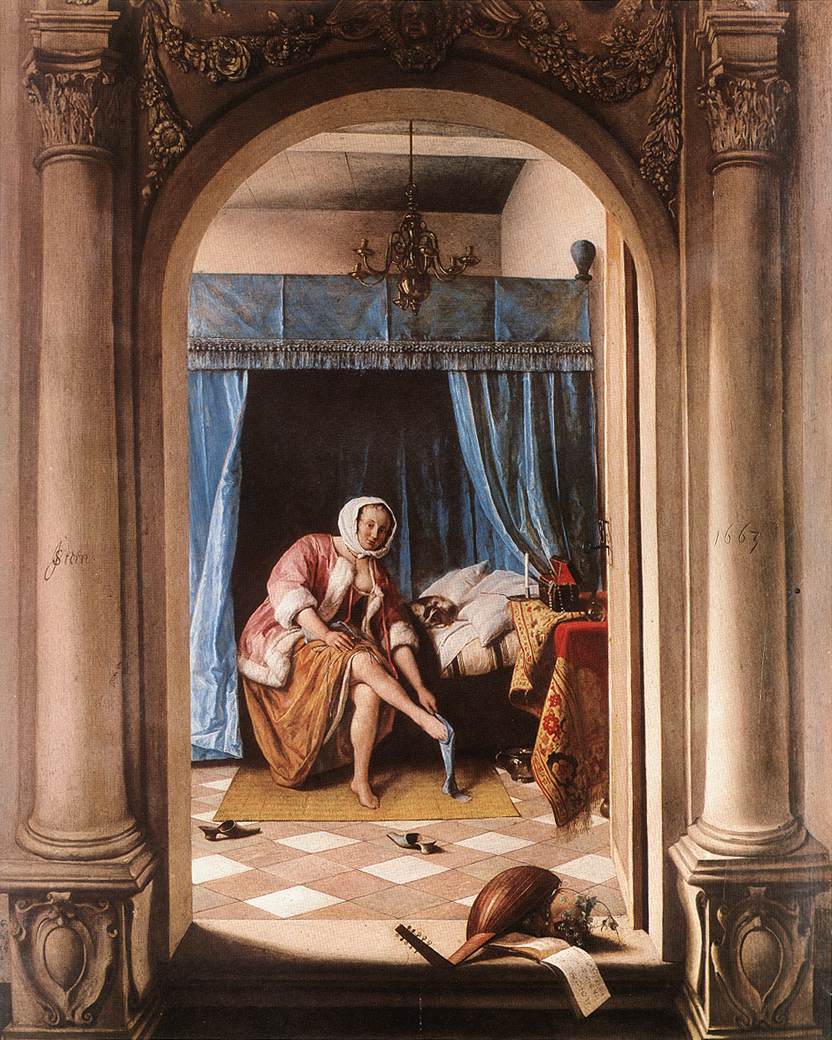
The Morning Toilet
- MEDIUM
- Oil on wood, 64,7 x 53 cm
- TYPE
- Genre
PALETTE
HOVER OR TAP A SWATCH FOR NAME, SHARE AND HEX. SAMPLED FROM THE IMAGE — INDICATIVE, NOT A PIGMENT ANALYSIS.
DEVELOPMENT BUILD — NOT FOR PUBLIC USE. CONTRIBUTE ON GITHUB.
CURRENT LOCATION · Royal Collection (London)
03 — ARTWORK
PALETTE
HOVER OR TAP A SWATCH FOR NAME, SHARE AND HEX. SAMPLED FROM THE IMAGE — INDICATIVE, NOT A PIGMENT ANALYSIS.
COMMENTARY
UNDERLINED TERMS ARE DEFINED IN THE GLOSSARY.
The girl is shown in a state of undress, provocatively pulling on her stocking and looking directly - and invitingly - at the spectator. The erotic character of this delicately painted and boldly coloured panelTerm in painting for a support of wood, metal, or other rigid substance, as distinct from canvas. Until the adoption of canvas in the 15th century nearly all the movable paintings of Europe were executed on wood, and even up to the beginning of the 17th century it is probable that as much painting was done on the one support as on the other. Painters who worked on a small scale often used copper panels (Elsheimer is a leading example), and in the colonial art of South America copper and tin and even lead and zinc were used. On a larger scale, slate has occasionally been used as a support, notably by Rubens for his altarpiece for Sta Maria in Vallicella (the Chiesa Nuova) in Rome; the picture he originally painted was said to reflect the light unpleasantly and slate was used for the replacement to produce a more matt finish. For wood panels the Italian masters of the Renaissance preferred white poplar, while oak was the most common wood used in northern Europe. Many other types were used, however; analysis of the contents of art galleries has yielded a long list, including beech, cedar, chestnut, fir, larch, linden, mahogany, olive, and walnut. In the 20th century cedar, teak, and dark walnut are favourites, and modern painters have also used plywood, fibre-board, and other synthetic materials as supports. cannot be doubted. It has been argued that she is probably a prostitute - above the archThe pointed arch is widely regarded as the main identifiable feature of Gothic architecture (distinct from the round arch of the Romanesque period). The three most common Gothic arches are the Equilateral, Lancet and Tudor. is Cupid and beside her bed a jewel-case - and yet the scene, framed in an archway, gives few real clues as to her status. We may, in fact, simply be glimpsing a desirable young woman at her toilet. The lute and the music book in the archway (as well as Cupid) associate the scene with the pleasures of love, while the skull wreathed in vine leaves reminds us that such pleasures are fleeting. The chamber pot is a characteristically realistic and down-to-earth element, while the archway with its Corinthian columns and swags of flowers frames this all-too-human scene in a mock grandiose manner.
Today we may admire not just the illusionismThe painting techniques that create the realistic impression of solid, three-dimensional objects (such as picture frames, architectural features, plasterwork etc.), the amusing conceit of the subject but also the remarkable skill with which Steen described the rush-carpet, the canopied bed, the tiled floor and all the other details which go to make up this rich and intricate composition.
@online{wga-rfa613a3a0ff1f4,
  author       = {Krén, Emil and Marx, Daniel},
  title        = {The Morning Toilet by STEEN, Jan},
  organization = {{Web Gallery of Art}},
  date         = {2026-09-13},
  url          = {https://beta.wga.hu/artists/steen-jan-rb9ab2005aa3a59/the-morning-toilet-rfa613a3a0ff1f4},
  urldate      = {2026-09-13},
  langid       = {english}
}
ACCESSED 2026-09-13. REPLACE THE AUTHOR FIELD WITH THE COMMENTARY AUTHOR WHERE ONE IS NAMED.


