03 — ARTWORK
Salammbô
- MEDIUM
- Oil on canvas, 187 x 287 cm
- TYPE
- Other
PALETTE
HOVER OR TAP A SWATCH FOR NAME, SHARE AND HEX. SAMPLED FROM THE IMAGE — INDICATIVE, NOT A PIGMENT ANALYSIS.
DEVELOPMENT BUILD — NOT FOR PUBLIC USE. CONTRIBUTE ON GITHUB.
03 — ARTWORK
PALETTE
HOVER OR TAP A SWATCH FOR NAME, SHARE AND HEX. SAMPLED FROM THE IMAGE — INDICATIVE, NOT A PIGMENT ANALYSIS.
COMMENTARY
UNDERLINED TERMS ARE DEFINED IN THE GLOSSARY.
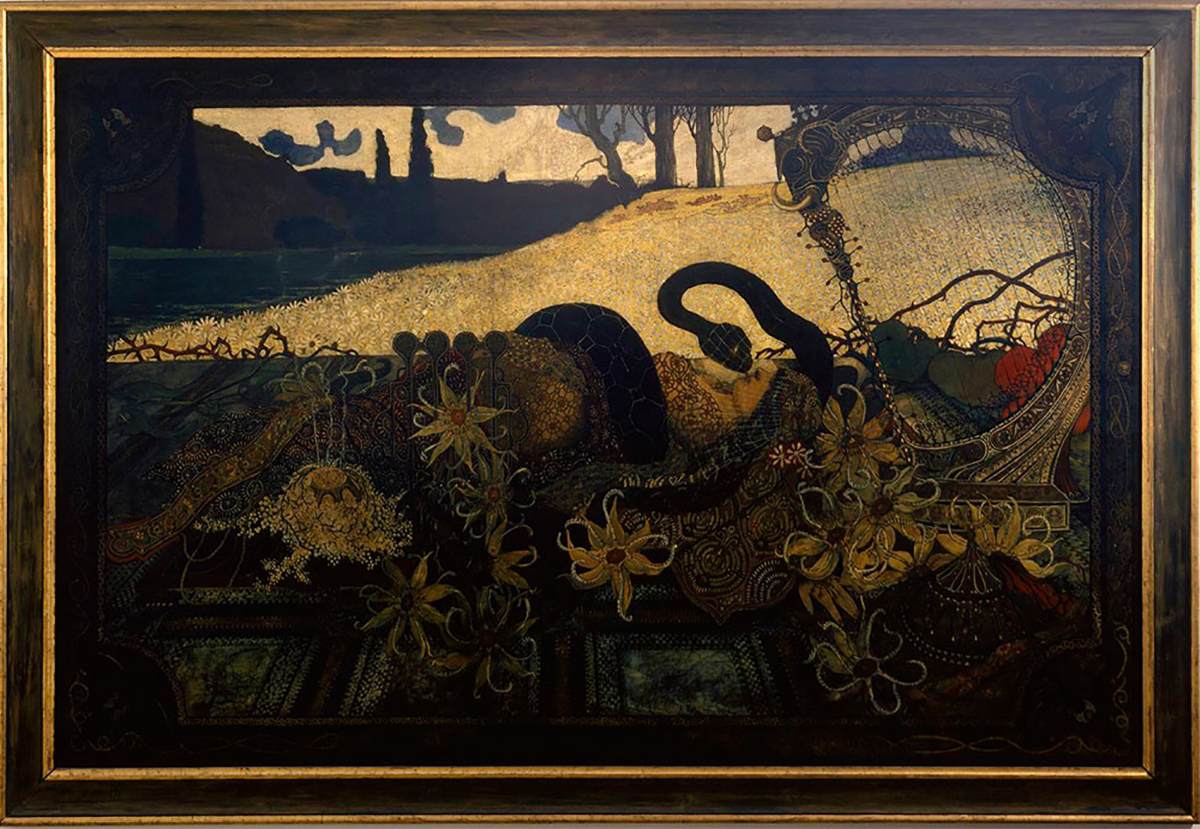
Salammbô c. 1894 Oil on canvasA woven cloth used as a support for painting. The best-quality canvas is made of linen; other materials used are cotton, hemp, and jute. It is now so familiar a material that the word 'canvas' has become almost a synonym for an oil painting, but it was not until around 1500 that it began to rival the wooden panel (which was more expensive and took longer to prepare) as the standard support for movable paintings (the transition came later in Northern Europe than in Italy). Canvas is not suitable for painting on until it has been coated with a ground, which isolates the fabric from the paint; otherwise it will absorb too much paint, only very rough effects will be obtainable, and parts of the fabric may be rotted by the pigments. It must also be made taut on a stretcher or by some other means., 187 x 287 cm Kunstsammlungen zu Schlossmuseum, Weimar
Strathmann's most famous picture is Salammbô, representing the fictional title character of a historical novel by Gustave Flaubert. Lovis Corinth wrote of the painting in 1903: "Soon, however, the model was sent home, and Strathmann gradually covered his Salammbô's nakedness with more and more rugs and fantastical garments of his own invention, so that by the end only a mystical profile and the fingers of one hand peeped out from amongst a profusion of ornamental fabrics."
Flaubert's novel is set in Carthage immediately before and during the Mercenary Revolt (241-237 B.C.). It was enormously popular when first published and jumpstarted a renewed interest in the history of the Roman Republic's conflict with the North African Phoenician colony of Carthage.
Salammbô is a priestess and the daughter of the foremost Carthaginian general. She is the object of the obsessive lust of Matho, a leader of the mercenaries. Matho steals the sacred veil of Carthage, the Zaïmph, prompting Salammbô to enter the mercenaries' camp in an attempt to steal it back. The Zaïmph is an ornate bejewelled veil, the city's guardian, and touching it will bring death to the perpetrator.
@online{wga-r74972a2e654fbd,
  author       = {Krén, Emil and Marx, Daniel},
  title        = {Salammbô by STRATHMANN, Carl},
  organization = {{Web Gallery of Art}},
  date         = {2026-09-13},
  url          = {https://beta.wga.hu/artists/strathmann-carl-r174028bb248a5e/salammb-r74972a2e654fbd},
  urldate      = {2026-09-13},
  langid       = {english}
}
ACCESSED 2026-09-13. REPLACE THE AUTHOR FIELD WITH THE COMMENTARY AUTHOR WHERE ONE IS NAMED.
The archive catalogues no further works by this artist.
TRY SAME COLLECTION →

