03 — ARTWORK
Van Allen Building
SULLIVAN, Louis Henry · 1914 →
- MEDIUM
- Photo
- TYPE
- Other
PALETTE
HOVER OR TAP A SWATCH FOR NAME, SHARE AND HEX. SAMPLED FROM THE IMAGE — INDICATIVE, NOT A PIGMENT ANALYSIS.
DEVELOPMENT BUILD — NOT FOR PUBLIC USE. CONTRIBUTE ON GITHUB.
03 — ARTWORK
SULLIVAN, Louis Henry · 1914 →
PALETTE
HOVER OR TAP A SWATCH FOR NAME, SHARE AND HEX. SAMPLED FROM THE IMAGE — INDICATIVE, NOT A PIGMENT ANALYSIS.
COMMENTARY
UNDERLINED TERMS ARE DEFINED IN THE GLOSSARY.
During the period when Sullivan designed banks (the "jewel boxes") in small towns in the Midwest, he also designed the Van Allen Building (1912-14), Clinton, Iowa, and two large houses, the Babson House (1907; destroyed), Riverside, Illinois, and the Bradley House (1909), Madison, Wisconsin.
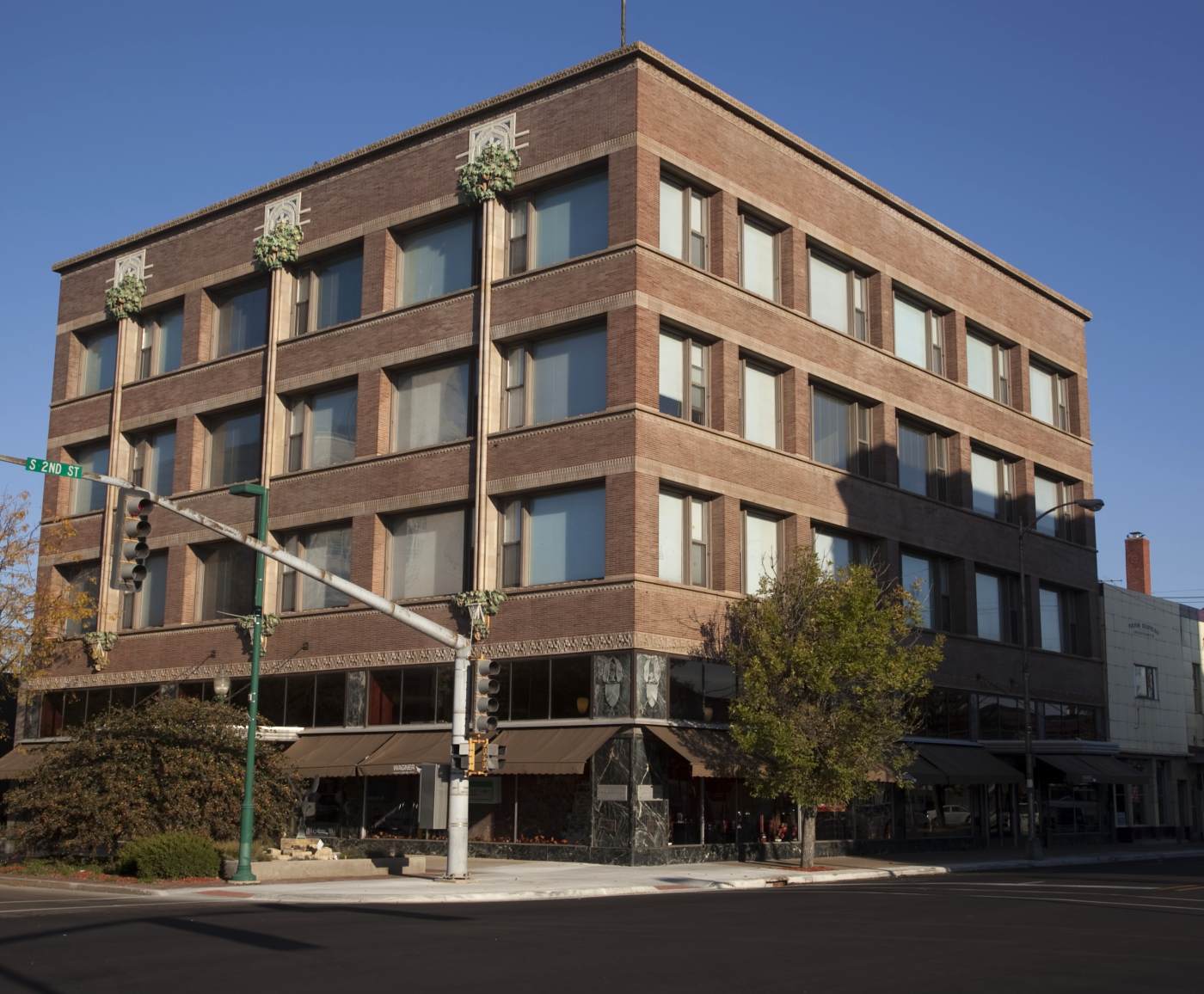
The Van Allen Building, also known as Van Allen and Company Department Store, is a four-story building commissioned by John Delbert Van Allen (1850-1928). Constructed as a department store, it now has upper floor apartments with ground-floor commercial space.
The exterior has brick spandrels and piers over the structural steel skeletal frame. Terra-cotta is used for horizontal accent banding and for three slender, vertically applied mullionan upright support separating the main panels of a large window. medallions on the façadethe front or principal face of a building, especially one elaborately constructed; a blind façade is a façade that is purely decorative and does not relate to the structure of the building. running through three storeys, from ornate corbels at the second-floor level to huge outbursts of vivid green terra-cotta foliage in the attic.
There is a very slight cornicea molded horizontal ledge along the top of a building or wall; a decorative molding between wall and roof.. Black marbleloosely applied to any hard limestone that can be sawn into thin slabs and will take a good polish so that it is suitable for decorative work; more strictly, it refers to metamorphosed limestones whose structure has been recrystallized by heat or pressure. Marbles are widely disseminated and occur in a great variety of colours and patterns, but certain types have been particularly prized by sculptors. The most famous of Greek white marbles in the ancient world was the close-grained Pentelic, which was quarried at Mount Pentelicon in Attica. The Elgin Marbles are carved in Pentelic. Widely used also were the somewhat coarser-grained translucent white marbles from the Aegean islands of Paros and Naxos. Parian marble was used for the celebrated Mausoleum at Halicarnassus. The pure white Carrara marble, quarried at Massa, Carrara, and Pietra Santa in Tuscany from the 3rd century BC, is the most famous of all sculptors' stones. It was used for the Apollo Belvedere, and was much favoured in the Renaissance, particularly by Michelangelo, who often visited the quarries to select material for his work. Neoclassical sculptors also favoured Carrara marble because of its ability to take a smooth, sleek surface, but it can look rather 'dead' compared with some of the finest Greek marbles. facing is used around the glass show windows on the first floor. The walls are made of long thin bricks in a burnt grey colour with a tinge of purple. Above the ground floor, all the windows are framed by a light grey terra-cotta.
As with Sullivan's late Midwestern banks, the Van Allen Building indicates the vigour and inventiveness of the architect during his late years. The play of the rich projecting terra-cotta ornament (particularly the three flowerlike cartouches above the fourth-floor windows) against the plain horizontal brick surfaces of the building was a design theme that he utilized in a good number of his late buildings.
@online{wga-rf7d2ef8f916399,
  author       = {Krén, Emil and Marx, Daniel},
  title        = {Van Allen Building by SULLIVAN, Louis Henry},
  organization = {{Web Gallery of Art}},
  date         = {2026-09-14},
  url          = {https://beta.wga.hu/artists/sullivan-louis-henry-r9e84bbd75553a2/van-allen-building-rf7d2ef8f916399},
  urldate      = {2026-09-14},
  langid       = {english}
}
ACCESSED 2026-09-14. REPLACE THE AUTHOR FIELD WITH THE COMMENTARY AUTHOR WHERE ONE IS NAMED.


