03 — ARTWORK
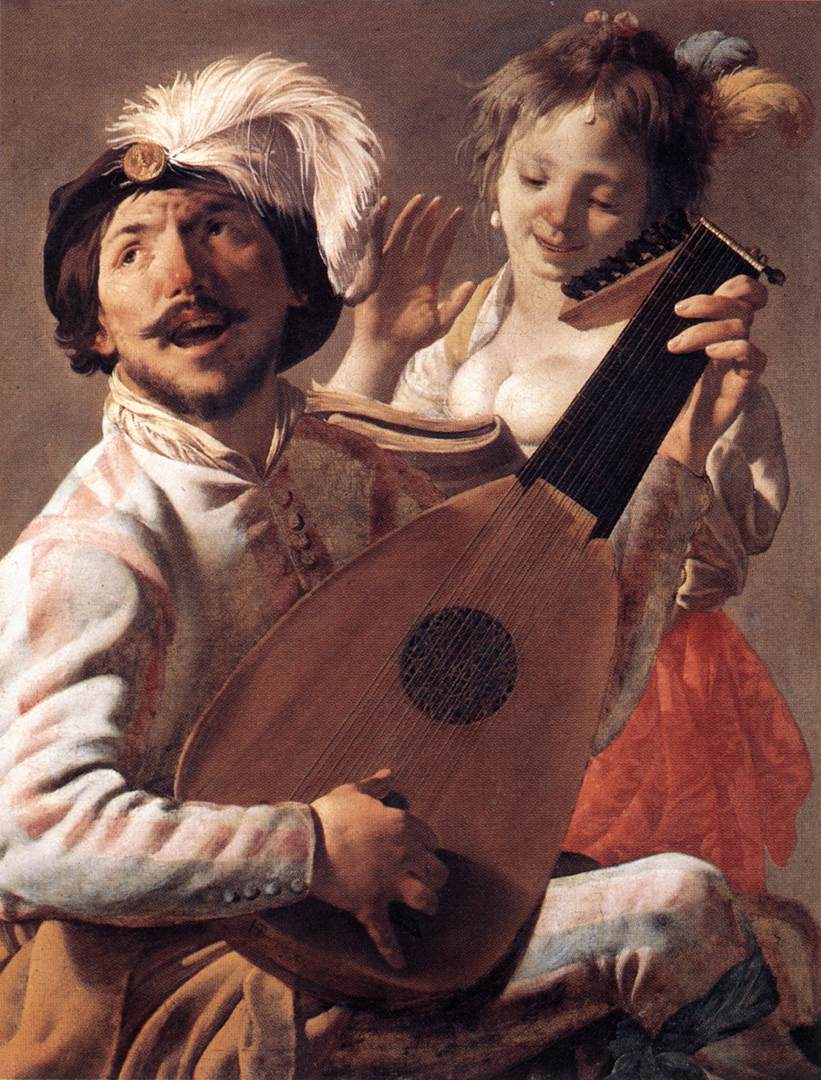
Duet
TERBRUGGHEN, Hendrick · 1628 →
- MEDIUM
- Oil on canvas, 101 x 81 cm
- TYPE
- Genre
PALETTE
HOVER OR TAP A SWATCH FOR NAME, SHARE AND HEX. SAMPLED FROM THE IMAGE — INDICATIVE, NOT A PIGMENT ANALYSIS.
DEVELOPMENT BUILD — NOT FOR PUBLIC USE. CONTRIBUTE ON GITHUB.
03 — ARTWORK
TERBRUGGHEN, Hendrick · 1628 →
PALETTE
HOVER OR TAP A SWATCH FOR NAME, SHARE AND HEX. SAMPLED FROM THE IMAGE — INDICATIVE, NOT A PIGMENT ANALYSIS.
COMMENTARY
UNDERLINED TERMS ARE DEFINED IN THE GLOSSARY.
Engravings portraying young men playing lutes in the company of young women were created with various texts during the sixteenth and seventeenth centuries. As part of a series depicting the five senses, such couples may have referred to Hearing; they may also have symbolized sanguineRed chalk with a rownish tinge, used for drawing. temperament, or, in some cases, "earth" from among the four elements, or the age of twenty. In each case, however, the common factors are youth, earthiness and full-bloodedness; these have been depicted since the Middle Ages, and all had to do with love: "Learn to play the lute and the spinet, The strings can caress the heart!" advised the poet Jacob Westerbaen (Gedichte II, The Hague, 1672). The lute often appeared on the cover illustration of hymnbooks as an erotic symbol, or as the attributeA symbolic object which is conventionally used to identify a particular person, usually a saint. In the case of martyrs, it is usually the nature of their martyrdom. of Voluptas or Luxuria.
It is thus very likely that the ornamental, double-stringed lute with its large rosetteA small architectural ornament consisting of a disc on which there is a carved or molded a circular, stylized design representing an open rose. appears in Terbrugghen's painting to express a similar idea.
In the painting of this Caravaggist artist from Utrecht the singing youths are characterized by exuberant gaiety, fully matured bodies and bright colours. The unusually colourful clothes, however, do not seem to be in accord with the fashions of the contemporary Dutch bourgeoisie. They resemble the dress of Burgundian actors from the previous century; thus they emphasize the "Bohemian" character of the two figures. The feathered beret, which was commonly used to indicate sensuality, bears special attention. The low-cut dress of the young woman is also a hint: an Amsterdam iconographic text from the sixteenth century prescribes a similar dress to express indecency. This must have been intended as a moralizing element in this otherwise rather tempting, happy scene, as these frivolous-looking paintings were always created with the aim of teaching a moral lesson. <P> <TABLE ALIGN=LEFT CELLPADDING=5 BORDER=1 WIDTH=320 BGCOLOR="#99CCCC"> <TR VALIGN=MIDDLE><TD><IMG SRC="/support/gif/listen.gif" BORDER=0 VALIGN=MIDDLE> Suggested listening (streaming mp3, 2 minutes):<BR><A HREF="#" onClick="w=window.open ('/music1/16_cent/milano_lute.html', 'newWin', 'scrollbars=yes,status=no,dependent=yes,screenX=0,screenY=0,width=350,height=350');w.opener=this;w.focus();return true"><B>Francesco da Milano: Tre fantasie for lute</B></A> </TD></TR></TABLE>
@online{wga-rc5a533787d1904,
  author       = {Krén, Emil and Marx, Daniel},
  title        = {Duet by TERBRUGGHEN, Hendrick},
  organization = {{Web Gallery of Art}},
  date         = {2026-09-09},
  url          = {https://beta.wga.hu/artists/terbrugghen-hendrick-rc5450073970782/duet-rc5a533787d1904},
  urldate      = {2026-09-09},
  langid       = {english}
}
ACCESSED 2026-09-09. REPLACE THE AUTHOR FIELD WITH THE COMMENTARY AUTHOR WHERE ONE IS NAMED.


