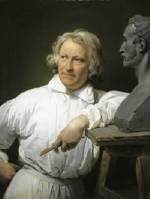
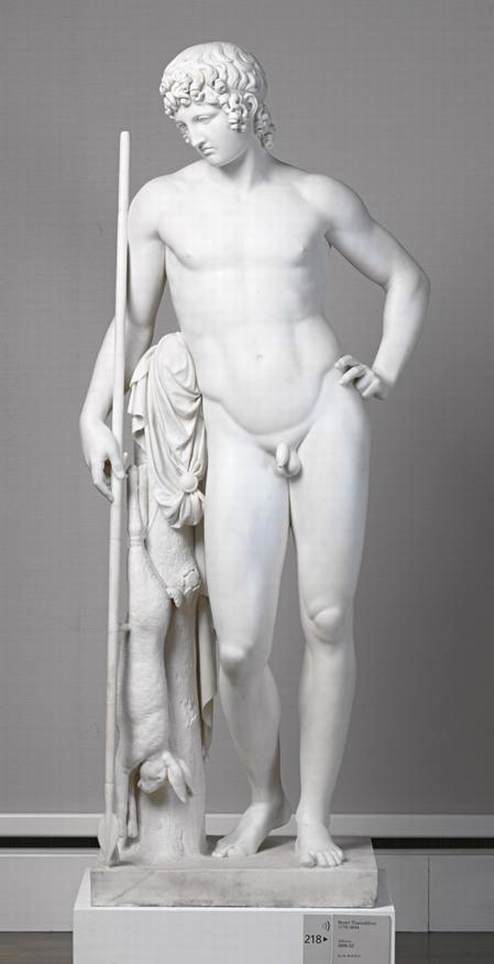
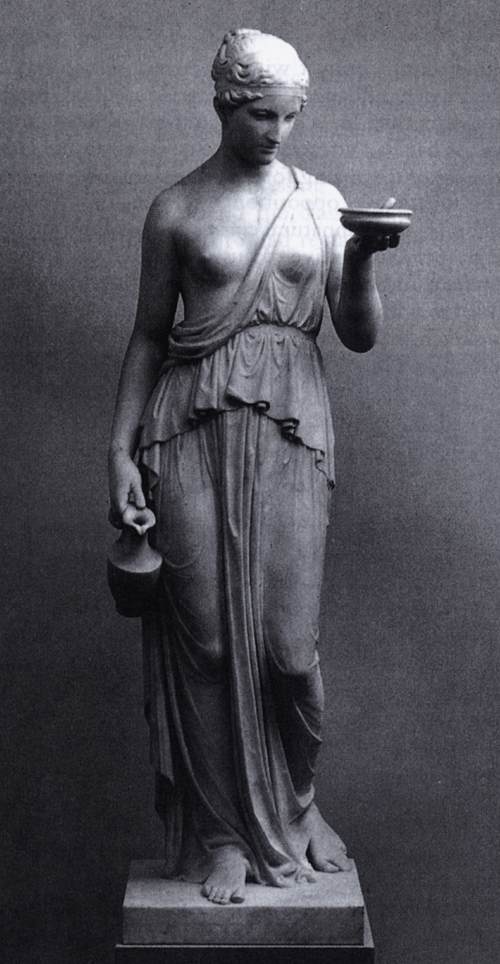
Danish sculptor, next to Canova the most celebrated sculptor of the Neoclassical movement. After five years at the Academy in his native Copenhagen, he reached Rome in 1797 on 3 March, a day which he henceforth considered as his birthday. He made his name with the statue Jason (Thorvaldsens Museum, Copenhagen, 1802-03), which was based on the Doryphoros of Polyclitus, and his growing reputation resulted in so many commissions that by 1820 he had forty assistants in his Roman workshop. In that year, when visiting Copenhagen, he began planning the decoration of the newly built church of Our Lady with marbleGLOSSARYloosely applied to any hard limestone that can be sawn into thin slabs and will take a good polish so that it is suitable for decorative work; more strictly, it refers to metamorphosed limestones whose structure has been recrystallized by heat or pressure. Marbles are widely disseminated and occur in a great variety of colours and patterns, but certain types have been particularly prized by sculptors. The most famous of Greek white marbles in the ancient world was the close-grained Pentelic, which was quarried at Mount Pentelicon in Attica. The Elgin Marbles are carved in Pentelic. Widely used also were the somewhat coarser-grained translucent white marbles from the Aegean islands of Paros and Naxos. Parian marble was used for the celebrated Mausoleum at Halicarnassus. The pure white Carrara marble, quarried at Massa, Carrara, and Pietra Santa in Tuscany from the 3rd century BC, is the most famous of all sculptors' stones. It was used for the Apollo Belvedere, and was much favoured in the Renaissance, particularly by Michelangelo, who often visited the quarries to select material for his work. Neoclassical sculptors also favoured Carrara marble because of its ability to take a smooth, sleek surface, but it can look rather 'dead' compared with some of the finest Greek marbles. statues and reliefs, a scheme which was to be his principal task for several years. His other major works include the tomb of Pius VII at St Peter's in Rome (1824-31) and a monument to Lord Byron (TrinityGLOSSARYin Christianity, the term used for the existence of one God in three persons: the Father, the Son and the Holy Spirit. College, Cambridge, 1829).
He returned finally to Denmark in 1838, a celebrity whose authority in the arts was sovereign. In Copenhagen a museum was built in his honour (1839-48), itself a remarkable piece of neo-antiqueGLOSSARYthe classical age of Greece and Rome began with the Greek migrations of the 2nd millennium BC, and ended in the West in 476 AD with the deposition of the Roman emperor Romulus Augustulus (c. 475 AD); in the East it ended in 529 AD when the Platonic Academy was closed by Justinian (482 - 565 AD). architecture, the courtyard of which contains his tomb. Thorvaldsen aimed at reviving the sublimity of Greek sculpture, but he never went to Greece and (in common with other artists of his time) bestowed his admiration mainly on late Hellenistic or Roman copies. He did, however, gain close knowledge of Greek sculpture from the restorations he made to the recently excavated sculptures from the Temple of Aphaia in Aegina, which in 1816 passed through Rome on their way to Munich (they are now in the Glyptothek there); Thorvaldsen's restorations have only recently been removed. Compared with Canova he is cool and calculating; his sculptures are more logically worked out and have great precision and clarity, but they lack Canova's sensitive surfaces.
Thorvaldsen was one of the outstanding collectors of his day, buying works by contemporary painters (notably the NazarenesGLOSSARYA group of young, idealistic German painters of the early 19th century who believed that art should serve a religious or moral purpose and desired to return to the spirit of the Middle Ages. The nucleus of the group was established in 1809 when six students at the Vienna Academy formed an association called the Brotherhood of St Luke (Lukasbrüder), named after the patron saint of painting. The name Nazarenes was given to them derisively because of their affectation of biblical dress and hairstyles. They wished to revive the working environment as well as the spiritual sincerity of the Middle Ages, and lived and worked together in a quasi-monastic fashion. In 1810 0verbeck. Pforr, and two other members moved to Rome, where they occupied the disused monastery of S. Isidore. Here they were joined by Peter von Cornelius and others. One of their aims was the revival of monumental fresco and they obtained two important commissions which made their work internationally known (Casa Bartholdy, 1816-17, the paintings are now in the Staatliche Museen, Berlin; and Casino Massimo, Rome, 1817-29). Stylistically they were much indebted to Perugino, and their work is clear and prettily coloured, but often insipid. In general, modern taste has been more sympathetic towards the Nazarenes' simple and sensitive landscape and portrait drawings than to their ambitious and didactic figure paintings. The Nazarenes broke up as a group in the 1820s, but their ideas continued to be influential. Cornelius had moved in 1819 to Munich, where he surrounded himself with a large number of pupils and assistants who in turn carried his style to other German centres. The studio of Overbeck (the only one to remain permanently in Rome) was a meeting-place for artists from many countries; Ingres admired him and Ford Madox Brown visited him. William Dyce introduced some of the Nazarene ideals into English art and there is a kinship of spirit with the Pre-Raphaelites.) as well as ancient works (now in the Thorvaldsens Museum).