03 — ARTWORK
The Last Judgment
- MEDIUM
- Oil on canvas, 1450 x 590 cm
- TYPE
- Religious
PALETTE
HOVER OR TAP A SWATCH FOR NAME, SHARE AND HEX. SAMPLED FROM THE IMAGE — INDICATIVE, NOT A PIGMENT ANALYSIS.
DEVELOPMENT BUILD — NOT FOR PUBLIC USE. CONTRIBUTE ON GITHUB.
03 — ARTWORK
PALETTE
HOVER OR TAP A SWATCH FOR NAME, SHARE AND HEX. SAMPLED FROM THE IMAGE — INDICATIVE, NOT A PIGMENT ANALYSIS.
COMMENTARY
UNDERLINED TERMS ARE DEFINED IN THE GLOSSARY.
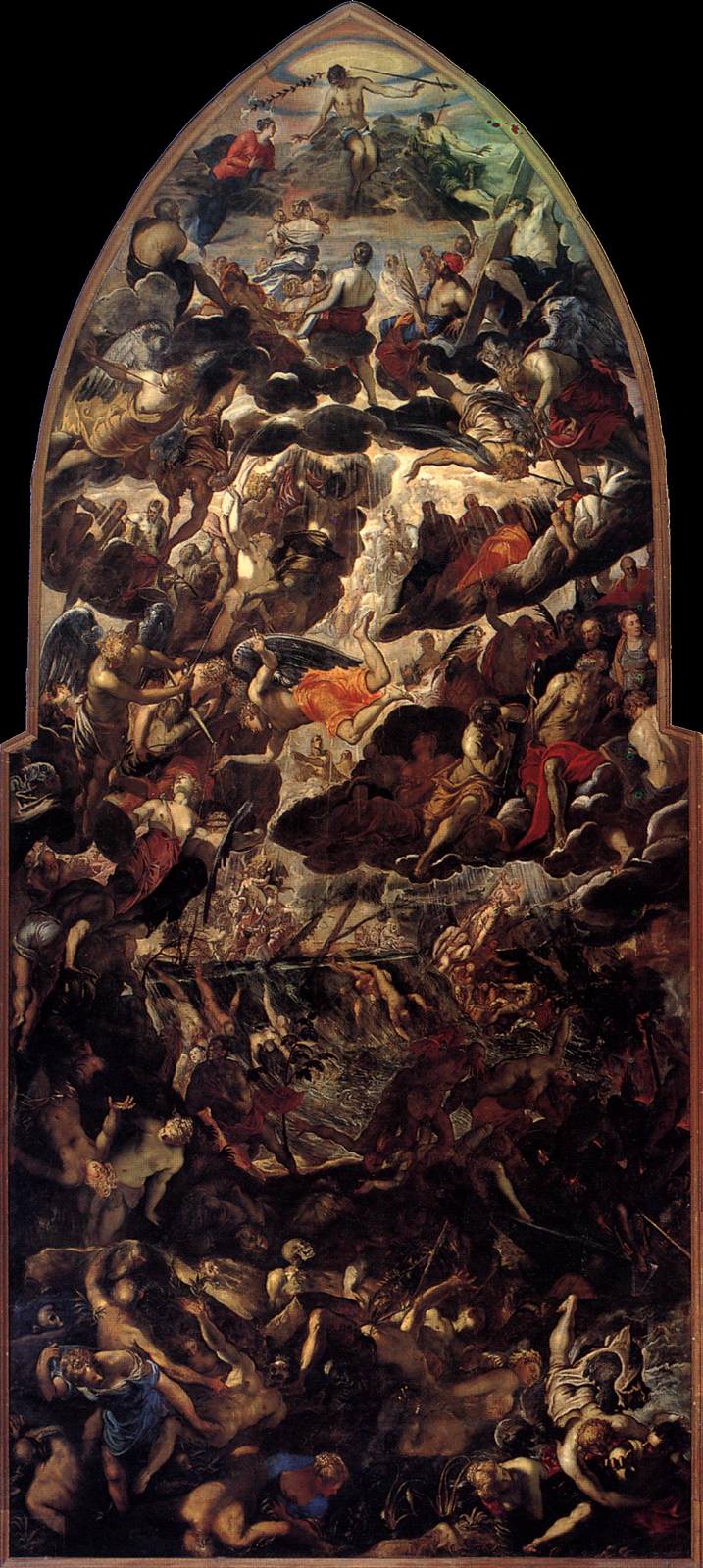
In the years when Veronese was producing his monumental banqueting scenes, Tintoretto also painted some large scale works: the Adoration of the Golden Calf and the Last Judgment in the presbyteryThe raised space at the end of a church's nave which contains the high altar and is reserved for members of the clergy. of Madonna dell'Orto are both almost fifteen meters high. The difference between the painters is evident. Veronese's works are brilliantly variegated, but Tintoretto deliberately dispenses with harmony and composure. Instead he favours a glaring, sultry light, in which the tense postures of the figures and the strained perspectiveThe method of representing three-dimensional objects on a flat surface. Perspective gives a picture a sense of depth. The most important form of perspective in the Renaissance was linear perspective (first formulated by the architect Brunelleschi in the early 15th century), in which the real or suggested lines of objects converge on a vanishing point on the horizon, often in the middle of the composition (centralized perspective). The first artist to make a systematic use of linear perspective was Masaccio, and its principles were set out by the architect Alberti in a book published in 1436. The use of linear perspective had a profound effect on the development of Western art and remained unchallenged until the 20th century. are used for expressive effect.
Tintoretto's Last Judgment is a systematic summary of Titian's and Michelangelo's great models in a judgment that resembles a flood. The height of the painting and a skilful manipulation of the point of view enable the artist to create the illusion that the slanting cosmic deluge is pouring over to the viewer.
Iconographically, this is probably Tintoretto's most complex painting, and it has still not been fully interpreted. The artist shows the Last Judgment as a raging elemental event of cosmic dimensions. If, as is often claimed, Tintoretto ever strove to achieve a synthesis of Titian and Michelangelo, then it was here, where he combines the composition of the Gloria of 1553 for Charles V with the monumentality of the wall painting of the Sistine Chapela small separate place for worship, either part of a large church or a separate building.. As in late medieval northern panel paintingPainting on wooden panels. Until the introduction of canvas in the 15th century, wooden panels were the standard support in painting., Christ is shown as judge of the world, with the lily of mercy and the sword of righteousness, while the Virgin Mary and John the Baptist intercede for resurrected mankind. A particularly unusual feature is the depiction of The Last Judgment as a catastrophe involving flooding.
@online{wga-rfca621c08d4a3c,
  author       = {Krén, Emil and Marx, Daniel},
  title        = {The Last Judgment by TINTORETTO, Jacopo},
  organization = {{Web Gallery of Art}},
  date         = {2026-09-13},
  url          = {https://beta.wga.hu/artists/tintoretto-jacopo-rd67c173db626ef/the-last-judgment-rfca621c08d4a3c},
  urldate      = {2026-09-13},
  langid       = {english}
}
ACCESSED 2026-09-13. REPLACE THE AUTHOR FIELD WITH THE COMMENTARY AUTHOR WHERE ONE IS NAMED.


