03 — ARTWORK
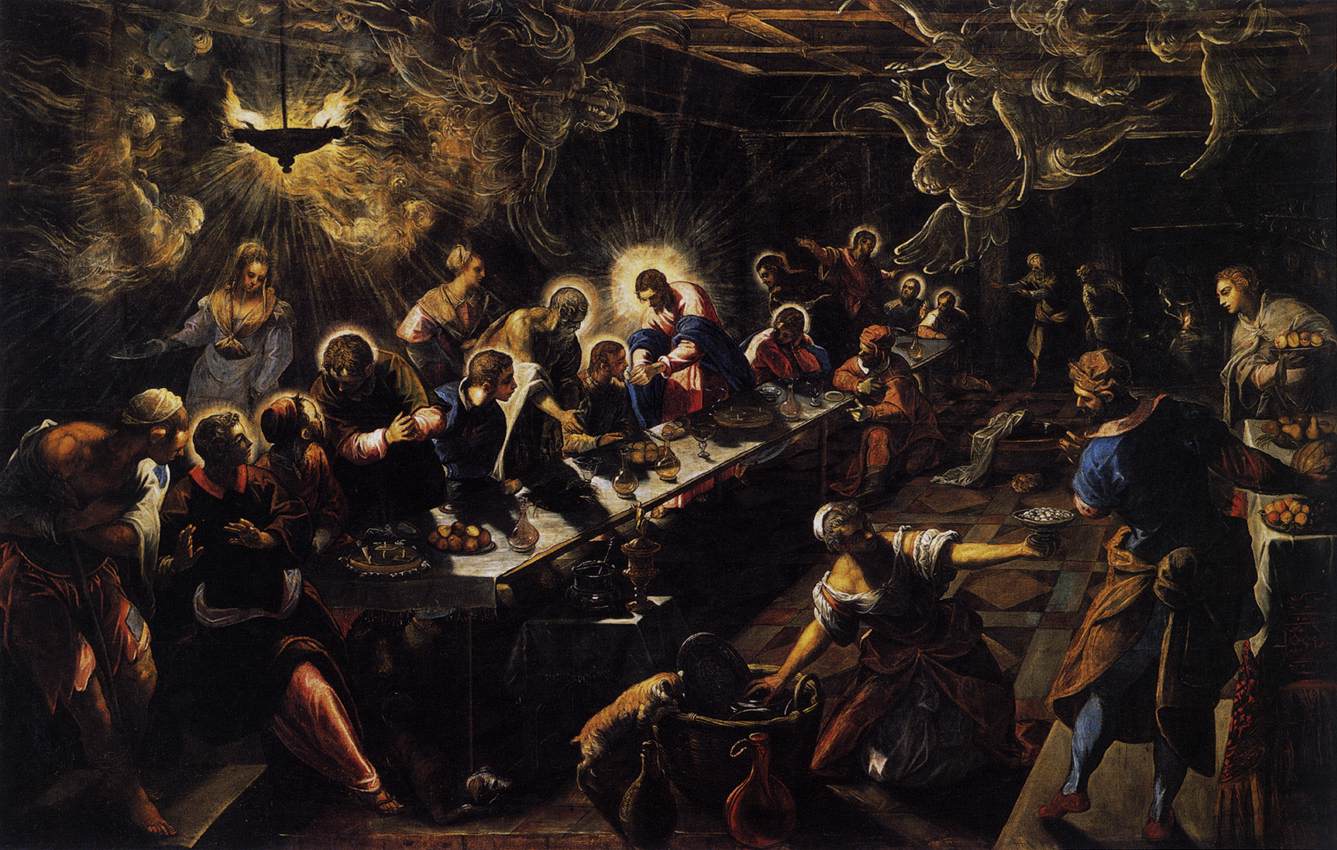
The Last Supper
- MEDIUM
- Oil on canvas, 365 x 568 cm
- TYPE
- Religious
PALETTE
HOVER OR TAP A SWATCH FOR NAME, SHARE AND HEX. SAMPLED FROM THE IMAGE — INDICATIVE, NOT A PIGMENT ANALYSIS.
DEVELOPMENT BUILD — NOT FOR PUBLIC USE. CONTRIBUTE ON GITHUB.
CURRENT LOCATION · San Giorgio Maggiore
03 — ARTWORK
PALETTE
HOVER OR TAP A SWATCH FOR NAME, SHARE AND HEX. SAMPLED FROM THE IMAGE — INDICATIVE, NOT A PIGMENT ANALYSIS.
COMMENTARY
UNDERLINED TERMS ARE DEFINED IN THE GLOSSARY.
The church of San Giorgio Maggiore was built on the San Giorgio Island between 1566 and 1600 using the design of Palladio. After 1590 the workshop of Tintoretto was commissioned to paint big canvases for decorating it. Due the large number of commissions, Tintoretto in his late years increasingly relied on his coworkers. However, three surviving paintings placed in a chapela small separate place for worship, either part of a large church or a separate building. consacrated in 1592 - The Jews in the Desert, The Last SupperChrist's last meal with His disciples before His arrest and trial; the rite of communion is based on this. One of most famous depictions of the event is a fresco painted by Leonardo da Vinci. and The Entombment - were certainly painted by Tintoretto himself.
Tintoretto painted the Last Supper several times in his life. This version can be described as the fest of the poors, in which the figure of Christ mingles with the crowds of apostles. However, a supernatural scene with winged figures comes into sight by the light around his head. This endows the painting with a visional character clearly differentiating it from paintings of the same subject made by earlier painters like Leonardo.
The curious diagonal position of the table for the Last Supper is explained by the installation of the painting on the right wall of the presbyteryThe raised space at the end of a church's nave which contains the high altar and is reserved for members of the clergy. of San Giorgio Maggiore. The table was to be perceived by visitors to the church as an extension in perspectiveThe method of representing three-dimensional objects on a flat surface. Perspective gives a picture a sense of depth. The most important form of perspective in the Renaissance was linear perspective (first formulated by the architect Brunelleschi in the early 15th century), in which the real or suggested lines of objects converge on a vanishing point on the horizon, often in the middle of the composition (centralized perspective). The first artist to make a systematic use of linear perspective was Masaccio, and its principles were set out by the architect Alberti in a book published in 1436. The use of linear perspective had a profound effect on the development of Western art and remained unchallenged until the 20th century. of the high altar, or conversely the high altar was to be seen as a prolongation of the table for the Last Supper. The priestly bearing of Christ and the liturgical utensils on the small side table play on the same connection. The winged apparitions characterize the Eucharistthe sacrament of Holy Communion, celebrated with bread and wine, the most sacred moment of the Christian liturgy. as the "bread of angels" (St Thomas Aquinas) and in their non-material, other-worldly nature indicate the mystery of transubstantiation (the transformation of bread and wine into the body and blood of Christ). While the composition of The Last Supper as a whole follows a wall hanging by Giulio Romano depicting the Passover, the detail of the eerily flickering candlestick was suggested by a Crowning with Thorns by Titian (Alte Pinakothek, Munich), which Tintoretto had acquired from the master's estate when he died.
@online{wga-r09474fa5b87c50,
  author       = {Krén, Emil and Marx, Daniel},
  title        = {The Last Supper by TINTORETTO, Jacopo},
  organization = {{Web Gallery of Art}},
  date         = {2026-09-13},
  url          = {https://beta.wga.hu/artists/tintoretto-jacopo-rd67c173db626ef/the-last-supper-r09474fa5b87c50},
  urldate      = {2026-09-13},
  langid       = {english}
}
ACCESSED 2026-09-13. REPLACE THE AUTHOR FIELD WITH THE COMMENTARY AUTHOR WHERE ONE IS NAMED.


