03 — ARTWORK
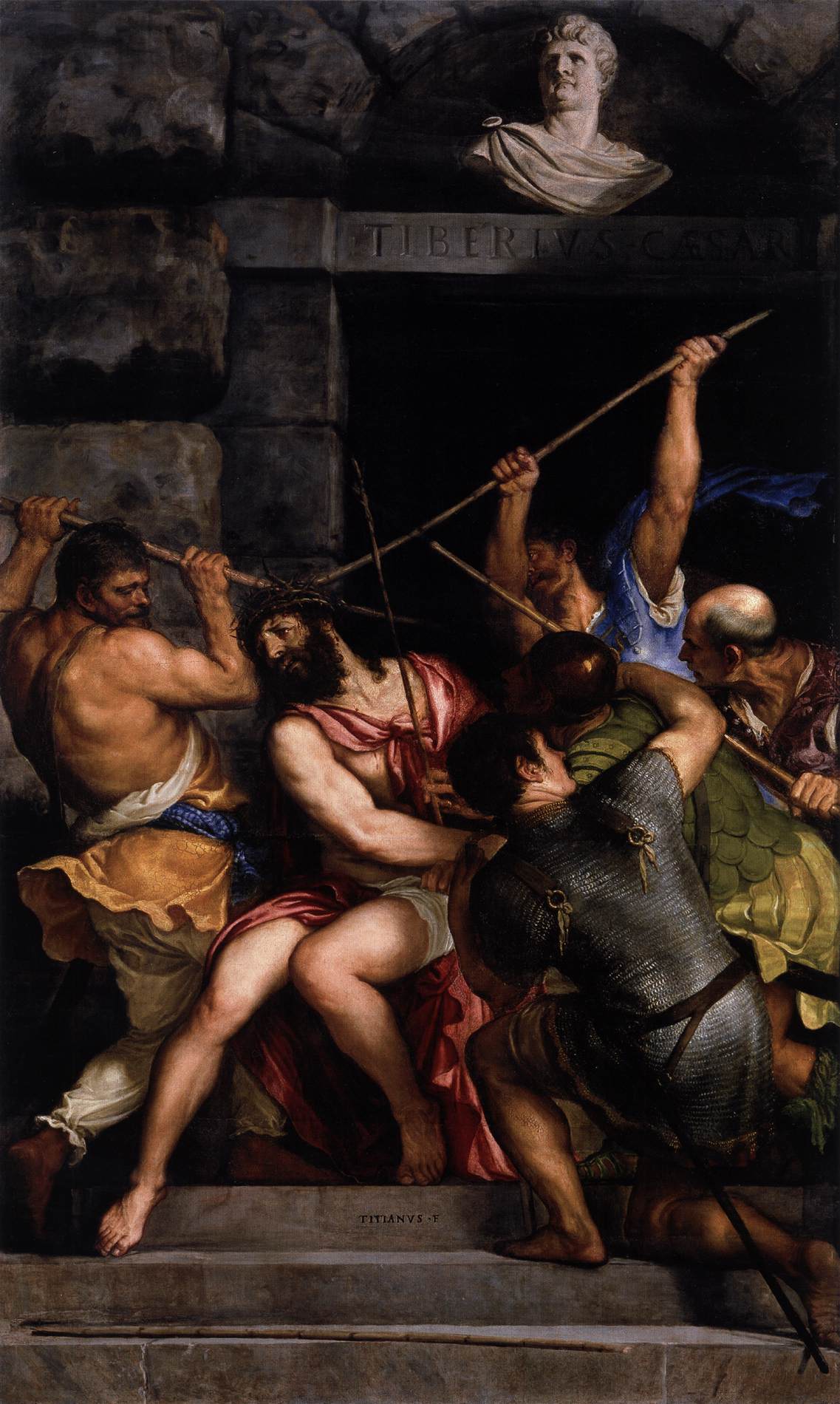
Crowning with Thorns
- MEDIUM
- Oil on panel, 303 x 181 cm
- TYPE
- Religious
PALETTE
HOVER OR TAP A SWATCH FOR NAME, SHARE AND HEX. SAMPLED FROM THE IMAGE — INDICATIVE, NOT A PIGMENT ANALYSIS.
DEVELOPMENT BUILD — NOT FOR PUBLIC USE. CONTRIBUTE ON GITHUB.
CURRENT LOCATION · Musée du Louvre
03 — ARTWORK
PALETTE
HOVER OR TAP A SWATCH FOR NAME, SHARE AND HEX. SAMPLED FROM THE IMAGE — INDICATIVE, NOT A PIGMENT ANALYSIS.
COMMENTARY
UNDERLINED TERMS ARE DEFINED IN THE GLOSSARY.
In the Crowning with Thorns, painted for the church of Santa Maria delle Grazie in Milan, the space is compressed in the scene by arranging the figures on a shallow plane delimited by the wall of a building. There are explicit references to antiquity: the figure of Christ derives from the celebrated Laocoon, an antiquethe classical age of Greece and Rome began with the Greek migrations of the 2nd millennium BC, and ended in the West in 476 AD with the deposition of the Roman emperor Romulus Augustulus (c. 475 AD); in the East it ended in 529 AD when the Platonic Academy was closed by Justinian (482 - 565 AD). statue discovered in Rome in 1506, an archetypal exemplum doloris ("example of pain"). Another famous antique sculptural fragment, the Belvedere Torso, provides the model for the upper body of the torturer on the left. With the inclusion of the bust of Tiberius Caesar, a direct reference to the Roman authorities who condemned Christ, Titian also pays homage to the classicalRelating to the culture of ancient Greece and Rome (classical Antiquity). The classical world played a profoundly important role in the Renaissance, with Italian scholars, writers, and artists seeing their own period as the rebirth (the "renaissance") of classical values after the Middle Ages. The classical world was considered the golden age for the arts, literature, philosophy, and politics. Concepts of the classical, however, changed greatly from one period to the next. Roman literature provided the starting point in the 14th century, scholars patiently finding, editing and translating a wide range of texts. In the 15th century Greek literature, philosophy and art - together with the close study of the remains of Roman buildings and sculptures-expanded the concept of the classical and ensured it remained a vital source of ideas and inspiration. past.
This is a brutal scene, in which Christ's tormentors twist the crown onto his head with their canes, but the violence is relieved and Christ's suffering exalted by the beauty of the colours, which especially in the blue and green to the right are colder than usual in deference to Titian's Roman sources. In Christ's foot extended on the steps, however, Titian pulls out all the Venetian stops and one can sense the blood flowing through the veins under the flesh. The pattern of the canes slices through the massed figures like the strokes of a knife, forming a Trinitarian triangle to the right of Christ's head. An inimitable Titian touch is the cane lying unused on the foremost step, still, shadowless and deadly, like a snake.
@online{wga-r779aa35a29b1d9,
  author       = {Krén, Emil and Marx, Daniel},
  title        = {Crowning with Thorns by TIZIANO Vecellio},
  organization = {{Web Gallery of Art}},
  date         = {2026-09-13},
  url          = {https://beta.wga.hu/artists/tiziano-vecellio-rf16f53052a933d/crowning-with-thorns-r779aa35a29b1d9},
  urldate      = {2026-09-13},
  langid       = {english}
}
ACCESSED 2026-09-13. REPLACE THE AUTHOR FIELD WITH THE COMMENTARY AUTHOR WHERE ONE IS NAMED.


