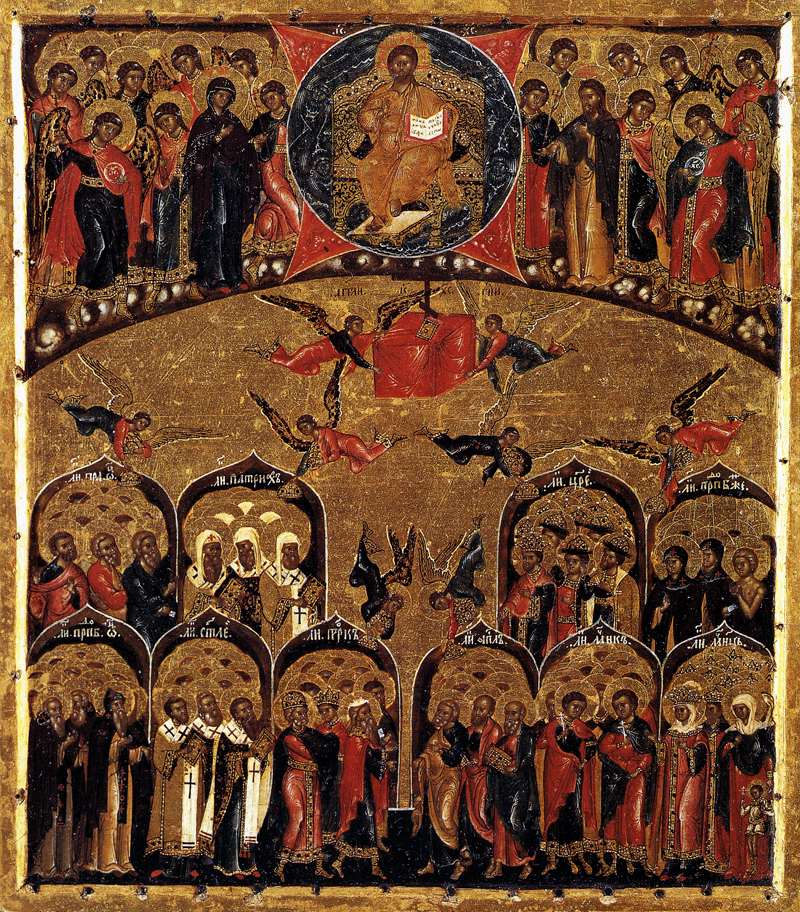
This icona small, portable painting in the Orthodox Church. The form and colours are strictly idealized and unnatural. The cultic worship of icons was a result of traditionally prescribed patterns of representation in terms of theme and form, for it was believed that icons depicted the original appearances of Christ, Mary and the saints., inspired by representations of the Last Judgment, is in fact an iconographic illustration of the feast of All Saints, which the Byzantine Church celebrates on the first Sunday after Pentecost. This feast had in fact been established in memory of the Resurrection of our Lord and of those of his precursors or followers who had already been crowned in heaven: patriarchs of the Old Testament, prophets, kings, contemporaries of Christ who had joined him and followed his teaching, preachersThe field of preaching was dominated by the religious orders, primarily the mendicants. Quite apart from the notorious incompetence of the secular clergy, members of regular orders were the acknowledged masters of pulpit oratory, of the sermon as an art form. This pre-eminence was not challenged even in the 16th century, when reformers called for the secular clergy engaged in the pastoral ministry, bishops especially, to discharge their preaching duties. The great preaching events of the year were still the Lenten sermons given by friars or monks of repute; star preachers journeyed all over Italy. The major collections of sermons published in the 16th century came from friars or monks, several of whom became bishops; sermons of bishops not drawn from the orders are hard to find. Outstanding preachers of the 15th century whose sermons are extant are the Franciscans S. Bernardino da Siena and Bernardino da Feltre (d. 1494), together with the Dominican Savonarola. For the 16th century there are the Capuchin Ochino; the Franciscans Franceschino Visdomini (1514-73), Cornelio Musso (1511-74), bishop of Bertinoro and Bitonto, and Francesco Panigarola (1548-94), bishop of Asti; the Augustinian Canon Gabriele Fiamma (1533-85), bishop of Chioggia; and, from the secular clergy, Borromeo. The call to repentance was a major feature of Lenten sermons: here Bernardino da Feltre stood out for his harsh, minatory exhortations; Savonarola and Musso, in their appeals for communal religious renewal, took on the dramatic role of Old Testament prophets as if laying claim to divine inspiration. Mendicants of the 15th century castigated the vices of society, not least those of statesmen and prelates, but 16th century ones were more cautious here. The styles of S. Bernardino da Siena and Bernardino da Feltre were earthy, abrasive even; Savonarola's by contrast was cultivated and his last sermons were complex and arcane; Ochino's unadorned style was peculiarly limpid and conveys a winged emotionality. The sermons of Visdomini, Musso and Panigarola on the other hand often strain after emotional effect by accumulation of rhetoric and largesse of poetic vocabulary; Panigarola is particularly noted for his literary conceits and has been viewed as a significant precursor of the literary Baroque. Fiamma's sermons, however, are not florid in style; his forte was allegorical explication of scriptural references. The flow of Borromeo's grandiose and sometimes emotive style shows how he, by contrast with the mendicant preachers, was versed in classical and patristic rhetoric. In general 16th century sermons were very free in their formal organization and in no way bound to the principles of construction laid down in medieval preaching manuals., hermits, martyrs, hierarchs, priests, devout kings, and defenders of the Church.