03 — ARTWORK
The Nativity
UNKNOWN MASTER, Austrian · 1400 →
- MEDIUM
- Tempera on walnut, 41 x 29,5 cm
- TYPE
- Religious
PALETTE
HOVER OR TAP A SWATCH FOR NAME, SHARE AND HEX. SAMPLED FROM THE IMAGE — INDICATIVE, NOT A PIGMENT ANALYSIS.
DEVELOPMENT BUILD — NOT FOR PUBLIC USE. CONTRIBUTE ON GITHUB.
03 — ARTWORK
UNKNOWN MASTER, Austrian · 1400 →
PALETTE
HOVER OR TAP A SWATCH FOR NAME, SHARE AND HEX. SAMPLED FROM THE IMAGE — INDICATIVE, NOT A PIGMENT ANALYSIS.
COMMENTARY
UNDERLINED TERMS ARE DEFINED IN THE GLOSSARY.
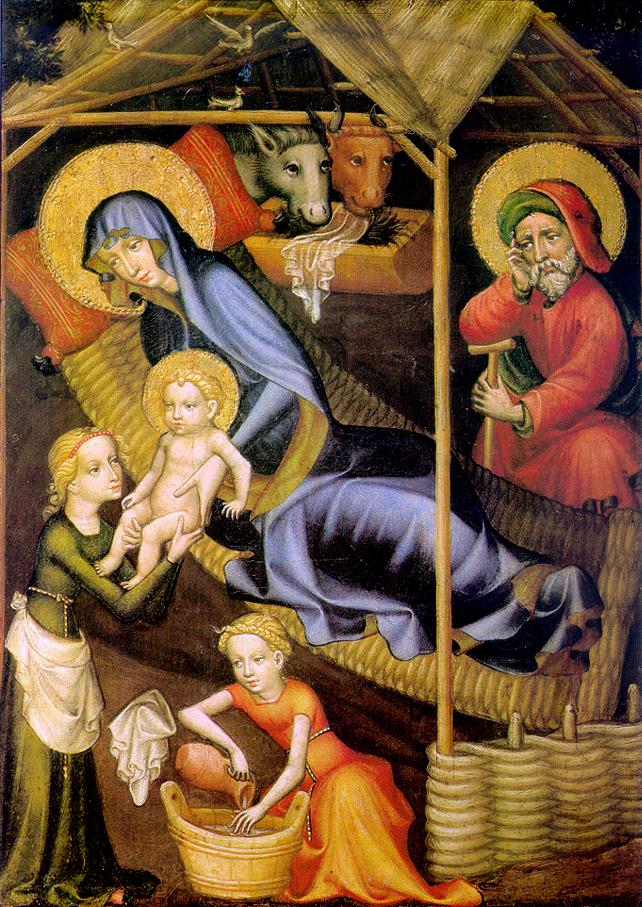
The Nativity c. 1400 TemperaA method of painting in which the pigments are mixed with an emulsion of water and egg yolks or whole eggs (sometimes glue or milk). Tempera was widely used in Italian art in the 14th and 15th centuries, both for panel painting and fresco, then being replaced by oil paint. Tempera colors are bright and translucent, though because the paint dried very quickly there is little time to blend them, graduated tones being created by adding lighter or darker dots or lines of color to an area of dried paint. on walnut, 41 x 29,5 cm Galerie mittelalterlicher österreichischer Kunst, Vienna
The artist of this painting is referred to as Master of Salzburg.
In this picture the scene of the Nativity is represented according to an apocryphal story of the Gospel: the Virgin is reclining on her bed while two midwives are on the point of giving a bath to the Infant. The woman in green is taking the Child from His mother, while the other is taking care that the bathwater is at right temperature. The bath puts an emphasis on the human aspect of the divine Child and is a hint to baptism. Joseph is seated on the right-hand side deep in thought. He holds his staff with his left hand, and is supporting his head with his right hand. The ox and the ass at the manger in the back seem to warm the straw and the small cambric kerchief with their breath.
In addition to some stylistic resemblances the painting is reminiscent in other respects too of the Trebon Master's picture of the same scene. In both pictures the composition is divided by the building of the stable, with the difference that here the supports of the stable look like the frame of the scene represented, and divide the surface into two parts and not into three. In both pictures the supporting pole, emphatically placed in the foreground, separates Joseph, who views the events from the back and plays a role similar to the spectator's. In this picture too we can see birds on the roof of the stable, but they are shaped more firmly and realistically (as are the figures) than in the work of the Master of Trebon.
In spite of the simplicity of the presentation and the somewhat rugged shaping of the figures with their rather large heads the susceptibility of the International GothicEuropean art was characteristic of a rare uniformity for 60-70 years around 1400. Art historians have still not been able to come to an agreement on an appropriate name for it. The term "art around 1400" suits the style best which, because of its prevalence is referred to as international Gothic. The terms court style, soft style, beautiful style, trecento rococo and lyrical style, etc. are also used in art literature. Elements of style which were generally wide-spread, did not belong to any particular country and were characteristic of art in courts. In the second half of the 14th century, models appeared in court art in the circle of French-Flemish artists serving at French courts and Bohemian regions of the Emperor's Court which determined works of art all over Europe at the end of the century. Human figures, landscapes and spaces in a realistic approach were accompanied by a peculiar quality of dreams, decorative dynamism and deep emotional charge. It is called as a soft style on the basis of lyrical expressions and drapes: it is more than a simple system of formal motifs, it denominates a kind of behaviour. Artists of the period were engaged in learning the human soul until their attention was attracted to the world (e.g. Donatallo, Masaccio and Jan van Eyck). style to elegance and decorative patterns evinces itself in this painting too. The elegance can be seen in the buoyant lines of the draperies, and in the Virgin's mantleAn overcoat, worn open, popular during the second half of the 15th century and the 16th century and often lined with fur along the hem and around the collar. It reached to the knee or foot, depending on the social class of the wearer., which clings to her body as if it were wet; the decorativeness in the way in which the painter has used the opportunities inherent in the rustic surroundings, and brought into harmony the pattern of the thatched roof, the mat and the fence, which are made of similar materials, and there is an additional harmonious touch in the plaited hair of one of the midwives.
As in a great many other pictures of the period the ground is exceedingly steep here; compared to the figures in the foreground the stable seems to be high, on the other hand the beam underneath the roof touches the animals' heads. Although the white piece of cloth between the two midwives-in all probability a napkin, another symbol of the human nature of Jesus-looks as though it were hovering, in fact it lies on the ground. All this is not surprising, since these forms do not convey space, they are meant, first and foremost, to fill up the surface of the picture.
@online{wga-r124be98af91933,
  author       = {Krén, Emil and Marx, Daniel},
  title        = {The Nativity by UNKNOWN MASTER, Austrian},
  organization = {{Web Gallery of Art}},
  date         = {2026-09-12},
  url          = {https://beta.wga.hu/artists/unknown-master-austrian-rb52dcd7729a57b/the-nativity-r124be98af91933},
  urldate      = {2026-09-12},
  langid       = {english}
}
ACCESSED 2026-09-12. REPLACE THE AUTHOR FIELD WITH THE COMMENTARY AUTHOR WHERE ONE IS NAMED.