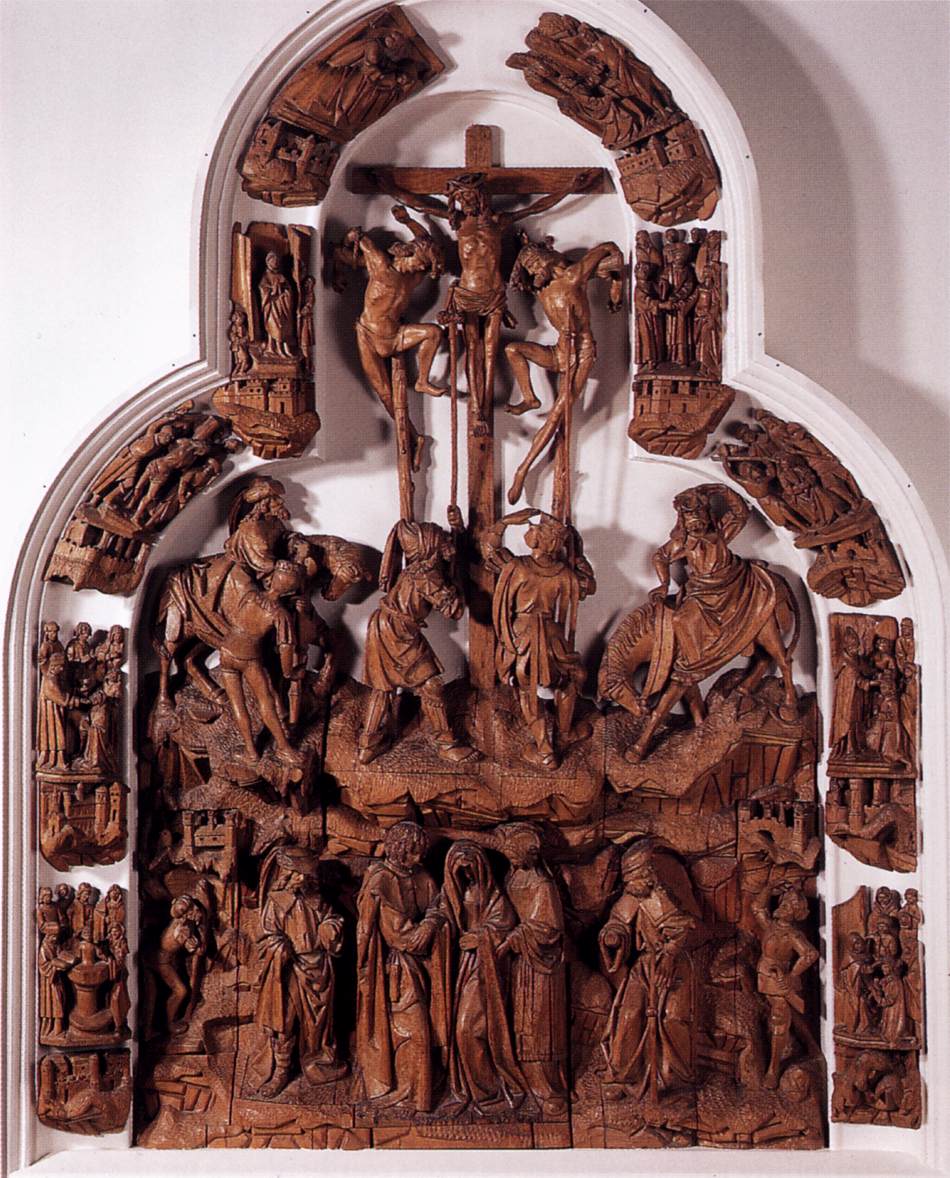
03 — ARTWORK
Altar retable
UNKNOWN MASTER, Flemish · 1520 →
- MEDIUM
- Wood, 183 x 142 cm
- TYPE
- Religious
PALETTE
HOVER OR TAP A SWATCH FOR NAME, SHARE AND HEX. SAMPLED FROM THE IMAGE — INDICATIVE, NOT A PIGMENT ANALYSIS.
DEVELOPMENT BUILD — NOT FOR PUBLIC USE. CONTRIBUTE ON GITHUB.
03 — ARTWORK
UNKNOWN MASTER, Flemish · 1520 →
PALETTE
HOVER OR TAP A SWATCH FOR NAME, SHARE AND HEX. SAMPLED FROM THE IMAGE — INDICATIVE, NOT A PIGMENT ANALYSIS.
COMMENTARY
UNDERLINED TERMS ARE DEFINED IN THE GLOSSARY.
This sculpture from an altar retableOrnamental panel behind an altar and, in the more limited sense, the shelf behind an altar on which are placed the crucifix, candlesticks, and other liturgical objects. The panel is usually made of wood or stone, though sometimes of metal, and is decorated with paintings, statues, or mosaics depicting the Crucifixion or a similar subject. Although frequently forming part of the architectural structure of the church, especially in the High Gothic period, retables can be detached and, sometimes, as in the case of the famous retable by Hubert and Jan van Eyck, "The Adoration of the Lamb" (1432, Cathedral of Saint-Bavon, Ghent), consist merely of a painting. Probably the most well-known retable is that in the Basilica of St Mark in Venice, which is one of the most remarkable examples in existence of the craft of the jeweler and goldsmith. Originally commissioned in 976, the St. Mark's retable was enlarged and enriched in the 13th century. With the development of freestanding altars, retables have become extinct. was produced by an Antwerp workshop specialized in making carved altarpieceA picture or sculpture that stands on or is set up behind an altar. The term reredos is used for an ornamental screen or partition, not directly attached to the altar table but affixed to the wall behind it. A diptych is an altarpiece consisting of two panels, a triptych one of three panels, and a polyptych one of four or more panels. From the 14th to 16th century, the altarpiece was one of the most important commissions in European art; it was through the altarpiece that some of the most decisive developments in painting and sculpture came about. parts.
@online{wga-re6078fe8fb5b7c,
  author       = {Krén, Emil and Marx, Daniel},
  title        = {Altar retable by UNKNOWN MASTER, Flemish},
  organization = {{Web Gallery of Art}},
  date         = {2026-09-13},
  url          = {https://beta.wga.hu/artists/unknown-master-flemish-r352cb7184742a1/altar-retable-re6078fe8fb5b7c},
  urldate      = {2026-09-13},
  langid       = {english}
}
ACCESSED 2026-09-13. REPLACE THE AUTHOR FIELD WITH THE COMMENTARY AUTHOR WHERE ONE IS NAMED.


