03 — ARTWORK
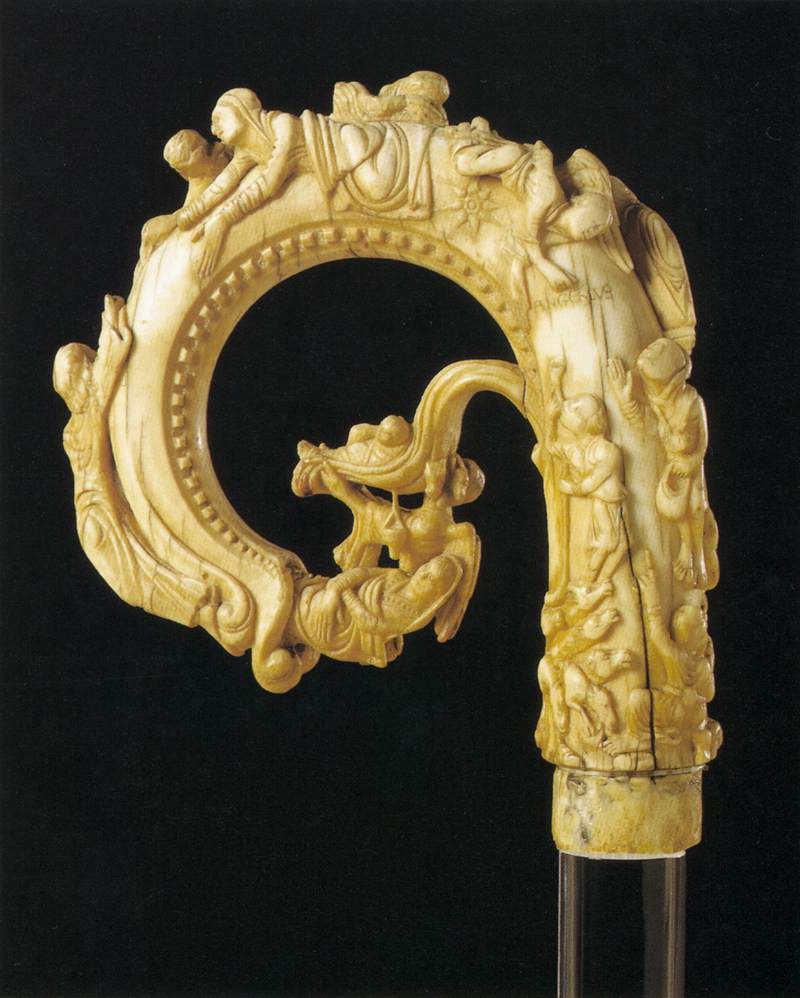
Crozier
UNKNOWN MASTER, French · 1150 →
- MEDIUM
- Ivory, height 13 cm
- TYPE
- Religious
PALETTE
HOVER OR TAP A SWATCH FOR NAME, SHARE AND HEX. SAMPLED FROM THE IMAGE — INDICATIVE, NOT A PIGMENT ANALYSIS.
DEVELOPMENT BUILD — NOT FOR PUBLIC USE. CONTRIBUTE ON GITHUB.
03 — ARTWORK
UNKNOWN MASTER, French · 1150 →
PALETTE
HOVER OR TAP A SWATCH FOR NAME, SHARE AND HEX. SAMPLED FROM THE IMAGE — INDICATIVE, NOT A PIGMENT ANALYSIS.
COMMENTARY
UNDERLINED TERMS ARE DEFINED IN THE GLOSSARY.
A natural product, ivory has been widely used in the production of small works of art from the late ClassicalRelating to the culture of ancient Greece and Rome (classical Antiquity). The classical world played a profoundly important role in the Renaissance, with Italian scholars, writers, and artists seeing their own period as the rebirth (the "renaissance") of classical values after the Middle Ages. The classical world was considered the golden age for the arts, literature, philosophy, and politics. Concepts of the classical, however, changed greatly from one period to the next. Roman literature provided the starting point in the 14th century, scholars patiently finding, editing and translating a wide range of texts. In the 15th century Greek literature, philosophy and art - together with the close study of the remains of Roman buildings and sculptures-expanded the concept of the classical and ensured it remained a vital source of ideas and inspiration. era onwards. African ivory imported via Venice and other Italian ports was the most commonly used. Of equal importance, however, were the teeth of hippopotami, narwhals, sperm whales and walruses. Even brown rhinoceros horn was so similar to ivory that it was considered an equally valuable resource. The popularity of medieval carvings and sculptures in ivory lasted right into the twelfth century. Apart from the production of small sculptures, ivory found other uses, but these were mainly religious ones for liturgical purposes.
On this crozierThe crook-shaped staff carried by a bishop. The crook is intended to resemble a shepherd's crook, i.e. it symbolizes the shepherd (the bishop) looking after his flock., coming from the area ruled by the Plantagenets, scenes from the childhood of Christ and the life of St Nicholas are depicted.
@online{wga-r6ec3c9ecfb568c,
  author       = {Krén, Emil and Marx, Daniel},
  title        = {Crozier by UNKNOWN MASTER, French},
  organization = {{Web Gallery of Art}},
  date         = {2026-09-09},
  url          = {https://beta.wga.hu/artists/unknown-master-french-r2b942644e40f91/crozier-r6ec3c9ecfb568c},
  urldate      = {2026-09-09},
  langid       = {english}
}
ACCESSED 2026-09-09. REPLACE THE AUTHOR FIELD WITH THE COMMENTARY AUTHOR WHERE ONE IS NAMED.


