03 — ARTWORK
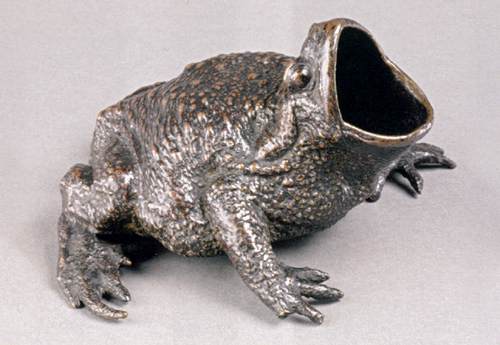
Toad
UNKNOWN MASTER, Italian · 1510 →
- MEDIUM
- Bronze, diameter cm
- TYPE
- Other
PALETTE
HOVER OR TAP A SWATCH FOR NAME, SHARE AND HEX. SAMPLED FROM THE IMAGE — INDICATIVE, NOT A PIGMENT ANALYSIS.
DEVELOPMENT BUILD — NOT FOR PUBLIC USE. CONTRIBUTE ON GITHUB.
03 — ARTWORK
UNKNOWN MASTER, Italian · 1510 →
PALETTE
HOVER OR TAP A SWATCH FOR NAME, SHARE AND HEX. SAMPLED FROM THE IMAGE — INDICATIVE, NOT A PIGMENT ANALYSIS.
COMMENTARY
UNDERLINED TERMS ARE DEFINED IN THE GLOSSARY.
In the collections of the Renaissance period, which during the course of the 16th century developed into the famous "Kunst- und Wunderkammern" (cabinets of art and wonders), objects were combined which above all aroused astonishment whether they were of natural or artificial origins.
The present object representing a toad with a gaping mouth was cast from nature, it reproduces every detail down to the tiniest wart on its epidermis. Because the interior of the creature is hollow, it can be utilized as a container for writing-sand, which was needed for sprinkling over a recently written page so that the inkColoured fluid used for writing, drawing, or printing. Inks usually have staining power without body, but printers' inks are pigments mixed with oil and varnish, and are opaque. The use of inks goes back in China and Egypt to at least 2500 BC. They were usually made from lampblack (a pigment made from soot) or a red ochre ground into a solution of glue or gums. These materials were moulded into dry sticks or blocks, which were then mixed with water for use. Ink brought from China or Japan in such dry form came to be known in the West as 'Chinese ink' or 'Indian ink'. The names are also given to a similar preparation made in Europe. would dry more quickly.
@online{wga-r5b0539f0f6d075,
  author       = {Krén, Emil and Marx, Daniel},
  title        = {Toad by UNKNOWN MASTER, Italian},
  organization = {{Web Gallery of Art}},
  date         = {2026-09-13},
  url          = {https://beta.wga.hu/artists/unknown-master-italian-r475e5f0990c139/toad-r5b0539f0f6d075},
  urldate      = {2026-09-13},
  langid       = {english}
}
ACCESSED 2026-09-13. REPLACE THE AUTHOR FIELD WITH THE COMMENTARY AUTHOR WHERE ONE IS NAMED.


