03 — ARTWORK
Interior view
- MEDIUM
- Photo
- TYPE
- Other
PALETTE
HOVER OR TAP A SWATCH FOR NAME, SHARE AND HEX. SAMPLED FROM THE IMAGE — INDICATIVE, NOT A PIGMENT ANALYSIS.
DEVELOPMENT BUILD — NOT FOR PUBLIC USE. CONTRIBUTE ON GITHUB.
03 — ARTWORK
PALETTE
HOVER OR TAP A SWATCH FOR NAME, SHARE AND HEX. SAMPLED FROM THE IMAGE — INDICATIVE, NOT A PIGMENT ANALYSIS.
COMMENTARY
UNDERLINED TERMS ARE DEFINED IN THE GLOSSARY.
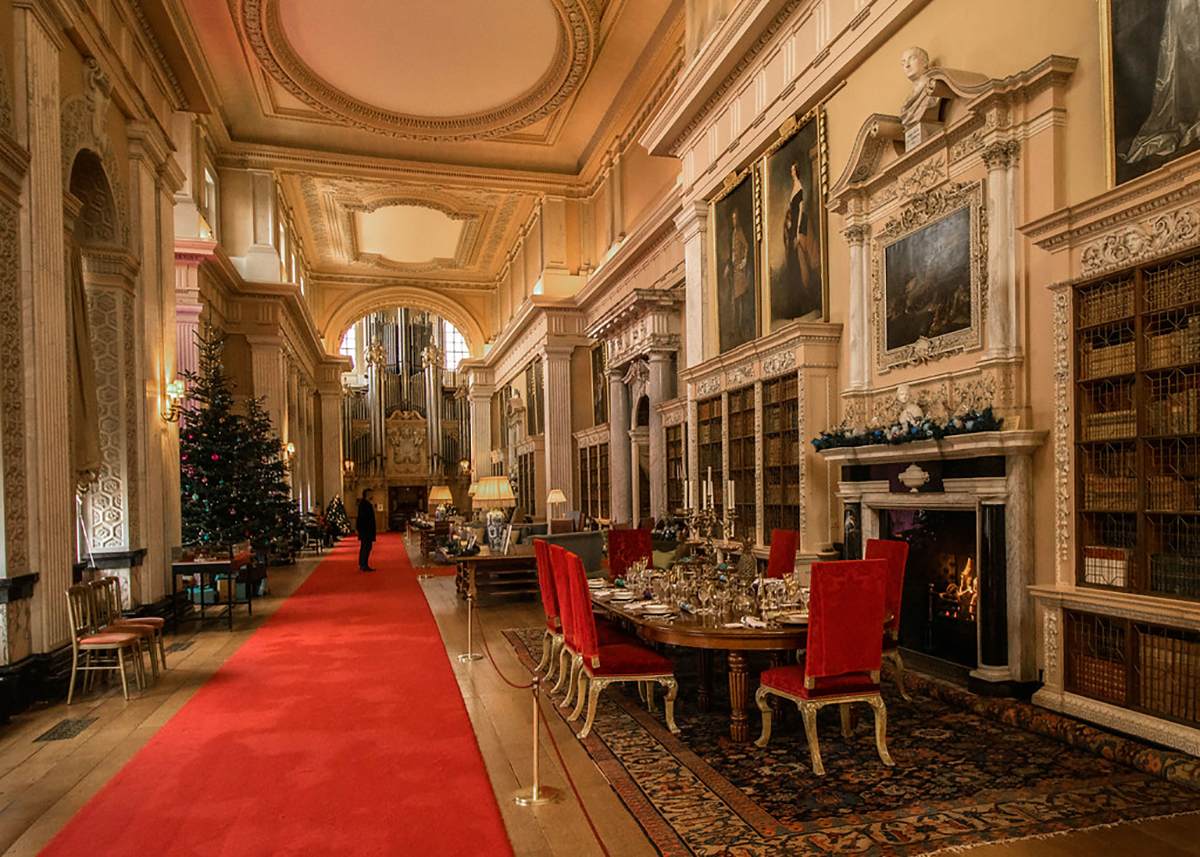
The palace is entered through a clerestoried Great Hall, from where the staircase leads to the upper floors. Beyond the Hall is the Saloon, with a musicians' galleryan upper story, similar to a tribune, running along the side of a building and open on one side to the interior; in a church (basilica) above the side aisles, over the ambulatory (central-plan building) and also over the west end. The gallery was used to keep certain groups of worshippers apart (women, noblemen). above. To either side of it extend symmetrical suites of state apartments consisting of antechamber, drawing-room and bed-chamber; together with the Saloon, these occupy the entire south front. Along the west front of the house runs the Long Gallery (intended as a picture gallery but completed as a library); to the east were the family apartments, designed on a more domestic scale.
The interior decoration and fittings were lavishly executed. Door- and window-frames are of marbleloosely applied to any hard limestone that can be sawn into thin slabs and will take a good polish so that it is suitable for decorative work; more strictly, it refers to metamorphosed limestones whose structure has been recrystallized by heat or pressure. Marbles are widely disseminated and occur in a great variety of colours and patterns, but certain types have been particularly prized by sculptors. The most famous of Greek white marbles in the ancient world was the close-grained Pentelic, which was quarried at Mount Pentelicon in Attica. The Elgin Marbles are carved in Pentelic. Widely used also were the somewhat coarser-grained translucent white marbles from the Aegean islands of Paros and Naxos. Parian marble was used for the celebrated Mausoleum at Halicarnassus. The pure white Carrara marble, quarried at Massa, Carrara, and Pietra Santa in Tuscany from the 3rd century BC, is the most famous of all sculptors' stones. It was used for the Apollo Belvedere, and was much favoured in the Renaissance, particularly by Michelangelo, who often visited the quarries to select material for his work. Neoclassical sculptors also favoured Carrara marble because of its ability to take a smooth, sleek surface, but it can look rather 'dead' compared with some of the finest Greek marbles., with architectural carvings by Grinling Gibbons (1648-1721) in an uncharacteristically restrained classicalRelating to the culture of ancient Greece and Rome (classical Antiquity). The classical world played a profoundly important role in the Renaissance, with Italian scholars, writers, and artists seeing their own period as the rebirth (the "renaissance") of classical values after the Middle Ages. The classical world was considered the golden age for the arts, literature, philosophy, and politics. Concepts of the classical, however, changed greatly from one period to the next. Roman literature provided the starting point in the 14th century, scholars patiently finding, editing and translating a wide range of texts. In the 15th century Greek literature, philosophy and art - together with the close study of the remains of Roman buildings and sculptures-expanded the concept of the classical and ensured it remained a vital source of ideas and inspiration. style appropriate to the great proportions of the rooms. The ceiling of the Great Hall was painted with an allegoryA work of art which represents some abstract quality or idea, either by means of a single figure (personification) or by grouping objects and figures together. Renaissance allegories make frequent allusions both to both Greek and Roman legends and literature, and also to the wealth of Christian allegorical stories and symbols developed during the Middle Ages. of the Duke presenting a plan of the Battle of Blenheim to Britannia (1716) by James Thornhill in his continental BaroqueThe period in art history from about 1600 to about 1750. In this sense the term covers a wide range of styles and artists. In painting and sculpture there were three main forms of Baroque: (1) sumptuous display, a style associated with the Catholic Counter Reformation and the absolutist courts of Europe (Bernini, Rubens); (2) dramatic realism (Caravaggio); and (3) everyday realism, a development seen in particular in Holland (Rembrandt, Vermeer). In architecture, there was an emphasis on expressiveness and grandeur, achieved through scale, the dramatic use of light and shadow, and increasingly elaborate decoration. In a more limited sense the term Baroque often refers to the first of these categories. The development of the Baroque reflects the period's religious tensions (Catholic versus Protestant); a new and more expansive world view based on science and exploration; and the growth of absolutist monarchies. style. The walls and ceiling of the Saloon were decorated (c. 1720) by Louis Laguerre (1663-1721), the former painted as an illusionistic composition of a colonnadeRow of columns with a straight entablature and no arches. open to the sky, from behind which figures representing the four continents look into the room. In the Gallery and Hall hung works by Titian, Rubens and Raphael, while the state suites were hung with Brussels tapestries, including a set of ten 'Victories' depicting the Duke's campaigns (in situ). There are said to be 187 rooms in the main building.
The photo shows the Long Gallery.
@online{wga-ra9765170d7bc64,
  author       = {Krén, Emil and Marx, Daniel},
  title        = {Interior view by VANBRUGH, John},
  organization = {{Web Gallery of Art}},
  date         = {2026-09-09},
  url          = {https://beta.wga.hu/artists/vanbrugh-john-rd4f5e71fa348c3/interior-view-ra9765170d7bc64},
  urldate      = {2026-09-09},
  langid       = {english}
}
ACCESSED 2026-09-09. REPLACE THE AUTHOR FIELD WITH THE COMMENTARY AUTHOR WHERE ONE IS NAMED.


