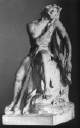
French sculptor. Son and pupil of the decorative sculptor François-Antoine Vassé (1681-1736), he entered Edme Bouchardon's workshop, becoming his favourite pupil. In 1739 he won the Prix de RomeGLOSSARYA scholarship, founded concurrently with the French Academy in Rome (1666), that enabled prize-winning students at the Academie Royale de Peinture et de Sculpture in Paris to spend a period (usually 4 years) in Rome at the state's expense. Prizes for architecture began to be awarded regularly in 1723, and prizes for engravers and musicians were added in the 19th century. The prizes were meant to perpetuate the academic tradition and during the 18th and 19th centuries winning the award was the traditional stepping stone to the highest honours for painters and sculptors. Many distinguished artists (as well as many nonentities) were Prix de Rome winners, notably David, Fragonard, and Ingres among painters and Clodion, Girardon, and Houdon among sculptors. The prizes are still awarded and the system has been adopted by other countries. with a bas-reliefGLOSSARYlow relief, a sculptured relief in which the desighn stands out only a little from the background. representing Jezebel Devoured by Dogs (untraced), and the following year he went to the Académie de France in Rome, returning to Paris in 1745. He was approved (agréé) by the Académie Royale in 1748 and received (reçu) as a full member in 1751 on presentation of a statuette of a Sleeping Shepherd (marbleGLOSSARYloosely applied to any hard limestone that can be sawn into thin slabs and will take a good polish so that it is suitable for decorative work; more strictly, it refers to metamorphosed limestones whose structure has been recrystallized by heat or pressure. Marbles are widely disseminated and occur in a great variety of colours and patterns, but certain types have been particularly prized by sculptors. The most famous of Greek white marbles in the ancient world was the close-grained Pentelic, which was quarried at Mount Pentelicon in Attica. The Elgin Marbles are carved in Pentelic. Widely used also were the somewhat coarser-grained translucent white marbles from the Aegean islands of Paros and Naxos. Parian marble was used for the celebrated Mausoleum at Halicarnassus. The pure white Carrara marble, quarried at Massa, Carrara, and Pietra Santa in Tuscany from the 3rd century BC, is the most famous of all sculptors' stones. It was used for the Apollo Belvedere, and was much favoured in the Renaissance, particularly by Michelangelo, who often visited the quarries to select material for his work. Neoclassical sculptors also favoured Carrara marble because of its ability to take a smooth, sleek surface, but it can look rather 'dead' compared with some of the finest Greek marbles.; Paris, Louvre). In 1761 he was made professor at the Académie Royale, and he was appointed Dessinateur de l'Académie des Inscriptions in 1762.
From 1748 he exhibited at the SalonGLOSSARYIn the French language of the 18th and 19th centuries it designated an actual exhibition space, as well as the academic art exhibitions staged in the Salon d'Apollon of the Louvre since 1667. From 1737, the exhibitions took place biennially and, after the French Revolution, annually in the Salon Carré of the Louvre in Paris. Towards the end of the 19th century the official Salon jury was dissolved in order to make way for a committee of state-approved artists, i.e. former Salon members, who created the highly influential Société des Artistes Français., notably a plaster model of a tomb (1748; untraced) comprising a woman weeping over an urn veiled with her draperies, the type of funerary monument in which he was to specialize in both free-standing and reliefGLOSSARYA sculptural work in which all or part projects from the flat surface. There are three basic forms: low relief (bas-relief, basso rilievo), in which figures project less than half their depth from the background; medium relief (mezzo-rilievo), in which figures are seen half round; and high relief (alto rilievo), in which figures are almost detached from their background. formats. In 1750 he exhibited a bust of Benedict XIV, a model of a Weeping Virgin and terracottaGLOSSARYUnglazed fired clay. It is used for architectural features and ornaments, vessels, and sculptures. sketch models of Daedalus and Nessus as well as a proposal for a public square with an equestrian statue of Louis XV (all untraced).