03 — ARTWORK
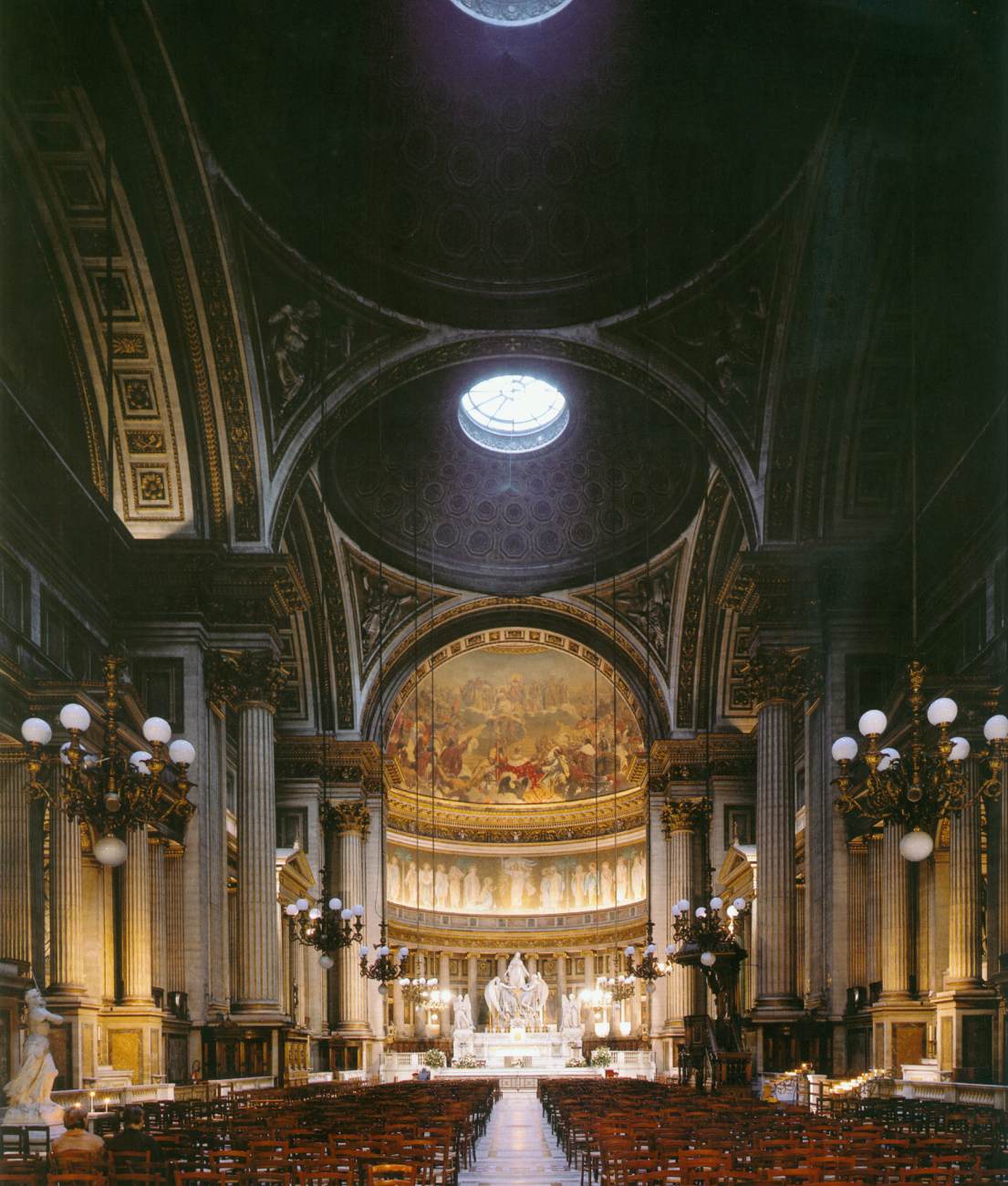
Interior view
VIGNON, Alexandre-Pierre · 1842 →
- MEDIUM
- Photo
- TYPE
- Interior
PALETTE
HOVER OR TAP A SWATCH FOR NAME, SHARE AND HEX. SAMPLED FROM THE IMAGE — INDICATIVE, NOT A PIGMENT ANALYSIS.
DEVELOPMENT BUILD — NOT FOR PUBLIC USE. CONTRIBUTE ON GITHUB.
03 — ARTWORK
VIGNON, Alexandre-Pierre · 1842 →
PALETTE
HOVER OR TAP A SWATCH FOR NAME, SHARE AND HEX. SAMPLED FROM THE IMAGE — INDICATIVE, NOT A PIGMENT ANALYSIS.
COMMENTARY
UNDERLINED TERMS ARE DEFINED IN THE GLOSSARY.
The most important contribution to church architecture in the Napoleonic period was the construction of the Église de la Madeleine.
Together with the Arc de Triomphe (1806–08) and the Vendôme Columna vertical structural member having a circular cross-section and usually consisting of a base, a long shaft, and a capital., the Madeleine is one of the monuments with which Napoleon sought to turn Paris into an imperial capitalThe head or crowning feature of a column or pillar. Structurally, capitals broaden the area of a column so that it can more easily bear the weight of the arch or entablature it supports.. Built in the form of a Roman temple surrounded by a Corinthian colonnadeRow of columns with a straight entablature and no arches., the Madeleine reflects the taste for ClassicalRelating to the culture of ancient Greece and Rome (classical Antiquity). The classical world played a profoundly important role in the Renaissance, with Italian scholars, writers, and artists seeing their own period as the rebirth (the "renaissance") of classical values after the Middle Ages. The classical world was considered the golden age for the arts, literature, philosophy, and politics. Concepts of the classical, however, changed greatly from one period to the next. Roman literature provided the starting point in the 14th century, scholars patiently finding, editing and translating a wide range of texts. In the 15th century Greek literature, philosophy and art - together with the close study of the remains of Roman buildings and sculptures-expanded the concept of the classical and ensured it remained a vital source of ideas and inspiration. art and architecture that predominated in France during the Empire phase of the Neoclassical movement.
Napoleon had ordered its design and construction, originally intending the building to be a temple of glory(1) The supernatural radiance surrounding a holy person. (2) To have the distinction of one's deeds recognized in life and to be revered for them posthumously: this was glory. The nature of true gloria was much discussed, whether it must be connected with the public good, whether the actions that led to it must conform with Christian ethics, how it differed from notoriety. The concept did not exclude religious figures (the title of the church of the Frari in Venice was S. Maria Gloriosa), but it was overwhelmingly seen in terms of secular success and subsequent recognition, as determining the lifestyles of the potent and the form of their commemoration in literature, in portraits and on tombs. As such, it has been taken as a denial of medieval religiosity ('sic transit gloria mundi'), and thus a hallmark of Renaissance individual ism; as a formidable influence on cultural patronage; and as spurring on men of action, as well as writers and artists, to surpass their rivals - including their counterparts in antiquity. celebrating his Grande Armée. This commemorative role, however, was assumed instead by the Arc de Triomphe, and in 1816 the Madeleine was made a church by the restored Bourbon regime. Its interior, completed 1828–42 under the supervision of Jean-Jacques-Marie Huvé (1783-1852), was modeled on the Roman baths.
The photo shows a view of the interior towards the altar.
@online{wga-rd3d118534252e0,
  author       = {Krén, Emil and Marx, Daniel},
  title        = {Interior view by VIGNON, Alexandre-Pierre},
  organization = {{Web Gallery of Art}},
  date         = {2026-09-13},
  url          = {https://beta.wga.hu/artists/vignon-alexandre-pierre-r3b6ad3244d553a/interior-view-rd3d118534252e0},
  urldate      = {2026-09-13},
  langid       = {english}
}
ACCESSED 2026-09-13. REPLACE THE AUTHOR FIELD WITH THE COMMENTARY AUTHOR WHERE ONE IS NAMED.
The archive catalogues no further works by this artist.
TRY SAME COLLECTION →