03 — ARTWORK
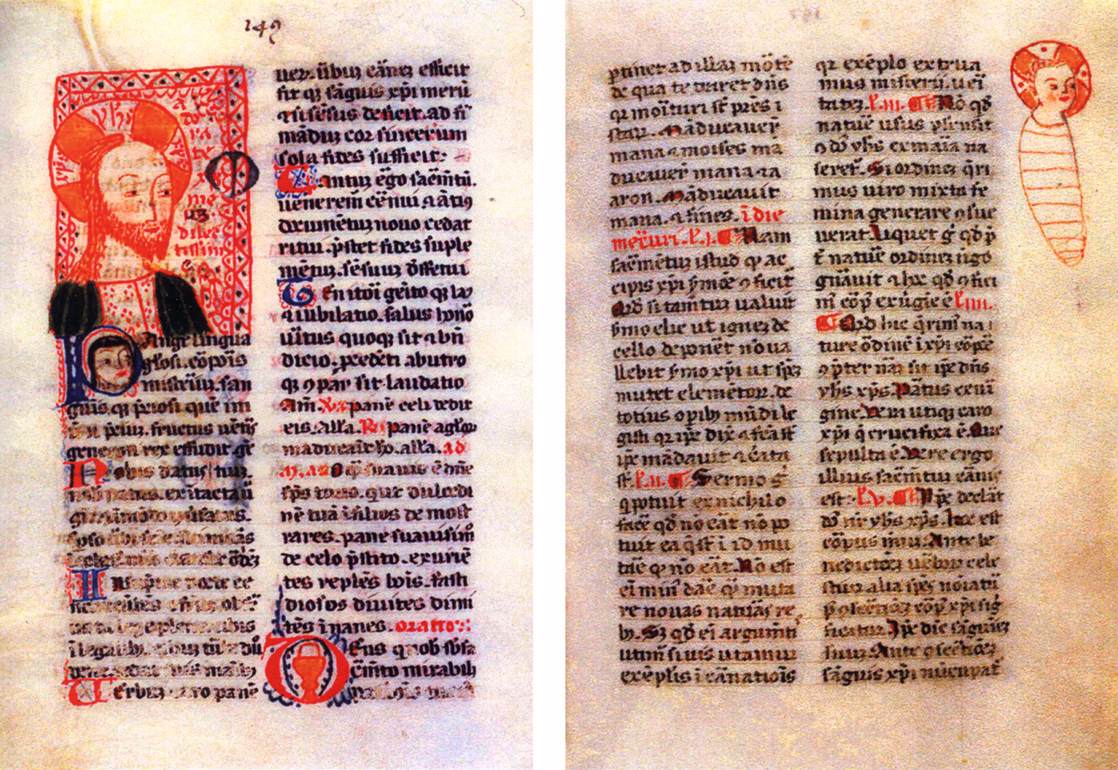
Breviary with Miniatures
- MEDIUM
- Tempera on parchment, 200 x 300 mm
- TYPE
- Religious
PALETTE
HOVER OR TAP A SWATCH FOR NAME, SHARE AND HEX. SAMPLED FROM THE IMAGE — INDICATIVE, NOT A PIGMENT ANALYSIS.
DEVELOPMENT BUILD — NOT FOR PUBLIC USE. CONTRIBUTE ON GITHUB.
03 — ARTWORK
PALETTE
HOVER OR TAP A SWATCH FOR NAME, SHARE AND HEX. SAMPLED FROM THE IMAGE — INDICATIVE, NOT A PIGMENT ANALYSIS.
COMMENTARY
UNDERLINED TERMS ARE DEFINED IN THE GLOSSARY.
These folios belong to a BreviaryA book of daily prayers and readings used by priest and monks., a parchmentWriting material made from the skins of sheep or calf, less frequently pig, goat,, and other animals; it has also been used for painting, and occasionally for printing and bookbinding. Pliny says that it ewas invented in the 2nd century BC in Pergamum; hence the name parchment from the Latin pergamena (of Pergamum). Skin had been used as a writng material before this, but the refined methods of cleaning and stretching involved in making parchment enabled booth sides of a leaf to be used, leading eventually to the supplanting of the manuscript roll by the bound book. Vellum is a fine kind of parchment made from delicate skins of young (sometimes stillborn) animals. Paper began to replace parchment from about the 14th century, but parchment is still used for certain kinds of documents, and the name is often applied to high-quality writng paper. manuscriptcollective term for books or other documents written by hand; in a specific sense, the hand-written medieval book, the Codex manuscriptus, often ornamented with decorative borders, illuminated initials and miniatures, and containing works of ancient philosophy or scholarly, ecclesiastical, and literary texts. Manuscripts were usually produced on commission. At first the scriptoria (writing rooms) of monasteries transcribed the contents of famous manuscripts and made copies. Monastic communities in the Netherlands and northern Germany began producing manuscripts around 1383/84. Flanders, Burgundy, and in particular Paris became major centres for the mass production of breviaries (prayer books) and Books of Hours. of 519 sheets, almost all written in two columns, decorated with ornaments and miniatures inserted in the principal capitalThe head or crowning feature of a column or pillar. Structurally, capitals broaden the area of a column so that it can more easily bear the weight of the arch or entablature it supports. letters and sometimes straying into the margins. The autography of the codex is confirmed by the presence of Vigni's signature in three passages.
The present picture shows folio 149v containing a miniatureTerm originally applied to the art of manuscript illumination but later used of paintings, usually portraits, executed on a very small scale. The earliest miniaturists (16th century) continued to use the materials of the illuminators, painting in gouache on vellum or card. with bust of Christ and the face of St Clare in the letter V; and folio 157r containing a miniature with Christ Child in the margin.
@online{wga-r0b7fcf672b6b85,
  author       = {Krén, Emil and Marx, Daniel},
  title        = {Breviary with Miniatures by VIGRI, Caterina},
  organization = {{Web Gallery of Art}},
  date         = {2026-09-09},
  url          = {https://beta.wga.hu/artists/vigri-caterina-redfa10400cca63/breviary-with-miniatures-r0b7fcf672b6b85},
  urldate      = {2026-09-09},
  langid       = {english}
}
ACCESSED 2026-09-09. REPLACE THE AUTHOR FIELD WITH THE COMMENTARY AUTHOR WHERE ONE IS NAMED.
The archive catalogues no further works by this artist.
TRY SAME COLLECTION →