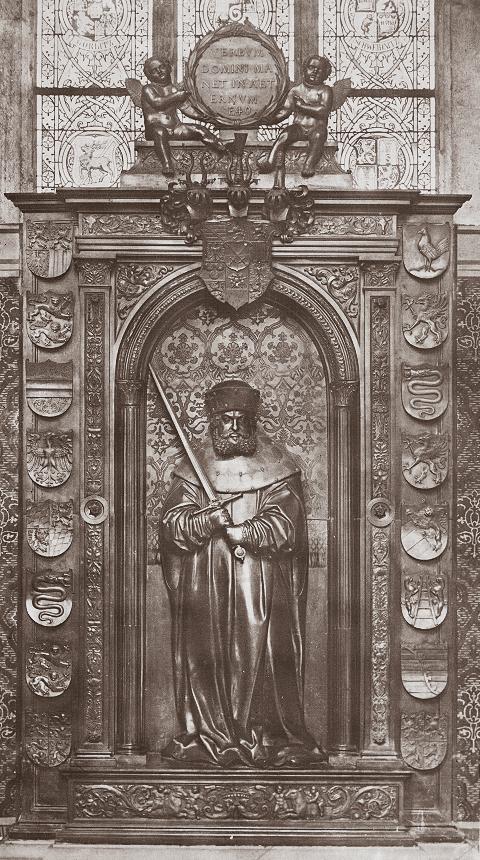
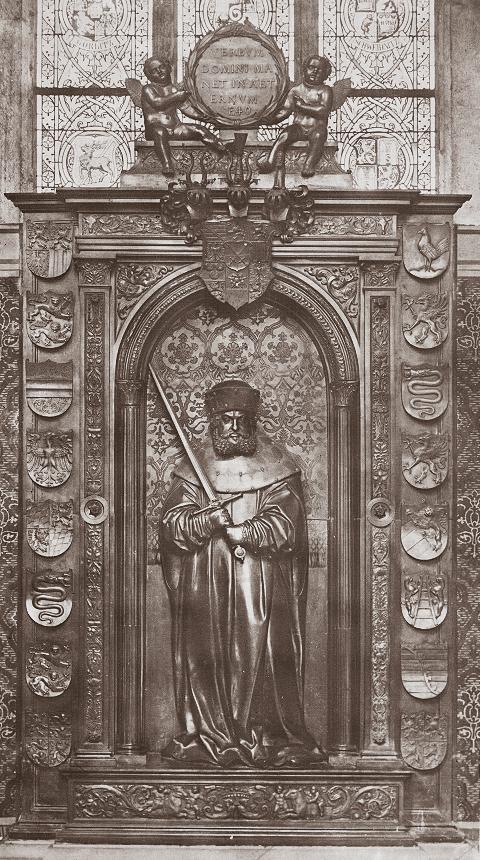
The Vischers were a family of sculptors active in Nuremberg.
Hermann the Elder (d. 1488) established the family bronzeGLOSSARYAn alloy of copper (usually about 90 per cent) and tin, often also containing small amounts of other metals such as lead or zinc. Since antiquity it has been the metal most commonly used in cast sculpture because of its strength, durability, and the fact that it is easily workable - both hot and cold - by a variety of processes. It is easier to cast than copper because it has a lower melting-point, and its great tensile strength makes possible the protrusion of unsupported parts - an advantage over marble sculpture. The colour of bronze is affected by the proportion of tin or other metals present, varying from silverish to a rich, coppery red, and its surface beauty can be enhanced when it acquires a patina.-foundry, and the business was inherited by his son Peter the Elder (1460-1529), the best known of the Vischers. He was assisted by five sons: Hermann the Younger (1486-1517), Peter the Younger (1487-1528), Hans (1489-1550), Jacob and Paulus.
The masterpieceGLOSSARYA term now loosely applied to the finest work by a particular artist or to any work of art of acknowledged greatness or of preeminence in its field. Originally it meant the piece of work by which a craftsman, having finished his training, gained the rank of'master' in his guild. of the Vischer workshop is the spectacular bronze shrine over the sarcophagusGLOSSARYA coffin or tomb, made of stone, wood or terracotta, and sometimes (especially among the Greeks and Romans) carved with inscriptions and reliefs. of St Sebald in the church dedicated to him in Nuremberg. The first design by Peter the Elder (Academy, Vienna) dates from 1488, but actual work began only in 1508 and was carried out till 1519.
Through journeys of the younger generation the workshop had by that time gained a good deal of knowledge of Italian bronzes and in particular the work of north Italian sculptors. Thus the Sebald tomb became a fascinating mixture of GothicGLOSSARYGothic, which may well have originated with Alberti as a derogatory term and which certainly corresponds to Vasari's 'maniera tedesca' ('German style'), is properly the descriptive term for an artistic style which achieved its first full flowering in the Ile de France and the surrounding areas in the period between c. 1200 and c. 1270, and which then spread throughout northern Europe. It is characterized by the hitherto unprecedented integration of the arts of sculpture, painting, stained glass and architecture which is epitomized in the great cathedrals of Chartres, Amiens, and Reims or in the Sainte Chapelle in Paris. In all the arts the predominantly planar forms of the Romanesque are replaced by an emphasis on line. There is a transcendental quality, whether in the soaring forms of the pointed arches or in the new stress on the humanity of Christ, which similarly distinguishes it from the preceding Romanesque style. In thinking of Nicola (d. c. 1284) or Giovanni Pisano (d. after 1314) there is same danger of forgetting what had happened in French sculpture half a century or more earlier, and likewise it is hard to remember that the spectacular achievements of early Renaissance art are a singularly localized eddy in the continuing stream of late gothic European art. By northern European standards few Italian works of art can be called gothic without qualification, and the story of 13th and 14th century Italian architecture is as much one of resistance to the new style as of its reception, whether directly from France or through German or central European intermediaries. In sculpture and in painting, the Italian reluctance to distort the human figure, conditioned by a never wholly submerged awareness of the omnipresent antique heritage, gives a special quality to the work of even those artists such as Giovanni Pisano or Simone Martini who most closely approached a pure gothic style. Nevertheless, the vitalizing role of Northern gothic art throughout the early Renaissance and the period leading up to it should never be underestimated. The artistic, like the cultural and commercial, interaction was continuous and much of the Italian achievement is incomprehensible if seen in isolation. It is not merely at the level of direct exchanges between one artist and another, or the influence of one building; painting, manuscript or piece of sculpture upon another, that the effects are to be felt. The streaming quality of line which is so characteristic of Brunelleschi's early Renaissance architecture surely reflects a sensitivity to the gothic contribution which is entirely independent of, and lies much deeper than, the superficial particularities of form. The counterflow of influence and inspiration from South to North must likewise not be underrated. In particular, the contribution of Italian painters from Duccio and Simone Martini onwards is central to the evolution of the so-called International Gothic style developing in Burgundy, Bohemia and north Italy in the late 14th and early 15th centuries. and Renaissance styles. Peter the Elder also made two splendid free-standing figures (1512-13) of Theodoric and King Arthur for the tomb of the emperor Maximillian I in the Hofkirche, Innsbruck.
Georg (1522-92), a son of Hans, seems to have specialized in small decorative bronzes such as inkGLOSSARYColoured fluid used for writing, drawing, or printing. Inks usually have staining power without body, but printers' inks are pigments mixed with oil and varnish, and are opaque. The use of inks goes back in China and Egypt to at least 2500 BC. They were usually made from lampblack (a pigment made from soot) or a red ochre ground into a solution of glue or gums. These materials were moulded into dry sticks or blocks, which were then mixed with water for use. Ink brought from China or Japan in such dry form came to be known in the West as 'Chinese ink' or 'Indian ink'. The names are also given to a similar preparation made in Europe.-wells.