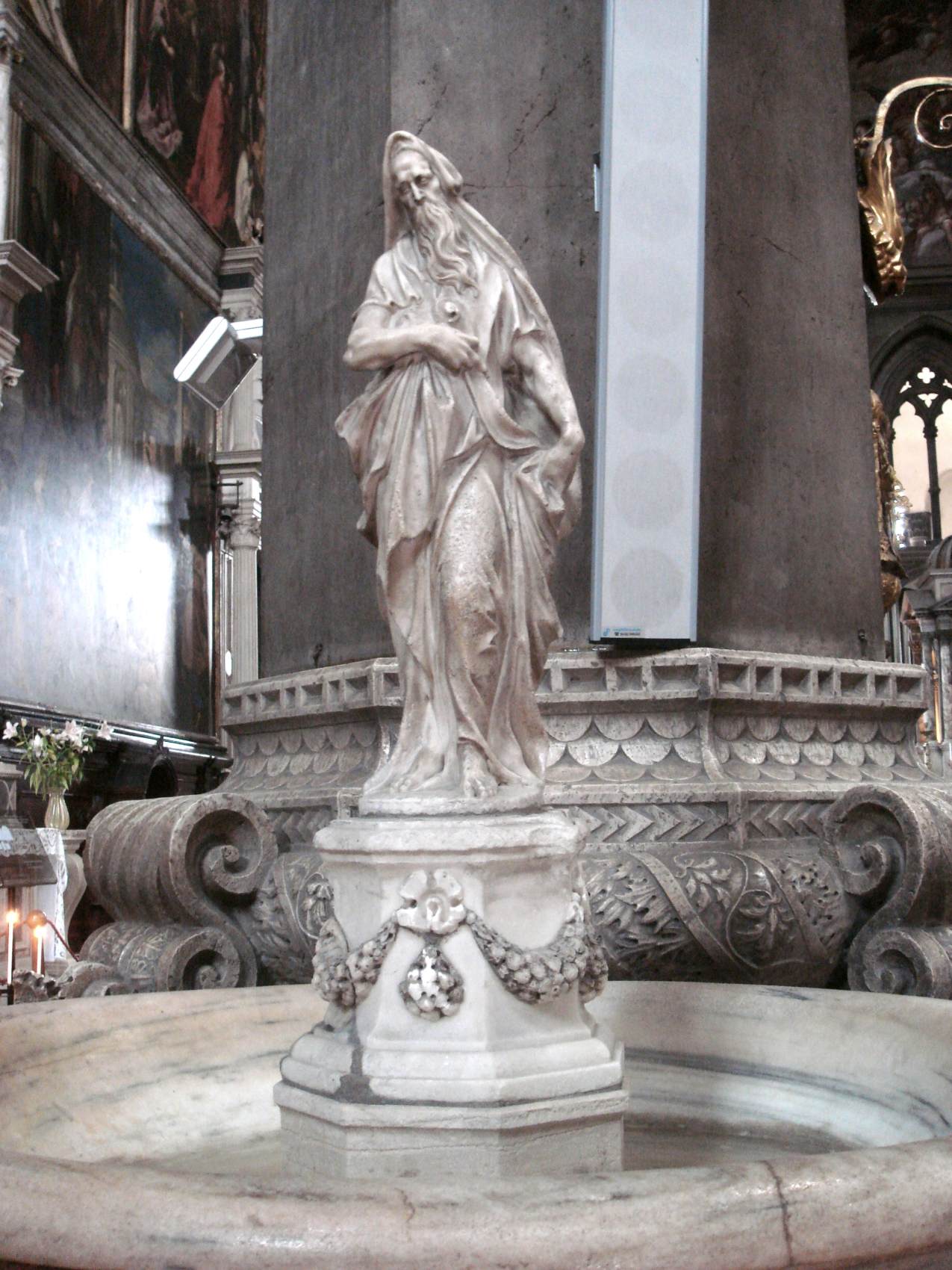
03 — ARTWORK
St Zacharias
- MEDIUM
- Terracotta
- TYPE
- Religious
PALETTE
HOVER OR TAP A SWATCH FOR NAME, SHARE AND HEX. SAMPLED FROM THE IMAGE — INDICATIVE, NOT A PIGMENT ANALYSIS.
DEVELOPMENT BUILD — NOT FOR PUBLIC USE. CONTRIBUTE ON GITHUB.
03 — ARTWORK
PALETTE
HOVER OR TAP A SWATCH FOR NAME, SHARE AND HEX. SAMPLED FROM THE IMAGE — INDICATIVE, NOT A PIGMENT ANALYSIS.
COMMENTARY
UNDERLINED TERMS ARE DEFINED IN THE GLOSSARY.
Vittoria's final will of 1608 included the marbleloosely applied to any hard limestone that can be sawn into thin slabs and will take a good polish so that it is suitable for decorative work; more strictly, it refers to metamorphosed limestones whose structure has been recrystallized by heat or pressure. Marbles are widely disseminated and occur in a great variety of colours and patterns, but certain types have been particularly prized by sculptors. The most famous of Greek white marbles in the ancient world was the close-grained Pentelic, which was quarried at Mount Pentelicon in Attica. The Elgin Marbles are carved in Pentelic. Widely used also were the somewhat coarser-grained translucent white marbles from the Aegean islands of Paros and Naxos. Parian marble was used for the celebrated Mausoleum at Halicarnassus. The pure white Carrara marble, quarried at Massa, Carrara, and Pietra Santa in Tuscany from the 3rd century BC, is the most famous of all sculptors' stones. It was used for the Apollo Belvedere, and was much favoured in the Renaissance, particularly by Michelangelo, who often visited the quarries to select material for his work. Neoclassical sculptors also favoured Carrara marble because of its ability to take a smooth, sleek surface, but it can look rather 'dead' compared with some of the finest Greek marbles. statuette of St John the Baptist as a bequest to the nuns of San Zaccaria. It was transferred there shortly after his death, together with an autograph terracottaUnglazed fired clay. It is used for architectural features and ornaments, vessels, and sculptures. statuette of Zacharias. He asked in his will that the pair be placed on either side of the Altar of St Zacharias. It remains unclear whether the nuns ever placed either statuette on the Altar of St Zacharias, nor is it yet known at what date they were placed on the holy-water stoups (the Baptist on the right-hand stoop, Zacharias on the left-hand stoop). Sadly, today, one is not able to see the Baptist, as he is shrouded in cloth, after an act of vandalism resulted in his right arm being snapped off.
@online{wga-rf5a8e2a81b17af,
  author       = {Krén, Emil and Marx, Daniel},
  title        = {St Zacharias by VITTORIA, Alessandro},
  organization = {{Web Gallery of Art}},
  date         = {2026-09-09},
  url          = {https://beta.wga.hu/artists/vittoria-alessandro-re56dcf75122ba8/st-zacharias-rf5a8e2a81b17af},
  urldate      = {2026-09-09},
  langid       = {english}
}
ACCESSED 2026-09-09. REPLACE THE AUTHOR FIELD WITH THE COMMENTARY AUTHOR WHERE ONE IS NAMED.


