03 — ARTWORK
Nativity
- MEDIUM
- Oil on panel, 106 x 75 cm
- TYPE
- Religious
PALETTE
HOVER OR TAP A SWATCH FOR NAME, SHARE AND HEX. SAMPLED FROM THE IMAGE — INDICATIVE, NOT A PIGMENT ANALYSIS.
DEVELOPMENT BUILD — NOT FOR PUBLIC USE. CONTRIBUTE ON GITHUB.
CURRENT LOCATION · O.-L. Vrouwekathedraal
03 — ARTWORK
PALETTE
HOVER OR TAP A SWATCH FOR NAME, SHARE AND HEX. SAMPLED FROM THE IMAGE — INDICATIVE, NOT A PIGMENT ANALYSIS.
COMMENTARY
UNDERLINED TERMS ARE DEFINED IN THE GLOSSARY.
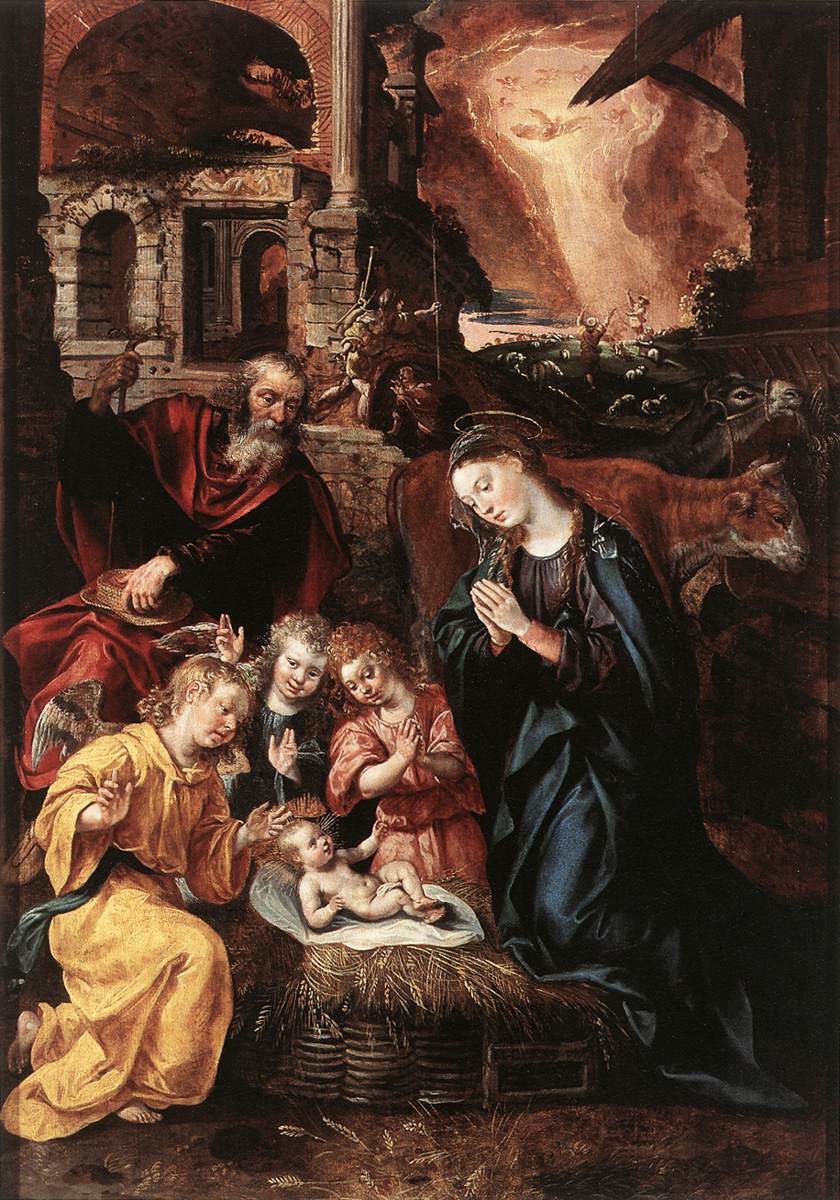
Three little angels kneel with Mary and Joseph in worship of the newborn Child. The ox and the ass stand behind them. Other angels in the distance announce the birth of Christ to a group of shepherds. The ruin behind Joseph symbolises the defeat of paganism by the coming of the Saviour. The artist has made the symbolismAn artistic movement that arose in France toward the end of the nineteenth century, primarily in literature, in opposition to the reigning schools of Realism and Impressionism. Symbolism rejected objectivity in favour of the subjective, and turned away from the direct representation of reality in favour of a synthesis of many different aspects of it, aiming to suggest ideas by means of ambiguous yet powerful symbols. Among the artists associated with the movement were Odilon Redon, Gustave Moreau and Puvis de Chavannes in France, Fernand Khnopff in Belgium, Jan Toorop in Holland, Ferdinand Hodler in Switzerland, Gustave Klimt in Austria, and Giovanni Segantini in Italy. even plainer by including a reliefA sculptural work in which all or part projects from the flat surface. There are three basic forms: low relief (bas-relief, basso rilievo), in which figures project less than half their depth from the background; medium relief (mezzo-rilievo), in which figures are seen half round; and high relief (alto rilievo), in which figures are almost detached from their background. in the classicalRelating to the culture of ancient Greece and Rome (classical Antiquity). The classical world played a profoundly important role in the Renaissance, with Italian scholars, writers, and artists seeing their own period as the rebirth (the "renaissance") of classical values after the Middle Ages. The classical world was considered the golden age for the arts, literature, philosophy, and politics. Concepts of the classical, however, changed greatly from one period to the next. Roman literature provided the starting point in the 14th century, scholars patiently finding, editing and translating a wide range of texts. In the 15th century Greek literature, philosophy and art - together with the close study of the remains of Roman buildings and sculptures-expanded the concept of the classical and ensured it remained a vital source of ideas and inspiration. ruin - a recumbent female nude, possibly Venus, and several playful little naked figures. These represent the pagan world and 'impure', earthly love, as opposed to the divine love in which Christ was conceived.
Marten de Vos spent some time in Italy, where he familiarised himself with the new art of the Renaissance. This is apparent in details like the lively poses, the realistic approach to the anatomy and the references to classical antiquity. The divided upper zone, one half containing an architectural setting and the other a deep landscape, was also typical of 16th-century Venetian art. <P> <TABLE ALIGN=LEFT CELLPADDING=5 BORDER=1 WIDTH=320 BGCOLOR="#99CCCC"> <TR VALIGN=MIDDLE><TD><IMG SRC="/support/gif/listen.gif" BORDER=0 VALIGN=MIDDLE> Suggested listening (streaming mp3, 22 minutes):<BR><A HREF="#" onClick="w=window.open ('/music1/16_cent/tallis_mass.html', 'newWin', 'scrollbars=yes,status=no,dependent=yes,screenX=0,screenY=0,width=350,height=350');w.opener=this;w.focus();return true"><B>Thomas Tallis: Mass (Puer natus est)</B></A> </TD></TR></TABLE>
@online{wga-r3146c29ca13561,
  author       = {Krén, Emil and Marx, Daniel},
  title        = {Nativity by VOS, Marten de},
  organization = {{Web Gallery of Art}},
  date         = {2026-09-13},
  url          = {https://beta.wga.hu/artists/vos-marten-de-r0f6dcc1feb9b40/nativity-r3146c29ca13561},
  urldate      = {2026-09-13},
  langid       = {english}
}
ACCESSED 2026-09-13. REPLACE THE AUTHOR FIELD WITH THE COMMENTARY AUTHOR WHERE ONE IS NAMED.


