03 — ARTWORK
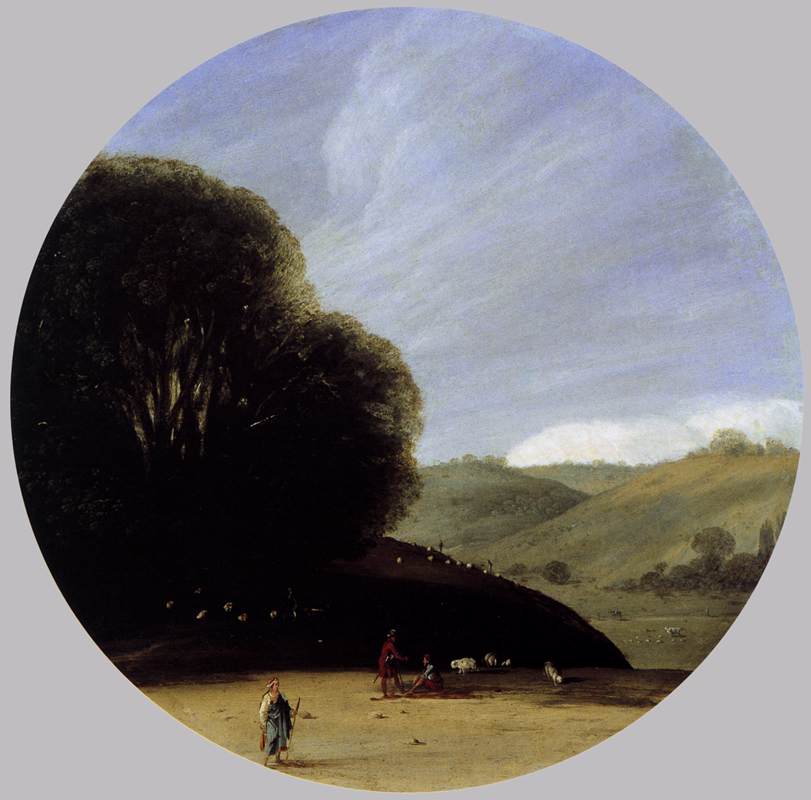
Pastoral Landscape
- MEDIUM
- Oil on copper, diameter 24,2 cm
- TYPE
- Landscape
PALETTE
HOVER OR TAP A SWATCH FOR NAME, SHARE AND HEX. SAMPLED FROM THE IMAGE — INDICATIVE, NOT A PIGMENT ANALYSIS.
DEVELOPMENT BUILD — NOT FOR PUBLIC USE. CONTRIBUTE ON GITHUB.
03 — ARTWORK
PALETTE
HOVER OR TAP A SWATCH FOR NAME, SHARE AND HEX. SAMPLED FROM THE IMAGE — INDICATIVE, NOT A PIGMENT ANALYSIS.
COMMENTARY
UNDERLINED TERMS ARE DEFINED IN THE GLOSSARY.
PastoralRelating to a romantic or idealized image of rural life; in classical literature, to a world peopled by shepherds, nymphs, and satyrs. Landscape c. 1616 Oil on copper, diameter 24,2 cm Ashmolean Museum, Oxford
Although once attributed to Breenbergh, this tondoA circular painting or relief sculpture. The tondo derives from classical medallions and was used in the Renaissance as a compositional device for creating an ideal visual harmony. It was particularly popular in Florence and was often used for depictions of the Madonna and Child. is certainly the work of Goffredo Wals. A native of Cologne, Wals came to Rome via Naples. Once in the Eternal City, he seems to have immediately come into contact with Agostino Tassi; he is recorded in Tassi's workshop by 1616. Some landscapes by the two artists are very similar, especially the rounded hills, silhouetted against each other, whose profiles are interrupted by only the scantiest vegetation. Whether Wals influenced Tassi or was instead indebted to him cannot be precisely assessed, since we know almost nothing about their relative chronologies.
According to the seventeenth-century writer Raffaello Soprani, Wals invented a kind of landscape structured on three planes, exactly like the one in this Pastoral Landscape. His interest in Adam Elsheimer's way of composing a landscape is, however, clear. While the Bolognese painters were concerned about a gradual recession into depth, Elsheimer, and later Wals and Tassi, liked to juxtapose a few planes. Wals worked only on a small scale, often using the circular format typical of mirrorsMirrors of glass 'silvered' on the back began to supplement those of polished metal in the 14th century, though it was only in the 16th century that high-quality glass ones were made (at Murano) on a scale that made them one of Venice's chief luxury exports. The connection between the increasing use of mirrors and the art of make-up (the mirror was a familiar symbol of vanity) and personal cleanliness is unexplored, but they had an influence on the development of the self-portrait in painting: Vasari assumed that Simone Martini (d. 1344) 'painted himself with two mirrors in order to get his head in profile'. Parmigianino (d. 1540) took self-scrutiny to a thoroughly introspective level in his Self-portrait in a (convex) Mirror., probably because he intended his art to be a reflection of nature. At least this is how Soprani interpreted it. Only rarely did Wals's pictures include a subject or even classicalRelating to the culture of ancient Greece and Rome (classical Antiquity). The classical world played a profoundly important role in the Renaissance, with Italian scholars, writers, and artists seeing their own period as the rebirth (the "renaissance") of classical values after the Middle Ages. The classical world was considered the golden age for the arts, literature, philosophy, and politics. Concepts of the classical, however, changed greatly from one period to the next. Roman literature provided the starting point in the 14th century, scholars patiently finding, editing and translating a wide range of texts. In the 15th century Greek literature, philosophy and art - together with the close study of the remains of Roman buildings and sculptures-expanded the concept of the classical and ensured it remained a vital source of ideas and inspiration. buildings. His shepherds here are probably contemporary ones, not inhabitants of a remote ArcadiaA mountainous area of Greece. In Greek and Roman literature, a place where a contented life of rural simplicity is lived; an earthly paradise peopled by shepherds.. Like Filippo Napoletano, he is interested in the simple solid volumes of unassuming dwellings, on whose surfaces light and shade are strongly contrasted.
@online{wga-red960d41e4a50c,
  author       = {Krén, Emil and Marx, Daniel},
  title        = {Pastoral Landscape by WALS, Goffredo},
  organization = {{Web Gallery of Art}},
  date         = {2026-09-13},
  url          = {https://beta.wga.hu/artists/wals-goffredo-rf394b9b20af766/pastoral-landscape-red960d41e4a50c},
  urldate      = {2026-09-13},
  langid       = {english}
}
ACCESSED 2026-09-13. REPLACE THE AUTHOR FIELD WITH THE COMMENTARY AUTHOR WHERE ONE IS NAMED.
The archive catalogues no further works by this artist.
TRY SAME COLLECTION →
