03 — ARTWORK
The Red Bridge
- MEDIUM
- Oil on canvas, 62 x 86 cm
- TYPE
- Landscape
PALETTE
HOVER OR TAP A SWATCH FOR NAME, SHARE AND HEX. SAMPLED FROM THE IMAGE — INDICATIVE, NOT A PIGMENT ANALYSIS.
DEVELOPMENT BUILD — NOT FOR PUBLIC USE. CONTRIBUTE ON GITHUB.
03 — ARTWORK
PALETTE
HOVER OR TAP A SWATCH FOR NAME, SHARE AND HEX. SAMPLED FROM THE IMAGE — INDICATIVE, NOT A PIGMENT ANALYSIS.
COMMENTARY
UNDERLINED TERMS ARE DEFINED IN THE GLOSSARY.
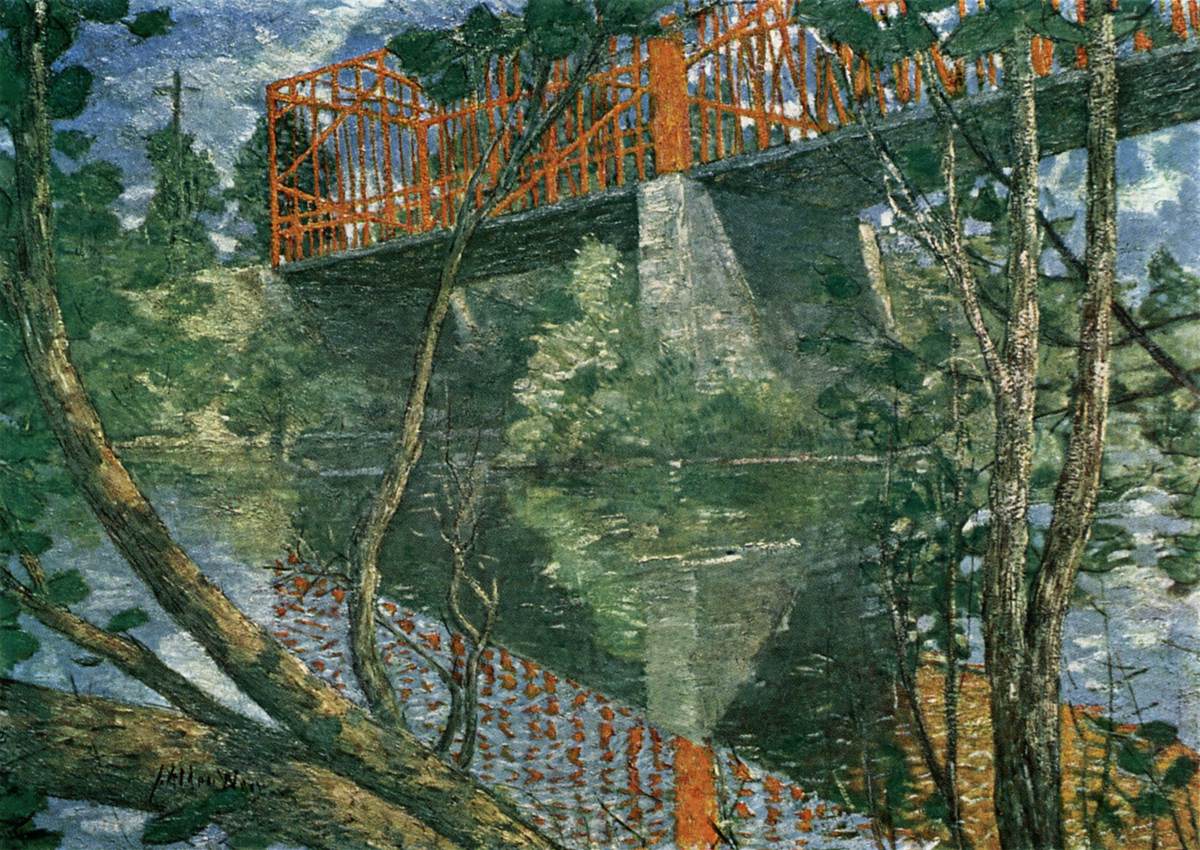
The Red Bridge c. 1895 Oil on canvasA woven cloth used as a support for painting. The best-quality canvas is made of linen; other materials used are cotton, hemp, and jute. It is now so familiar a material that the word 'canvas' has become almost a synonym for an oil painting, but it was not until around 1500 that it began to rival the wooden panel (which was more expensive and took longer to prepare) as the standard support for movable paintings (the transition came later in Northern Europe than in Italy). Canvas is not suitable for painting on until it has been coated with a ground, which isolates the fabric from the paint; otherwise it will absorb too much paint, only very rough effects will be obtainable, and parts of the fabric may be rotted by the pigments. It must also be made taut on a stretcher or by some other means., 62 x 86 cm Metropolitan Museum of Art, New York
The enthusiasm of Julian Alden Weir for the work of Japanese artists such as Hokusai or Hiroshige may have been prompted by the tales of friends who visited Japan and by exhibitions of Japanese print graphics in America. In the 1880s and 1890s Japanese art offered many painters a new direction to follow. One of Weir's most popular paintings, The Red Bridge, exemplifies his use of diagonal composition and zones of colour. The bridge, its colour contrasting strongly with natural setting, opens up decorative possibilities when seen together with its reflection - two diagonals running in at an angle to each other. The detailed brushwork, a product of Weir's study of ImpressionismA style of painting that became prominent in the last quarter of the 19th century as a reaction to the ossified doctrine of the Academy and the content-oriented atelier, historical, and genre painting. The name is derived from the 1872 painting Impression, Sunrise by Claude Monet, and first was used by art critics as a mocking description for a group of artists excluded from the official Salon, but who had their own first group exhibition in 1874 at the salon of the Parisian photographer Nadar. Impressionism, as a new type of naturalism, negated classical pictorial methods; based on contemporary theories of physics, it indicated the natural object in a revolutionary fashion - entirely as a manifestation of colour. Their supreme principle was "plein-air" or open-air painting, through which the painters tried to capture a direct, spontaneous impression of what they saw., loosens the composition without fragmenting it.
@online{wga-re5ad7cbda5811b,
  author       = {Krén, Emil and Marx, Daniel},
  title        = {The Red Bridge by WEIR, Julian Alden},
  organization = {{Web Gallery of Art}},
  date         = {2026-09-09},
  url          = {https://beta.wga.hu/artists/weir-julian-alden-r656efb3dfef58f/the-red-bridge-re5ad7cbda5811b},
  urldate      = {2026-09-09},
  langid       = {english}
}
ACCESSED 2026-09-09. REPLACE THE AUTHOR FIELD WITH THE COMMENTARY AUTHOR WHERE ONE IS NAMED.
The archive catalogues no further works by this artist.
TRY SAME COLLECTION →