03 — ARTWORK
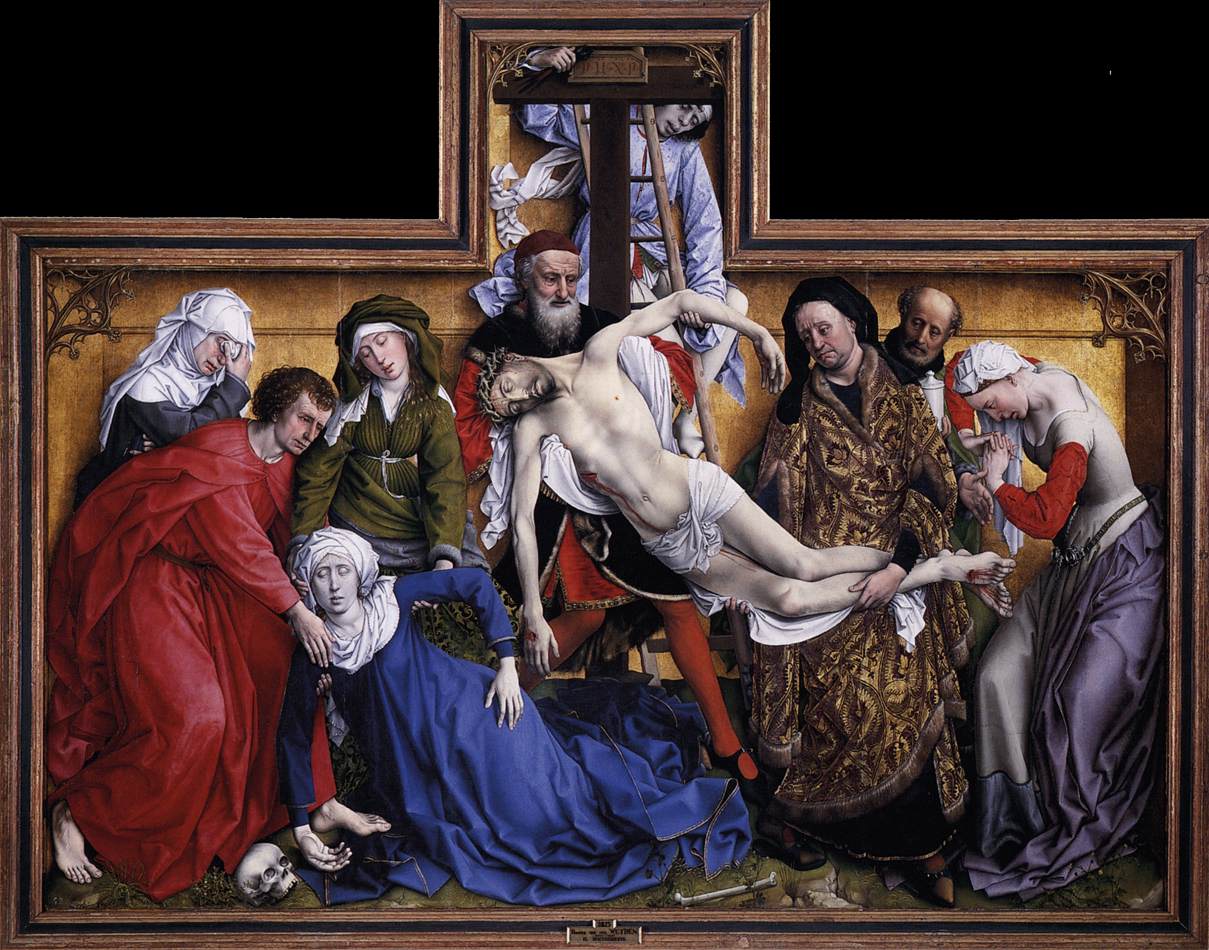
Deposition
WEYDEN, Rogier van der · 1435 →
- MEDIUM
- Oil on oak panel, 220 x 262 cm
- TYPE
- Religious
PALETTE
HOVER OR TAP A SWATCH FOR NAME, SHARE AND HEX. SAMPLED FROM THE IMAGE — INDICATIVE, NOT A PIGMENT ANALYSIS.
DEVELOPMENT BUILD — NOT FOR PUBLIC USE. CONTRIBUTE ON GITHUB.
03 — ARTWORK
WEYDEN, Rogier van der · 1435 →
PALETTE
HOVER OR TAP A SWATCH FOR NAME, SHARE AND HEX. SAMPLED FROM THE IMAGE — INDICATIVE, NOT A PIGMENT ANALYSIS.
COMMENTARY
UNDERLINED TERMS ARE DEFINED IN THE GLOSSARY.
The earliest painting that can be ascribed to Rogier van der Weyden with any certainty is also the artist's greatest and most influential extant work: the great Deposition. It cannot have been painted very long after 1435, the year established by dendrochronological dating methods, which would also fit the circumstances of Rogier's life at the time. On the other hand, it must have been painted before 1443, the date of the earliest copy (in the Sint-Pieterskerk, Leuven).
The Deposition was an altarpieceA picture or sculpture that stands on or is set up behind an altar. The term reredos is used for an ornamental screen or partition, not directly attached to the altar table but affixed to the wall behind it. A diptych is an altarpiece consisting of two panels, a triptych one of three panels, and a polyptych one of four or more panels. From the 14th to 16th century, the altarpiece was one of the most important commissions in European art; it was through the altarpiece that some of the most decisive developments in painting and sculpture came about., intended for the chapela small separate place for worship, either part of a large church or a separate building. of the Confraternity of the Archers of Leuven, who commissioned it. (The two small crossbows in the lower spandrels of the tracerythe geometrical architectural ornamentation which is used in Gothic architecture to subdivide the upper parts of the arches belonging to large windows, and later to subdivide gable ends, walls, and other surfaces. in the picture refer to the Confraternity.). Mary of Hungary (1505-1558), Regent of the Netherlands, acquired the painting from the Archers of Leuven before 1548. Later it came into the possession of her nephew King Philip II of Spain (1527-1598; king from 1556), who finally placed it in the monasterythe complex of buildings used by a community of monks. Among the main elements of the complex are the church, cloister, chapter house (used by the governing body), refectory (dining room) and dormitory (sleeping quarters). fortress of the Escorial he had founded near Madrid. At that time the Deposition formed the centre of a triptychA painting in three sections, usually an altarpiece, consisting of a central panel and two outer panels, or wings. In many medieval triptychs the two outer wings were hinged so that could be closed over the center panel. Early triptychs were often portable., but there is no indication that the side wings were originally part of the work, it is more likely that the Deposition was originally a single panelTerm in painting for a support of wood, metal, or other rigid substance, as distinct from canvas. Until the adoption of canvas in the 15th century nearly all the movable paintings of Europe were executed on wood, and even up to the beginning of the 17th century it is probable that as much painting was done on the one support as on the other. Painters who worked on a small scale often used copper panels (Elsheimer is a leading example), and in the colonial art of South America copper and tin and even lead and zinc were used. On a larger scale, slate has occasionally been used as a support, notably by Rubens for his altarpiece for Sta Maria in Vallicella (the Chiesa Nuova) in Rome; the picture he originally painted was said to reflect the light unpleasantly and slate was used for the replacement to produce a more matt finish. For wood panels the Italian masters of the Renaissance preferred white poplar, while oak was the most common wood used in northern Europe. Many other types were used, however; analysis of the contents of art galleries has yielded a long list, including beech, cedar, chestnut, fir, larch, linden, mahogany, olive, and walnut. In the 20th century cedar, teak, and dark walnut are favourites, and modern painters have also used plywood, fibre-board, and other synthetic materials as supports..
At about 2.2 meters high and 2.6 meters wide, the painting is very large by the usual standards of Early Netherlandish pictures; in terms of concept it is truly monumental. Ten figures in all cover the painted surface almost entirely, with their heads close to the upper edge of the panel. The body of Jesus has already been removed from the Cross, and is received by two elderly men, the bearded Joseph of Arimathaea and Nicodemus. Surrounded by Jesus's mourning friends they are holding His dead body for a moment before setting it down. Mary is sinking to the ground in a faint beside her son, and is supported by John, the favourite disciple of Jesus, and by one of the holy women. On the extreme right, the despairing Mary Magdalene seems on the brink of collapse.
The scene shown would have lasted for only a moment, but there is nothing momentary about its depiction, which is quite detached from the historical event. Rogier achieves this effect principally by placing the group in a painted niche like an altar shrine; the hill of Golgotha, the Place of Skulls where the Cross stood, is suggested only by skulls and arm bones on the narrow strip of stone floor. A connection is thus established with those gilded shrines holding painted statues that were a particularly costly and lavish form of retableOrnamental panel behind an altar and, in the more limited sense, the shelf behind an altar on which are placed the crucifix, candlesticks, and other liturgical objects. The panel is usually made of wood or stone, though sometimes of metal, and is decorated with paintings, statues, or mosaics depicting the Crucifixion or a similar subject. Although frequently forming part of the architectural structure of the church, especially in the High Gothic period, retables can be detached and, sometimes, as in the case of the famous retable by Hubert and Jan van Eyck, "The Adoration of the Lamb" (1432, Cathedral of Saint-Bavon, Ghent), consist merely of a painting. Probably the most well-known retable is that in the Basilica of St Mark in Venice, which is one of the most remarkable examples in existence of the craft of the jeweler and goldsmith. Originally commissioned in 976, the St. Mark's retable was enlarged and enriched in the 13th century. With the development of freestanding altars, retables have become extinct.. However, Rogier was not imitating a carved altar. He shows "live" figures rather than statues, and the life-like effect is emphasized by their appearance, almost life-size, in the place where mere wooden statues would be expected in an altar. Using such methods, Rogier gives them the three-dimensionality of statues but the look of a painting, which is much more life-like than sculpture.
However, such considerations would have played only a minor part in Rogier's decision to set the scene in the painted altar niche. His primary concern was to emphasize the forcefulness of the depiction. Rogier even departs deliberately from what can be rationally imagined, and so breaks with the manner of realistic spatial depiction that had only recently been achieved in painting. The niche he paints is deep enough at the bottom of the picture to accommodate several figures, the upright of the Cross, and the ladder leaning against it; but in some areas at the top it seems to come close to the surface of the picture - the helper on the ladder is pressed tightly into the shallow upper space of the shrine, while the head of the bearded Joseph of Arimathaea just below seems to protrude from the picture. All the figures are brought forward by the golden back wall so that the space surrounds them closely: convincing as their actions may look individually, there would never really have been room for them all. The result is a sense of timelessness and an almost oppressive intensity.
The painted niche offered Rogier another advantage: he could retain the gold background usual in medieval painting without offending against the demands of naturalistic depiction. The background of the painting is, in fact, a real gilded surface and also a pictorial representation of one - the back of the shrine.
Rogier relates the figures to each other in a masterly composition, yet he emphasizes a number of different accents. The limp body of Christ is at the centre, and appears to be held quite naturally by the two men so that it is almost facing the observer, with hardly anything else encroaching on it. This is the part of the picture intended to inspire the greatest reverence, referring to the sacrament in which, in the Catholic faith, the host and the wine become the body and blood of Christ. During divine service the bread and wine would have stood on the altar below this picture, and when the priest raised the host above his head during the ceremony, the congregationA close community of monasteries within the same monastic order. would have seen him doing so directly in front of the painted body of Christ.
The almost radiant body is immaculate and beautiful, undisfigured by the marks of scourging, and its delicate but almost swelling form has a distinctly sensuous softness. Only the marks of the five wounds are ugly gashes running with blood. However, the long trickle from the wound in Christ's side passes over the body like a delicate line that traces the curve of the stomach.
The other main character in the picture is Mary. The Mother of God, sinking to the ground as if dead, forms a parallel to Christ, allowing the artist to create a link between the two main groups in a bold effect of composition, since they are moving in different directions: Christ is being carried away to the right, while Mary is falling to the left. At the same time, the correspondence between the figures illustrates an important theological idea of the time Mary's own compassionate suffering and her part in Christ's act of redemption. On the right of the picture not directly involved in the action, stands Mary Magdalene. Her magnificent, worldly garments, with the low-necked dress showing her full, sensuous breasts, indicate that she is the "great sinner" who has abandoned her depraved way of life and turned to Christ in repentance. In terms of composition, the Magdalene's figure closes off the picture on the right like a large bracket, matching the similarly bowed figure of John on the left. The curve of Mary Magdalene's cloak, sweeping forward into the picture, is echoed by the hem of the brocade robe worn by Nicodemus, and is continued in the left half of the picture by the folds in the Virgin Mary's blue dress. Such overlapping forms and lines determine the structure of the whole picture: the curve of Christ's body is continued in the Magdalene's left arm, and is crossed by the diagonal running in the opposite direction from the eyes of Nicodemus, through the hands of Christ and Mary, to the eye sockets of the skull. Christ's left arm too echoes the movements that seem to curve and turn on each other at the centre of the picture.
The Deposition is among the outstanding masterpieces of Netherlandish art, and one of the mainstays of Rogier's fame. As the work of a painter aged 35 to 40, it can hardly be described as a youthful production, yet only with this painting can we begin to see Rogier more clearly as an artistic personality. Most important of all, the picture shows unmistakable similarities with some of the major works of the Master of Flémalle.
@online{wga-ra57a4ec04aeee2,
  author       = {Krén, Emil and Marx, Daniel},
  title        = {Deposition by WEYDEN, Rogier van der},
  organization = {{Web Gallery of Art}},
  date         = {2026-09-09},
  url          = {https://beta.wga.hu/artists/weyden-rogier-van-der-r533377d705e827/deposition-ra57a4ec04aeee2},
  urldate      = {2026-09-09},
  langid       = {english}
}
ACCESSED 2026-09-09. REPLACE THE AUTHOR FIELD WITH THE COMMENTARY AUTHOR WHERE ONE IS NAMED.


