03 — ARTWORK
Lamentation
WEYDEN, Rogier van der · 1464 →
- MEDIUM
- Oil on wood, 35,5 45 cm
- TYPE
- Religious
PALETTE
HOVER OR TAP A SWATCH FOR NAME, SHARE AND HEX. SAMPLED FROM THE IMAGE — INDICATIVE, NOT A PIGMENT ANALYSIS.
DEVELOPMENT BUILD — NOT FOR PUBLIC USE. CONTRIBUTE ON GITHUB.
03 — ARTWORK
WEYDEN, Rogier van der · 1464 →
PALETTE
HOVER OR TAP A SWATCH FOR NAME, SHARE AND HEX. SAMPLED FROM THE IMAGE — INDICATIVE, NOT A PIGMENT ANALYSIS.
COMMENTARY
UNDERLINED TERMS ARE DEFINED IN THE GLOSSARY.
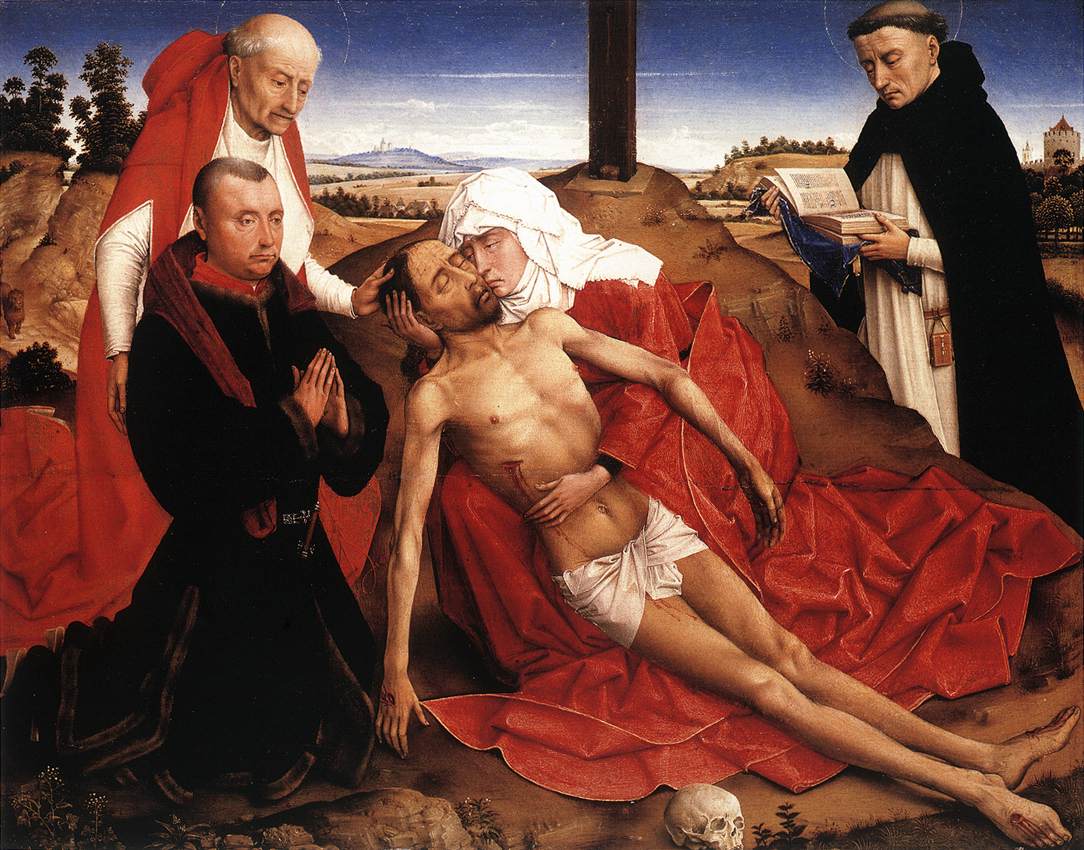
Rogier van der Weyden and his followers made several versions of the PietàA depiction of the Virgin Mary with the crucified body of Jesus across her lap. Developing in Germany in the 14th century, the Pietà became a familiar part of Renaissance religious imagery. One of the best-known examples is Michelangelo's "Pietà" (1497-1500) in St. Peter's, Rome.. This version with St Jerome, St Dominic and the donator belonged to a small portable altar and is considered as one of the best.
For this version of the Lamentation the man who commissioned it wanted to retain only Mary and Christ out of the central group, and to have himself and his patron saint, St Jerome, shown instead of St John. To the right, a Dominican replaces Mary Magdalene.
As the evidence of dendrochronology and the costume of the donora patron who commissioned a work of art for a church. Donors sometimes had their portraits included in the work they were donating as a sign of piety. indicate, the panelTerm in painting for a support of wood, metal, or other rigid substance, as distinct from canvas. Until the adoption of canvas in the 15th century nearly all the movable paintings of Europe were executed on wood, and even up to the beginning of the 17th century it is probable that as much painting was done on the one support as on the other. Painters who worked on a small scale often used copper panels (Elsheimer is a leading example), and in the colonial art of South America copper and tin and even lead and zinc were used. On a larger scale, slate has occasionally been used as a support, notably by Rubens for his altarpiece for Sta Maria in Vallicella (the Chiesa Nuova) in Rome; the picture he originally painted was said to reflect the light unpleasantly and slate was used for the replacement to produce a more matt finish. For wood panels the Italian masters of the Renaissance preferred white poplar, while oak was the most common wood used in northern Europe. Many other types were used, however; analysis of the contents of art galleries has yielded a long list, including beech, cedar, chestnut, fir, larch, linden, mahogany, olive, and walnut. In the 20th century cedar, teak, and dark walnut are favourites, and modern painters have also used plywood, fibre-board, and other synthetic materials as supports. must have been painted shortly before, or perhaps soon after, Rogier's death.
@online{wga-r74578aba46367b,
  author       = {Krén, Emil and Marx, Daniel},
  title        = {Lamentation by WEYDEN, Rogier van der},
  organization = {{Web Gallery of Art}},
  date         = {2026-09-12},
  url          = {https://beta.wga.hu/artists/weyden-rogier-van-der-r533377d705e827/lamentation-r74578aba46367b},
  urldate      = {2026-09-12},
  langid       = {english}
}
ACCESSED 2026-09-12. REPLACE THE AUTHOR FIELD WITH THE COMMENTARY AUTHOR WHERE ONE IS NAMED.


