03 — ARTWORK
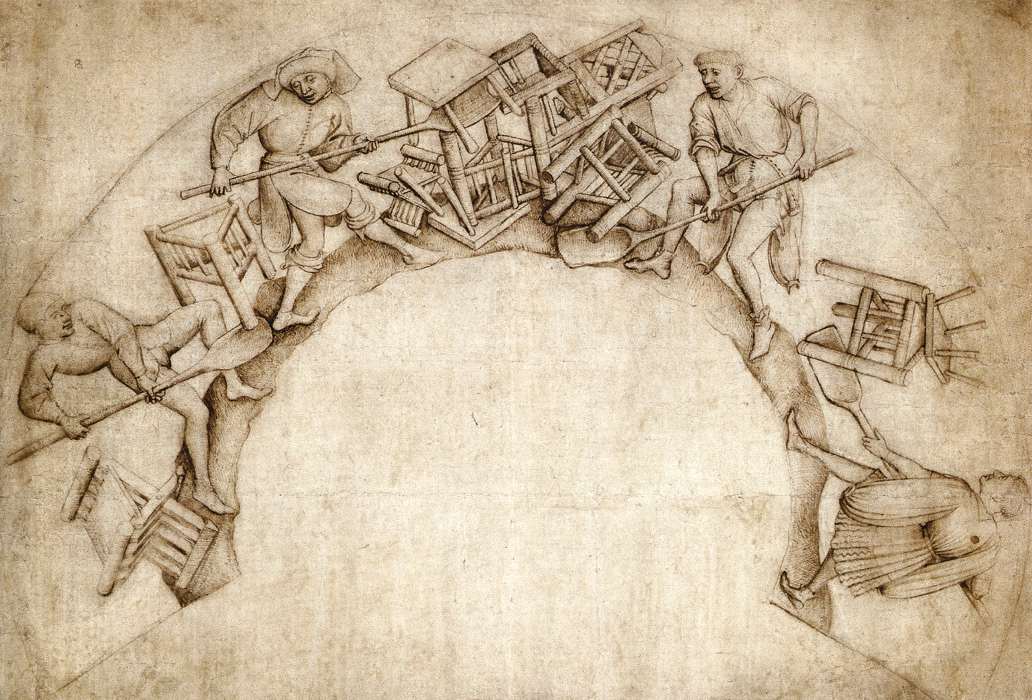
Scupstoel
WEYDEN, Rogier van der · 1450 →
- MEDIUM
- Pen over chalk tracing on paper, 298 x 425 mm
- TYPE
- Other
PALETTE
HOVER OR TAP A SWATCH FOR NAME, SHARE AND HEX. SAMPLED FROM THE IMAGE — INDICATIVE, NOT A PIGMENT ANALYSIS.
DEVELOPMENT BUILD — NOT FOR PUBLIC USE. CONTRIBUTE ON GITHUB.
CURRENT LOCATION · Metropolitan Museum of Art
03 — ARTWORK
WEYDEN, Rogier van der · 1450 →
PALETTE
HOVER OR TAP A SWATCH FOR NAME, SHARE AND HEX. SAMPLED FROM THE IMAGE — INDICATIVE, NOT A PIGMENT ANALYSIS.
COMMENTARY
UNDERLINED TERMS ARE DEFINED IN THE GLOSSARY.
The curious drawing of the Scupstoel is connected not with a painting but with a sculpture, more precisely the reliefA sculptural work in which all or part projects from the flat surface. There are three basic forms: low relief (bas-relief, basso rilievo), in which figures project less than half their depth from the background; medium relief (mezzo-rilievo), in which figures are seen half round; and high relief (alto rilievo), in which figures are almost detached from their background. ornamentation of a capitalThe head or crowning feature of a column or pillar. Structurally, capitals broaden the area of a column so that it can more easily bear the weight of the arch or entablature it supports.. This capital belonged the pillars on the lower floor of the west wing of the Brussels town hall, built from around 1447 to 1450, and although severely damaged it is still extant. Exactly reflecting the motif of the drawing, a carving of men shoveling chairs (a literal translation of the word "Scupstoel" = shovel chair) runs in high relief around the entire capital. The drawing represents a development of the curved surface of the conical architectural member. It cannot have been actually copied from the relief, for a draftsman wishing to record the different aspects of the capital would have either drawn the figures individually or shown the whole scene as a flat strip. The drawing must thus have been connected with the design of the capital, with its special manner of surface projection corresponding to the requirements of the sculptors carving the relief. However, the drawing, which is relatively well preserved in spite of its large dimensions, cannot have been the actual model, which would have been worn out with intensive use.
It seems very likely that the Brussels city council turned to their painter Rogier with a commission to design the capital. He must have prepared the basic design of the scene, and both the model followed by the sculptors and the extant drawing were presumably then copied from that design. Their author would have been an assistant in Rogier's workshop, perhaps one of the painters who participated in work on the panels of scenes from the life of St. Hubert (National Galleryan upper story, similar to a tribune, running along the side of a building and open on one side to the interior; in a church (basilica) above the side aisles, over the ambulatory (central-plan building) and also over the west end. The gallery was used to keep certain groups of worshippers apart (women, noblemen)., London), in which the faces of certain figures in the background are strongly reminiscent of the heads of the shoveling men. Perhaps Rogier himself merely sketched out the design and then directed his assistants to prepare a more detailed drawing as a model for the city council who had commissioned it. Or perhaps his design passed into the hands of the council, and he had a copy made by his assistants for the workshop stocks.
@online{wga-rcf5ff6a44823ba,
  author       = {Krén, Emil and Marx, Daniel},
  title        = {Scupstoel by WEYDEN, Rogier van der},
  organization = {{Web Gallery of Art}},
  date         = {2026-09-13},
  url          = {https://beta.wga.hu/artists/weyden-rogier-van-der-r533377d705e827/scupstoel-rcf5ff6a44823ba},
  urldate      = {2026-09-13},
  langid       = {english}
}
ACCESSED 2026-09-13. REPLACE THE AUTHOR FIELD WITH THE COMMENTARY AUTHOR WHERE ONE IS NAMED.


