03 — ARTWORK
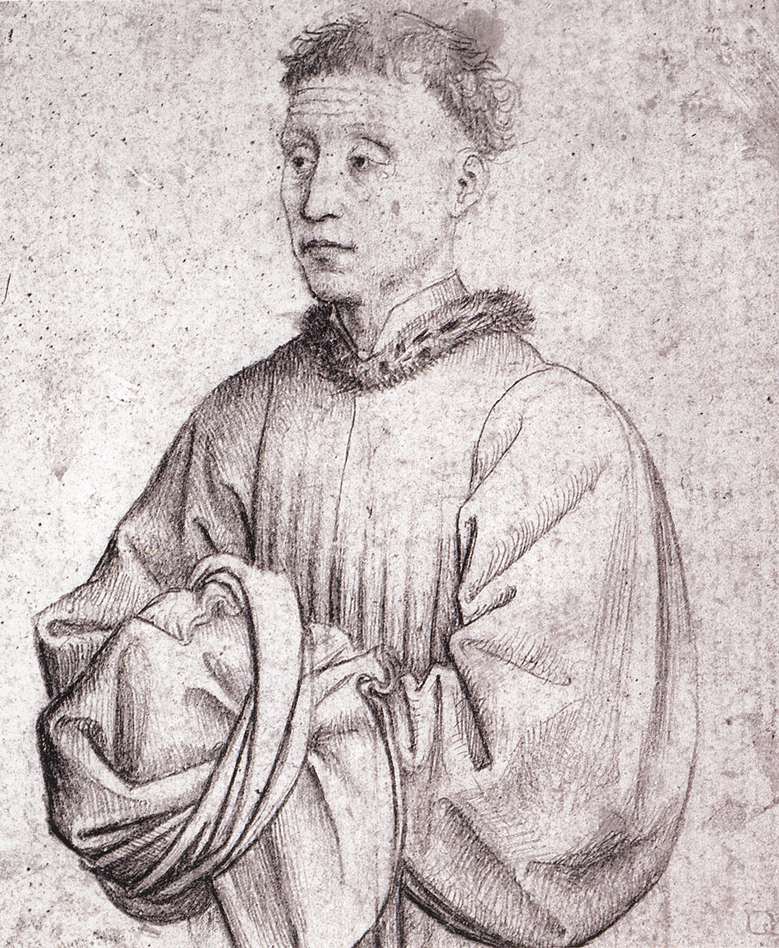
Young Man
WEYDEN, Rogier van der · 1439 →
- MEDIUM
- Silverpoint on prepared paper, 98 x 81 mm
- TYPE
- Study
PALETTE
HOVER OR TAP A SWATCH FOR NAME, SHARE AND HEX. SAMPLED FROM THE IMAGE — INDICATIVE, NOT A PIGMENT ANALYSIS.
DEVELOPMENT BUILD — NOT FOR PUBLIC USE. CONTRIBUTE ON GITHUB.
CURRENT LOCATION · Staatliche Museen (Berlin)
03 — ARTWORK
WEYDEN, Rogier van der · 1439 →
PALETTE
HOVER OR TAP A SWATCH FOR NAME, SHARE AND HEX. SAMPLED FROM THE IMAGE — INDICATIVE, NOT A PIGMENT ANALYSIS.
COMMENTARY
UNDERLINED TERMS ARE DEFINED IN THE GLOSSARY.
The drawing of a Young Man appears at first to be a portraitThe Roman portrait bust survived in the form of life-sized reliquaries of saints, but it was in 15th century Florence that the individual features and character of a contemporary sitter were accurately recorded by sculptors such as Donatello, Desiderio da Settignano, Mino da Fiesole and the Rossellino. A similar degree of realism occurs in 15th century tomb sculpture. The equestrian portrait, based on antique statues such as the Marcus Aurelius monument (Rome, Campidoglio), was revived in the 14th century. Two examples in fresco are Simone Martini's Guidoriccio (c. 1328; Siena, Palazzo Pubblico) and the posthumous portrait of Sir John Hawkwood (1436; Florence, Cathedral) by Uccello, which gives the illusion of a 3-dimensional statue seen from below. The Venetian Republic ordered imposing monuments from Donatello (1447; Gattarnelata, Padua) and Verrocchio (14799; Colleoni, Venice), whilst other statesmen ordered their own images to be erected in public places, directly relating themselves to the military heroes of ancient Rome. Another form of political portraiture derived from antiquity was the commemorative portrait medal designed by artists such as Pisanello. The carved or painted profile portrait became popular in the 1450s. The realism of the clear, flattened image, painted under the influence of Flemish examples by the Pollaiuolo brothers, Piero della Francesca and Botticelli, was superseded by the three-quarter and frontal portrait, psychologically more complex, such as Leonardo's enigmatic Mona Lisa (Paris, Louvre) with her momentary smile or Andrea del Sarto's arresting Portrait of a Man (London, National Gallery). The 16th century portrait became generalized, Lotto's Andrea Odoni (1527; Royal Collection) being an idealized concept of a collector rather than an individual. Group portraits, decorating whole rooms, include the narrative scenes of the Gonzaga court painted by Mantegna (completed 1474; Mantua, Palazzo Ducale) and the elaborate schemes commissioned by the Farnese family in Rome from Vasari (1546; Palazzo della Cancelleria) and Salviati (after 1553; Palazzo Farnese). Portraits were also incorporated into religious narratives, as in Ghirlandaio's fresco cycle painted for Giovanni Tornabuoni in S. Maria Novella, Florence (1486-90)., but is not connected with any individual portrait painting. The half length depiction of the subject - who may originally have been shown full length, since the drawing has been trimmed at the bottom - and more particularly the way he is holding his hat, the "chaperon," in front of his chest - indicate that he belongs in the context of some scene. Oddly, he has buried his hands in the chaperon as if in a muff. As he would not have been praying with his hands in this position, his glance cannot be bent on saintly figures. He is more likely to fit into the context of some secular event, in which he is a subordinate figure and must take off his hat; this would probably have been a scene similar to that of the introductory miniatureTerm originally applied to the art of manuscript illumination but later used of paintings, usually portraits, executed on a very small scale. The earliest miniaturists (16th century) continued to use the materials of the illuminators, painting in gouache on vellum or card. in the Hainault Chronicle.
The clothes he wears show that the Young Man is in fact earlier than the miniature: for instance, his chaperon has not yet acquired the large bulge of the Duke's in the miniature, his baggy sleeves have no shoulder padding, and his belt is obviously worn low, features corresponding to the fashions of the 1430s. In the face, with its emphasis on the eyes, its apparently long nose, and its clearly depicted bone structure, the drawing shows characteristic elements of Rogier's style in earlier heads such as that of St. Luke, as well as in his later portraits (Portrait of Jean de Gros, Chicago). The young man's grave but slightly skeptical expression imparts something lifelike to the portrait, and one is initially inclined to think that it was indeed drawn from life. On the other hand, more attention seems to have been paid to the man's clothing than to his face, and it is not very likely that he would have been sitting for his portrait in an attitude suggesting an established pictorial context. Yet the drawing appears on the whole spontaneous; the forms and folds of the man's garments are precisely depicted, with some areas more strongly outlined, and the hatchingIn a drawing, print or painting, a series of close parallel lines that create the effect of shadow, and therefore contour and three-dimensionality In crosshatching the lines overlap., sometimes in several layers, is relatively rapid and not overmeticulous. The freer line and hatching do show some similarities with much of the underdrawing in Rogier's work, but these are conventions of draftsmanship which may indeed indicate connections between the artists responsible, but do not allow an attribution to the same hand.
The Young Man will not really stand comparison with the much more finely worked Portrait of a Young Woman (British Museum, London), where light and shade are rendered in the manner of a painting. Even the details that the artist chose to depict show that the two drawings were made for different purposes. Moreover, the line is so different in the two portraits that although they were probably done at around the same time, it is difficult to see them as the work of a single artist, though these two drawings alone among Early Netherlandish drawings qualify for consideration as works by Rogier's own hand.
@online{wga-r8ac7bb340404df,
  author       = {Krén, Emil and Marx, Daniel},
  title        = {Young Man by WEYDEN, Rogier van der},
  organization = {{Web Gallery of Art}},
  date         = {2026-09-13},
  url          = {https://beta.wga.hu/artists/weyden-rogier-van-der-r533377d705e827/young-man-r8ac7bb340404df},
  urldate      = {2026-09-13},
  langid       = {english}
}
ACCESSED 2026-09-13. REPLACE THE AUTHOR FIELD WITH THE COMMENTARY AUTHOR WHERE ONE IS NAMED.


