03 — ARTWORK
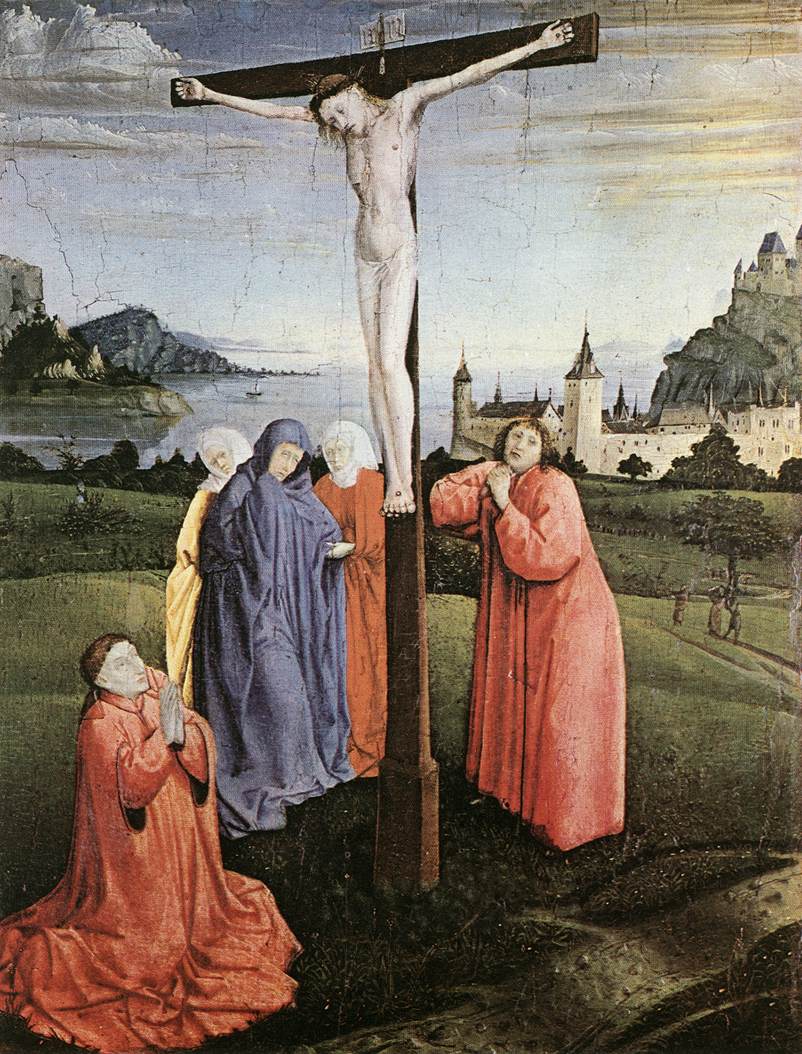
Christ on the Cross
- MEDIUM
- Panel, 34 x 26 cm
- TYPE
- Religious
PALETTE
HOVER OR TAP A SWATCH FOR NAME, SHARE AND HEX. SAMPLED FROM THE IMAGE — INDICATIVE, NOT A PIGMENT ANALYSIS.
DEVELOPMENT BUILD — NOT FOR PUBLIC USE. CONTRIBUTE ON GITHUB.
03 — ARTWORK
PALETTE
HOVER OR TAP A SWATCH FOR NAME, SHARE AND HEX. SAMPLED FROM THE IMAGE — INDICATIVE, NOT A PIGMENT ANALYSIS.
COMMENTARY
UNDERLINED TERMS ARE DEFINED IN THE GLOSSARY.
The Cross stands in an undulating landscape. The scene is profoundly peaceful, giving no suggestion of the place of execution as recorded in the Bible; the two thieves and the soldiers are missing. Only the mourners stand under the Cross, the Virgin on the left, supported by two female companions, and Saint John on the right, wringing his hands in anguish ; yet, far from conveying a deep sense of emotion, they seem almost like travellers who have stopped to pray by a wayside cross. The donora patron who commissioned a work of art for a church. Donors sometimes had their portraits included in the work they were donating as a sign of piety. of the picture is shown kneeling beside the stony path, his hands raised in prayer, his eyes turned heavenwards.
Almost the entire width of the background is taken up by a lake; a town and a fortified castle stand on its rocky shore. They are depicted with such precision as to suggest a definite locality, but the topographical details have never been identified with any known place. However, Lake Geneva suggests itself as one possibility, since the painter spent the greater part of his life in the Swiss countryside.
The motif of the Cross in an open landscape was one with which Witz would have become acquainted through the Netherlandish painters. The nature of the composition, the attitude of the kneeling donor, the mourners in their loose, flowing robes, the landscape and, not least, the fleecy clouds in the sky recall Van Eyck and Rogier van der Weyden. On the other hand, there is nothing in the artist's little-documented life-history to indicate how he came to be influenced by them.
Witz was born at Rottweil in Swabia, probably in the first decade of the fifteenth century. From 1434 onwards he lived in Basel, where he painted the so-called Altar of the Redemption, the several panels of which have found their way into different collections. In Geneva he completed the altar for St Peter's CathedralThe principal church of a province or diocese, where the throne of the bishop is placed. For reasons lost to time and tradition, a cathedral always faces west - toward the setting sun. The altar is placed at the east end. The main body, or nave, of the cathedral is usually divided into one main and two side aisles. These lead up to the north and south transepts, or arms of the cross, the shape in which a cathedral is usually formed. in 1444, but thereafter he disappears into obscurity, and in 1447 his wife was registered as a widow. Both the altarpieces show a highly individual and unmistakable style but give no real hint as to Konrad Witz's artistic antecedents. The Berlin CrucifixionAn important method of capital punishment, particularly among the Persians, Seleucids, Jews, Carthaginians, and Romans from about the 6th century BC to the 4th century AD. Constantine the Great, the first Christian emperor, abolished it in the Roman Empire in AD 337, out of veneration for Jesus Christ, the most famous victim of crucifixion. There were various methods of performing the execution. Usually, the condemned man, after being whipped, or "scourged," dragged the crossbeam of his cross to the place of punishment, where the upright shaft was already fixed in the ground. Stripped of his clothing either then or earlier at his scourging, he was bound fast with outstretched arms to the crossbeam or nailed firmly to it through the wrists. The crossbeam was then raised high against the upright shaft and made fast to it about 9 to 12 feet (approximately 3 metres) from the ground. Next, the feet were tightly bound or nailed to the upright shaft. A ledge inserted about halfway up the upright shaft gave some support to the body; evidence for a similar ledge for the feet is rare and late. Over the criminal's head was placed a notice stating his name and his crime. Death, apparently caused by exhaustion or by heart failure, could be hastened by shattering the legs (crurifragium) with an iron club, so that shock and asphyxiation soon ended his life. is of special interest, in that it was clearly painted in the earlier period of the artist's life, before he settled in Basel. In it one can see the first manifestation of the new realismRealism (with an upper case "R"), also known as the Realist school, denotes a mid-nineteenth century art movement and style in which artists discarded the formulas of Neoclassicism and the theatrical drama of Romanticism to paint familiar scenes and events as they actually looked. Typically it involved some sort of sociopolitical or moral message, in the depiction of ugly or commonplace subjects. One of the main representatives and spokesmen was the painter Gustave Courbet. In the dispute about ways to represent reality, Realism rebelled against the idealistic and classicist tendencies in painting., which, in the second quarter of the century, begins to replace the courtly, elegant, so-called `soft' style.
@online{wga-r934948cb1bb599,
  author       = {Krén, Emil and Marx, Daniel},
  title        = {Christ on the Cross by WITZ, Konrad},
  organization = {{Web Gallery of Art}},
  date         = {2026-09-09},
  url          = {https://beta.wga.hu/artists/witz-konrad-r90a25e4a2faabb/christ-on-the-cross-r934948cb1bb599},
  urldate      = {2026-09-09},
  langid       = {english}
}
ACCESSED 2026-09-09. REPLACE THE AUTHOR FIELD WITH THE COMMENTARY AUTHOR WHERE ONE IS NAMED.


