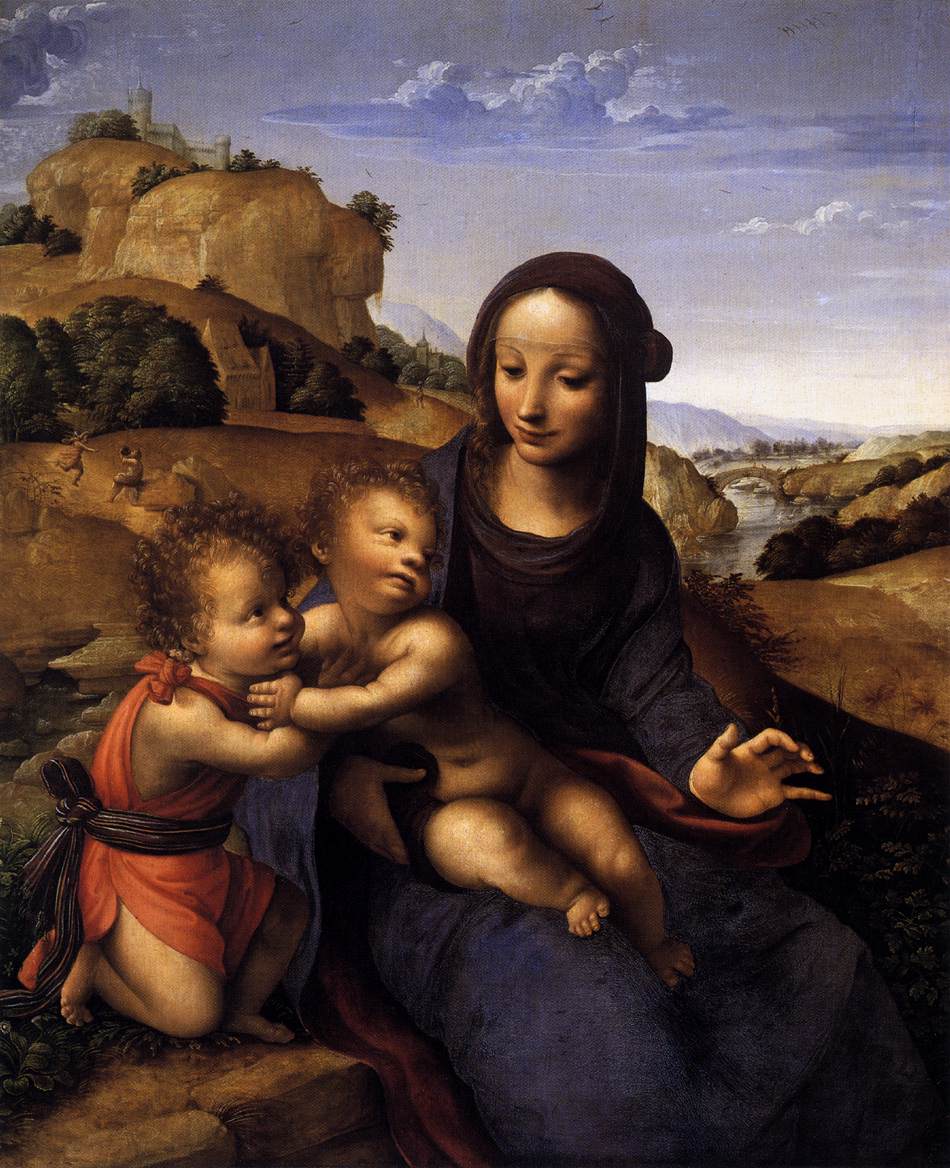
Madonna and Child with Infant St John c. 1505 Oil on panelTerm in painting for a support of wood, metal, or other rigid substance, as distinct from canvas. Until the adoption of canvas in the 15th century nearly all the movable paintings of Europe were executed on wood, and even up to the beginning of the 17th century it is probable that as much painting was done on the one support as on the other. Painters who worked on a small scale often used copper panels (Elsheimer is a leading example), and in the colonial art of South America copper and tin and even lead and zinc were used. On a larger scale, slate has occasionally been used as a support, notably by Rubens for his altarpiece for Sta Maria in Vallicella (the Chiesa Nuova) in Rome; the picture he originally painted was said to reflect the light unpleasantly and slate was used for the replacement to produce a more matt finish. For wood panels the Italian masters of the Renaissance preferred white poplar, while oak was the most common wood used in northern Europe. Many other types were used, however; analysis of the contents of art galleries has yielded a long list, including beech, cedar, chestnut, fir, larch, linden, mahogany, olive, and walnut. In the 20th century cedar, teak, and dark walnut are favourites, and modern painters have also used plywood, fibre-board, and other synthetic materials as supports., 78 x 64 cm National Galleryan upper story, similar to a tribune, running along the side of a building and open on one side to the interior; in a church (basilica) above the side aisles, over the ambulatory (central-plan building) and also over the west end. The gallery was used to keep certain groups of worshippers apart (women, noblemen). of Art, Washington
Yañez spent time in Florence and was powerfully influenced by Leonardo da Vinci, who had returned from Milan in April 1500. In fact, between 30 April and 10 August 1505, a certain "Ferrando Spagnuolo" received payments for assisting the master in the execution of the Battle of AnghiariA Florentine and papal army defeated a Milanese force under Piccinino outside this town near Arezzo (29 June 1440). Macchiavelli, in his History of Florence, used it shamelessly as an example of the reluctance of mercenaries to risk death in battle: he put the casualties as 'one man killed, and he fell off his horse and was trampled to death', whereas sources available to him put the joint fatalities at some 300. It was a subject of a fresco painted by Leonardo da Vinci in the Palazzo Vecchio in Florence (chosen because it was primarily a cavalry engagement and he could show horses in combat). The fresco rapidly decayed and its composition is best known from the sketch Rubens made of its central part. in the PalazzoPalaces: large urban dwellings, 'palazzo' in Italian carries no regal connotations. Alberti described the palace as a city in little, and, like cities, Italian Renaissance palaces vary in type according to differences of climate, tradition and social structure. On to these regional stocks were grafted new architectural strains, reflecting theoretical reinterpretations of antiquity and individually influential examples. The atrium and peristyle house described by Vitruvius and now known from Pompeii did not survive antiquity, and much of the interest of Renaissance designs lies in creative misunderstandings of Vitruvius's text. Medieval palace architecture probably inherited the insula type of ancient apartment house, related to the modest strip dwellings which never disappeared from Italian cities. In Florence a merchant palace developed from fortified beginnings, with vaulted shop openings on the ground floor, and the main apartments above, reached by internal stone staircases opening from an inner court. Renaissance developments regularized without changing the essential type, although large cloister-like courtyards were introduced, while shops came to be thought undignified. At Michelozzo's Medici Palace (1444) a square arcaded courtyard with axial entrance lies behind a façade of graduated rustication, with biforate windows, a classical cornice replacing the traditional wooden overhang. The apartments on the 'piano nobile' formed interconnecting suites of rooms of diminishing size and increasing privacy. The classical orders which Alberti introduced to the façade of the Palazzo Rucellai (c.1453) were not taken up by the conservative Florentines, who continued to build variations on the Medici Palace (Palazzo Pitti; Palazzo Strozzi). In the 16th century rustication was reduced to quoins and voussoirs, and large windows appeared on the ground floor, 'kneeling' on elongated volutes. At Urbino the Ducal Palace (1465) reflected Alberti's recommendations for the princely palace, and was in turn influential on late 15th century palaces in Rome (e.g. the Cancelleria). A harmonious Florentine courtyard and ample staircase replace the embattled spaces of medieval seigneurial castles, of which vestiges remain only in the towers flanking the balconies of the duke's private apartments, designed as a scholarly retreat. In the absence of a merchant class or a cultured nobility in 15th century Rome, the architectural pace was set by the papal court. Papal incentives to build, and large households, meant less compact plans for cardinals' palaces, often built next to their titular churches. Renaissance forms appear in the unfinished courtyard of the Palazzo Venezia (1460s), with its arcade system derived from the nearby Theatre of Marcellus, and in the delicately ordered stonework of the Cancelleria (1485). In the 16th century vestigial corner towers and shops disappear from cardinals' palaces, and Antonio da Sangallo's Palazzo Farnese (1516) introduces symmetrical planning and Vitrivuan elements, like the colonnaded vestibule, behind a sober Florentine façade, enlivened by Michelangelo's cornice. A smaller palace type supplied the needs of an enlarged papal bureaucracy, more ambitious for display than for domestic accommodation. Bramante's 'House of Raphael' sets the façade style not only for this new type, but also for Renaissance houses all over Europe. Raphael and Peruzzi made ingenious use of difficult sites (Palazzo da Brescia; Palazzo Massimi), and their sophisticated façades flattered the architectural pretensions of patron and pope (e.g. Palazzo Branconio dell'Aquila). Movement of patrons and architects, especially after the Sack of Rome, meant a diffusion of Roman forms to central and northern Italy, where Sanmicheli's palaces in Verona, and Palladio's in Vicenza, adapted Roman types to suit local conditions. Palladio's 4-columned atrium is a Vitruvian solution to the traditionally wide Veneto entrance hall, and his plan for the Palazzo da Porto-Festa contains explicit references to Vitruvius's House of the Greeks. In Venice, defended by its lagoon and a stable political system, the hereditary aristocracy built palaces open to trade and festivity on the Grand Canal. The traditional Venetian palace has a tripartite structure: long central halls above entrance vestibules used for unloading merchandise are lit on the canal façade by clusters of glazed windows (rare elsewhere), and at the back from small courts with external staircases (as in the Ca' d'Oro). Codussi's palaces introduced biforate windows and a grid of classical orders into the system, while Sansovino's Palazzo Cornaro retains vestiges of the Venetian type (small courtyard; tripartite façade) despite its Bramantesque coupled orders and licentious window surrounds. Other cities, like Genoa, evolved influential types. Through engravings and the illustrated treatises, Italian Renaissance ideas of palace planning, originally evolved in response to specific conditions, came to be applied all over Europe. della Signoriafrom the late Middle Ages, the governing body of some of the Italian city states, usually presided over by individual families.. The painter in question must have been Yañez, as suggested by the recent attribution of the Madonna and Child with Infant St John of his Italian period. This picture combines motifs from the compositions by Leonardo, notably the Madonna of the Yarnwinder, and places them against a bright landscape derived from Flemish painting, an idea found in paintings of Raphael and Fra Bartolommeo. Yañez continued to draw on Leonardo's vocabulary for the rest of his life, re-using motifs such as the extended, foreshortened hand of the Virgin until they became clichés.