03 — ARTWORK
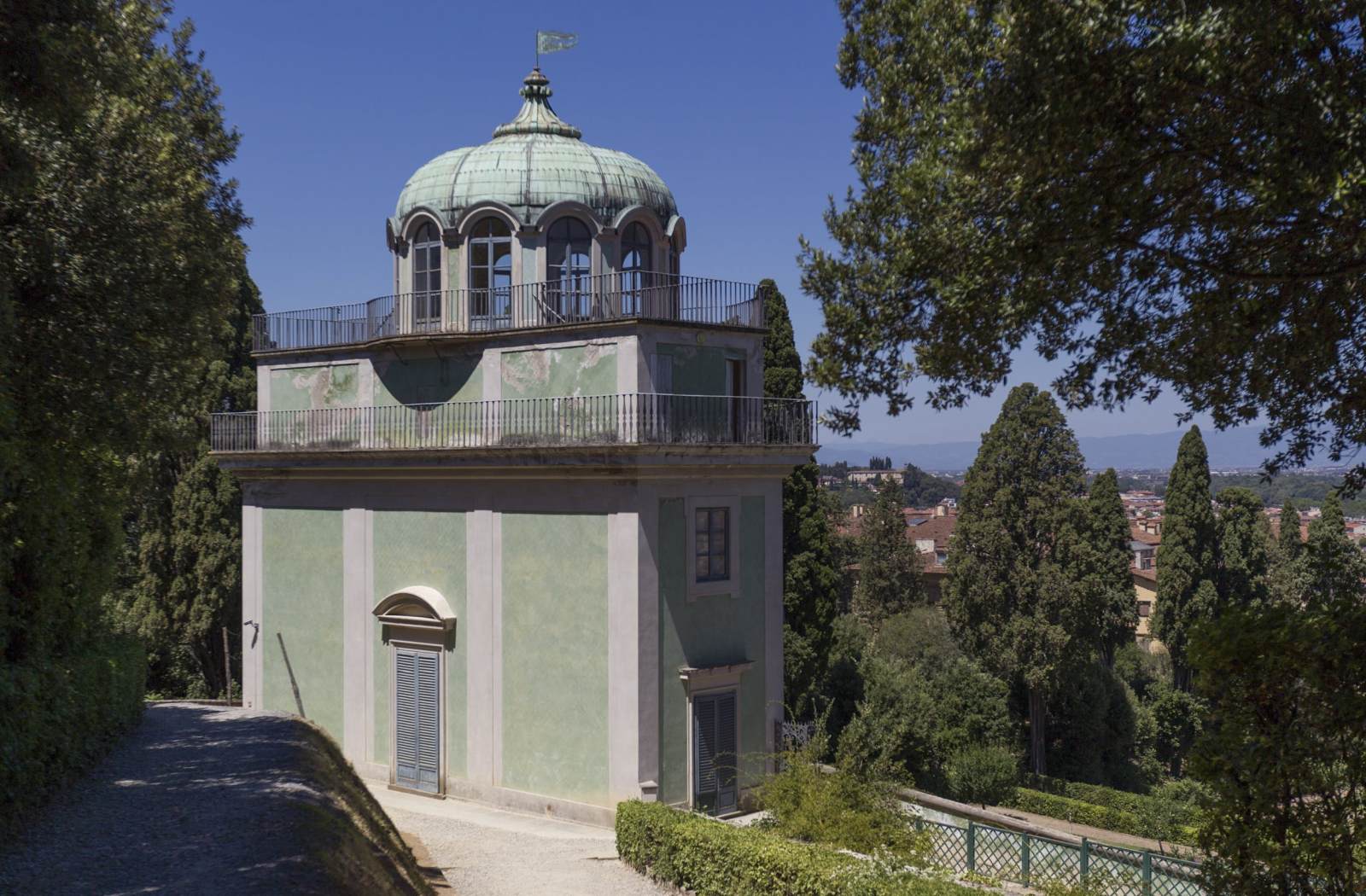
Kaffeehaus
- MEDIUM
- Photo
- TYPE
- Other
PALETTE
HOVER OR TAP A SWATCH FOR NAME, SHARE AND HEX. SAMPLED FROM THE IMAGE — INDICATIVE, NOT A PIGMENT ANALYSIS.
DEVELOPMENT BUILD — NOT FOR PUBLIC USE. CONTRIBUTE ON GITHUB.
03 — ARTWORK
PALETTE
HOVER OR TAP A SWATCH FOR NAME, SHARE AND HEX. SAMPLED FROM THE IMAGE — INDICATIVE, NOT A PIGMENT ANALYSIS.
COMMENTARY
UNDERLINED TERMS ARE DEFINED IN THE GLOSSARY.
The Kaffeehaus is one of the most interesting buildings inside the Boboli Gardens and is also one of the works carried out at the wishes of Grand Duke Peter Leopold of Lorraine, between 1774 and 1785. Work on the "new house under the fortress", as it was initially called, began in 1774, from designs by Zanobi del Rosso. In the first part of 1775, the new building was completed and ready to be used as a resting place, in which the court could enjoy a hot chocolate drink during its walks.
The building is an airy pavilionA lightly constructed, ornamental building, such as a garden summerhouse; a small, ornamental structure built onto a palace or cháteau; a prominent section of a monumental façade, projecting either centrally or at both ends., circular in shape and with an onion-shaped domein architecture, hemispherical structure evolved from the arch, usually forming a ceiling or roof. top. It is divided over three separate levels, beautifully inserted in a complex of small gardens and orchards. The interior is divided over four main levels and side mezzanine floors with triangular stairs. Between 1775 and 1776, the interiors were decorated on the main floor by three artists who were well known in Florence at the time: Giuseppe del Moro, Giuliano Traballesi, and Pasquale Micheli.
The perfection of the building lies in its exquisite, carefully applied detailing. This includes the small triangular stairway inside that takes the visitor through the whole Kaffeehaus, from the ground floor to the belvedere with dome top, or the insides of the doors and windows in the painted room on the first floor, harmoniously blended with the background colour of the paintings. A good deal of elegance has been incorporated into the terracottaUnglazed fired clay. It is used for architectural features and ornaments, vessels, and sculptures. flooring in rectangular and hexagonal tiling with blocks of white marbleloosely applied to any hard limestone that can be sawn into thin slabs and will take a good polish so that it is suitable for decorative work; more strictly, it refers to metamorphosed limestones whose structure has been recrystallized by heat or pressure. Marbles are widely disseminated and occur in a great variety of colours and patterns, but certain types have been particularly prized by sculptors. The most famous of Greek white marbles in the ancient world was the close-grained Pentelic, which was quarried at Mount Pentelicon in Attica. The Elgin Marbles are carved in Pentelic. Widely used also were the somewhat coarser-grained translucent white marbles from the Aegean islands of Paros and Naxos. Parian marble was used for the celebrated Mausoleum at Halicarnassus. The pure white Carrara marble, quarried at Massa, Carrara, and Pietra Santa in Tuscany from the 3rd century BC, is the most famous of all sculptors' stones. It was used for the Apollo Belvedere, and was much favoured in the Renaissance, particularly by Michelangelo, who often visited the quarries to select material for his work. Neoclassical sculptors also favoured Carrara marble because of its ability to take a smooth, sleek surface, but it can look rather 'dead' compared with some of the finest Greek marbles. and a double ring in white marble around the edge. With its rounded forms, the multilinear roof like a turret, known in the city as the "Chinese pavilion", is an example of completely new architecture on the late 18th-century panorama of Florence. It is quite similar to the structures of some Viennese palaces, characterised by evident similarities to the ottoman tents, the so-called "turqueries".
@online{wga-reeea5e2876e592,
  author       = {Krén, Emil and Marx, Daniel},
  title        = {Kaffeehaus by ZANOBI DEL ROSSO},
  organization = {{Web Gallery of Art}},
  date         = {2026-09-13},
  url          = {https://beta.wga.hu/artists/zanobi-del-rosso-rb774806b6cc0dd/kaffeehaus-reeea5e2876e592},
  urldate      = {2026-09-13},
  langid       = {english}
}
ACCESSED 2026-09-13. REPLACE THE AUTHOR FIELD WITH THE COMMENTARY AUTHOR WHERE ONE IS NAMED.


