03 — ARTWORK
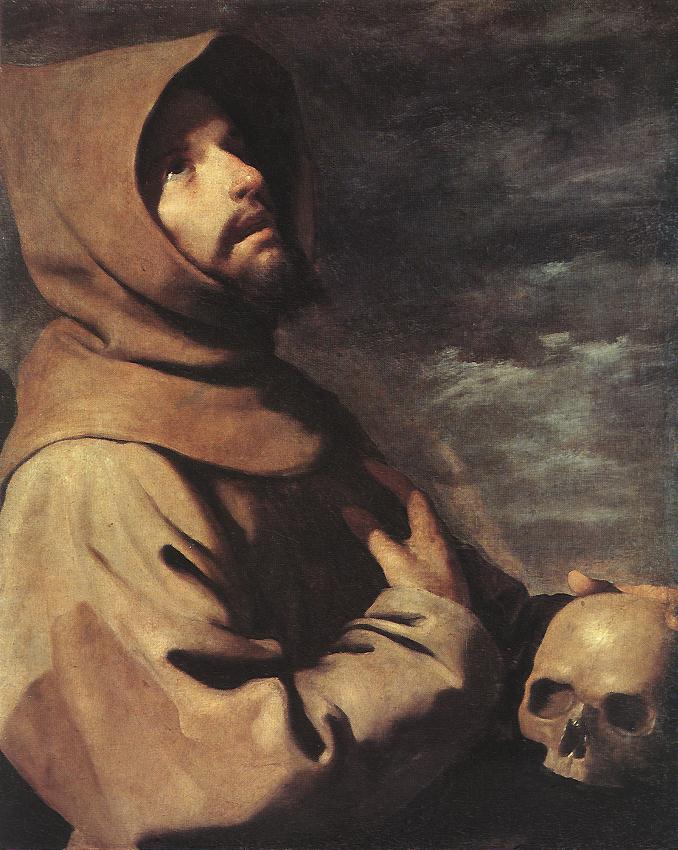
St Francis
ZURBARÁN, Francisco de · 1660 →
- MEDIUM
- Oil on canvas, 65 x 53 cm
- TYPE
- Religious
PALETTE
HOVER OR TAP A SWATCH FOR NAME, SHARE AND HEX. SAMPLED FROM THE IMAGE — INDICATIVE, NOT A PIGMENT ANALYSIS.
DEVELOPMENT BUILD — NOT FOR PUBLIC USE. CONTRIBUTE ON GITHUB.
03 — ARTWORK
ZURBARÁN, Francisco de · 1660 →
PALETTE
HOVER OR TAP A SWATCH FOR NAME, SHARE AND HEX. SAMPLED FROM THE IMAGE — INDICATIVE, NOT A PIGMENT ANALYSIS.
COMMENTARY
UNDERLINED TERMS ARE DEFINED IN THE GLOSSARY.
Born in 1181 or 1182 in Assisi as the son of a wealthy draper, he died in poverty in the same town on 3 October 1226. Francis' life of poverty, humility, selflessness and serene neighbourly love made the order of Friars Minor which he founded one of the most widespread religious orders in the entire western world. Following the council of Trent in the mid 16th century, St Francis was invariably portrayed as an ascetic, penitent and ecstatic monk, frequently dressed in the habit of the Capuchin monks and with a skull as attributeA symbolic object which is conventionally used to identify a particular person, usually a saint. In the case of martyrs, it is usually the nature of their martyrdom..
Zurbarán's saint bears the entire complexity of this figure. This is Francis the ascetic, dressed in a brown habit, without signs of office or adornment. This is the humble Francis dressed in the colours of the earth. This is Francis the ecstatic monk, who has received the stigmataThe five Crucifixion wounds of Christ (pierced feet, hands and side) which appear miraculously on the body of a saint. One of the most familiar examples in Renaissance art is the stigmatization of St. Francis of Assisi. of the five wounds. His young face is raised heavenwards in contemplation, one hand placed upon his heart, the other on the skull, the sign of meditation. He is shown as a holy man of spiritual profundity and scholarly intellect, as reflected in his facial traits. Yet he is not a monk who is alienated from daily life and caught up entirely in his mystical passionThe events leading up to Good Friday, beginning with Christ's arrest and ending with his burial. Portrayals of the Passion, which focus on the Suffering Christ, include depictions of Judas betraying Christ with a kiss, Peter cutting off Malchus's ear, the crown of thorns, and so on., but a man close to life, as Zurbarán shows. His "portraitThe Roman portrait bust survived in the form of life-sized reliquaries of saints, but it was in 15th century Florence that the individual features and character of a contemporary sitter were accurately recorded by sculptors such as Donatello, Desiderio da Settignano, Mino da Fiesole and the Rossellino. A similar degree of realism occurs in 15th century tomb sculpture. The equestrian portrait, based on antique statues such as the Marcus Aurelius monument (Rome, Campidoglio), was revived in the 14th century. Two examples in fresco are Simone Martini's Guidoriccio (c. 1328; Siena, Palazzo Pubblico) and the posthumous portrait of Sir John Hawkwood (1436; Florence, Cathedral) by Uccello, which gives the illusion of a 3-dimensional statue seen from below. The Venetian Republic ordered imposing monuments from Donatello (1447; Gattarnelata, Padua) and Verrocchio (14799; Colleoni, Venice), whilst other statesmen ordered their own images to be erected in public places, directly relating themselves to the military heroes of ancient Rome. Another form of political portraiture derived from antiquity was the commemorative portrait medal designed by artists such as Pisanello. The carved or painted profile portrait became popular in the 1450s. The realism of the clear, flattened image, painted under the influence of Flemish examples by the Pollaiuolo brothers, Piero della Francesca and Botticelli, was superseded by the three-quarter and frontal portrait, psychologically more complex, such as Leonardo's enigmatic Mona Lisa (Paris, Louvre) with her momentary smile or Andrea del Sarto's arresting Portrait of a Man (London, National Gallery). The 16th century portrait became generalized, Lotto's Andrea Odoni (1527; Royal Collection) being an idealized concept of a collector rather than an individual. Group portraits, decorating whole rooms, include the narrative scenes of the Gonzaga court painted by Mantegna (completed 1474; Mantua, Palazzo Ducale) and the elaborate schemes commissioned by the Farnese family in Rome from Vasari (1546; Palazzo della Cancelleria) and Salviati (after 1553; Palazzo Farnese). Portraits were also incorporated into religious narratives, as in Ghirlandaio's fresco cycle painted for Giovanni Tornabuoni in S. Maria Novella, Florence (1486-90)." is an allegoryA work of art which represents some abstract quality or idea, either by means of a single figure (personification) or by grouping objects and figures together. Renaissance allegories make frequent allusions both to both Greek and Roman legends and literature, and also to the wealth of Christian allegorical stories and symbols developed during the Middle Ages. of faith and simplicity. <P> <TABLE ALIGN=LEFT CELLPADDING=5 BORDER=1 WIDTH=320 BGCOLOR="#99CCCC"> <TR VALIGN=MIDDLE><TD><IMG SRC="/support/gif/listen.gif" BORDER=0 VALIGN=MIDDLE> Suggested listening (streaming mp3, 33 minutes):<BR><A HREF="#" onClick="w=window.open ('/music1/18_cent/haydn_m_mass.html', 'newWin', 'scrollbars=yes,status=no,dependent=yes,screenX=0,screenY=0,width=350,height=350');w.opener=this;w.focus();return true"><B>Michael Haydn: St Francis Mass</B></A> </TD></TR></TABLE>
*** Keywords: *************
Author: ZURBARÁN, Francisco de Title: St Francis Time-line: 1601-1650 School: Spanish Form: painting Type: religious
@online{wga-r74fc93f6c133ac,
  author       = {Krén, Emil and Marx, Daniel},
  title        = {St Francis by ZURBARÁN, Francisco de},
  organization = {{Web Gallery of Art}},
  date         = {2026-09-13},
  url          = {https://beta.wga.hu/artists/zurbarn-francisco-de-r77ca2ee6c5121d/st-francis-r74fc93f6c133ac},
  urldate      = {2026-09-13},
  langid       = {english}
}
ACCESSED 2026-09-13. REPLACE THE AUTHOR FIELD WITH THE COMMENTARY AUTHOR WHERE ONE IS NAMED.


