03 — ARTWORK
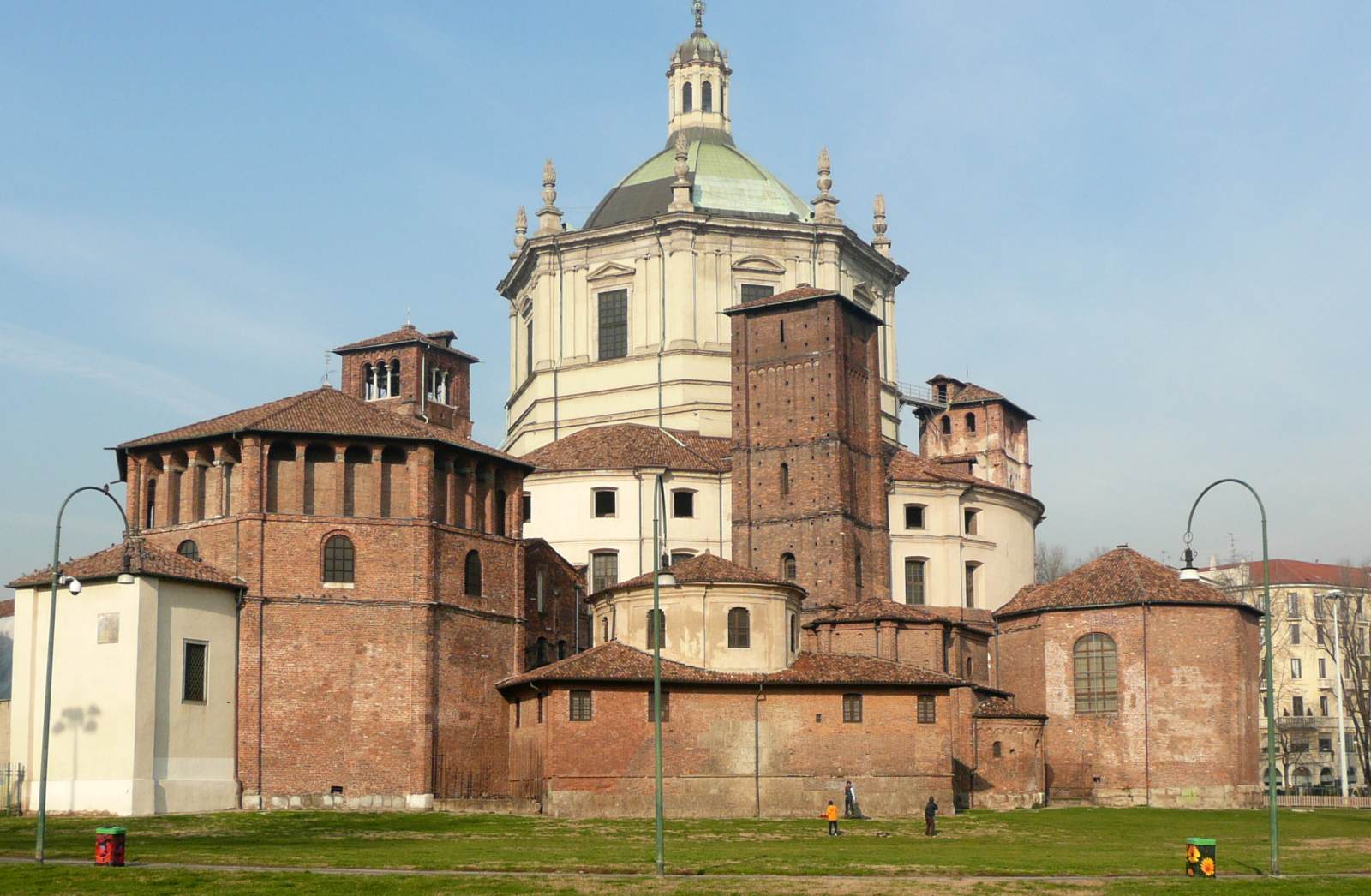
Exterior view
- MEDIUM
- Photo
- TYPE
- Religious
PALETTE
HOVER OR TAP A SWATCH FOR NAME, SHARE AND HEX. SAMPLED FROM THE IMAGE — INDICATIVE, NOT A PIGMENT ANALYSIS.
DEVELOPMENT BUILD — NOT FOR PUBLIC USE. CONTRIBUTE ON GITHUB.
CURRENT LOCATION · San Lorenzo Maggiore (Milan)
03 — ARTWORK
PALETTE
HOVER OR TAP A SWATCH FOR NAME, SHARE AND HEX. SAMPLED FROM THE IMAGE — INDICATIVE, NOT A PIGMENT ANALYSIS.
COMMENTARY
UNDERLINED TERMS ARE DEFINED IN THE GLOSSARY.
Milan was a Celtic settlement that became a Roman city called Mediolanum in 222 BC. It served as the capitalThe head or crowning feature of a column or pillar. Structurally, capitals broaden the area of a column so that it can more easily bear the weight of the arch or entablature it supports. of the Western Empire from AD 280 to 402 and also became a prominent Early Christian centre under Archbishop Ambrose (reg AD 374–97). Its history is closely linked with the early years of the Church, and it is famous for the Edict of Milan of 313.
The episcopate of St Ambrose saw the building of many Early Christian churches, including Sant'Ambrogio, San Lorenzo Maggiore, San Simpliciano, and the first church on the site of the later Sant'Eustorgio. There were also three 5th-century churches, but, with one exception, these churches preserve no trace of their origin except in the survival of their plans, which were basilical with navethe main interior space of a church building. It may have parallel aisles on each side, often separated from it by pillars, and is intersected by the transept, which cuts across it at the point where the choir begins., aisles, and an apsidal east end.
San Lorenzo is the exception, in that it was a domed centrally planned church, with an imposing forecourt constructed with reused Roman Corinthian columns, of which sixteen are still in situ. It has three small attached centrally planned chapels, all differently shaped: Sant'Aquilino (where St Ambrose baptized St Augustine in 387), Sant'Ippolito, also of the 4th century, and San Sisto of the 5th century, and only in these is there visible evidence of their original construction, particularly in Sant'Aquilino, where the font has been excavated. This chapela small separate place for worship, either part of a large church or a separate building. also has important mosaics, including one of Christ as Sol Invictus.
San Lorenzo Maggiore was rebuilt in the 12th century, and again in 1573, and it is difficult at first sight to perceive its great antiquity under its 16th-century reconstruction.
View the ground plan of the building.
@online{wga-rb7394ae41d5b01,
  author       = {Krén, Emil and Marx, Daniel},
  title        = {Exterior view by ARCHITECT, Italian},
  organization = {{Web Gallery of Art}},
  date         = {2026-09-14},
  url          = {https://beta.wga.hu/artists/architect-italian-rba53e875123939/exterior-view-rb7394ae41d5b01},
  urldate      = {2026-09-14},
  langid       = {english}
}
ACCESSED 2026-09-14. REPLACE THE AUTHOR FIELD WITH THE COMMENTARY AUTHOR WHERE ONE IS NAMED.


