03 — ARTWORK
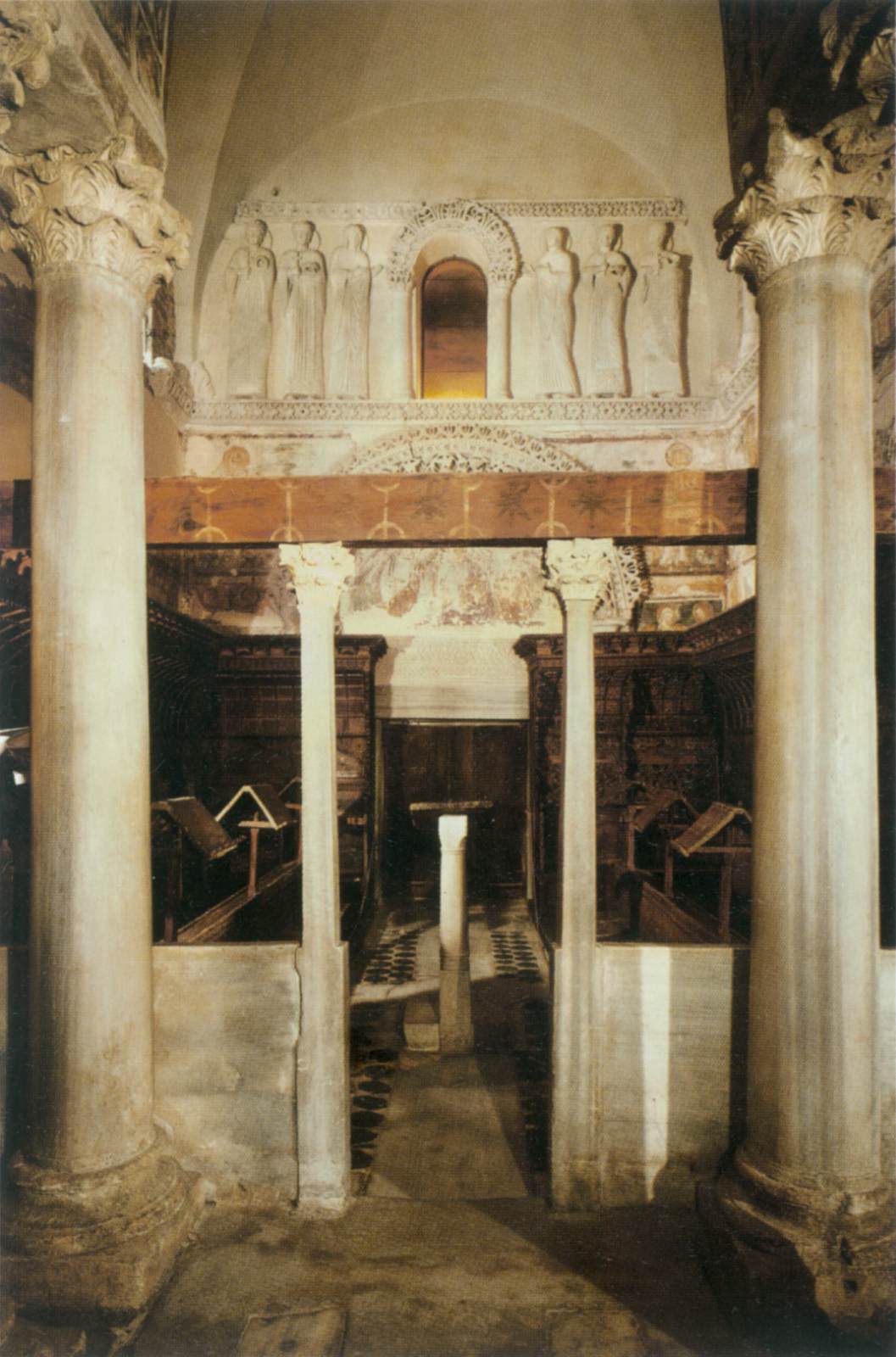
Interior view
- MEDIUM
- Photo
- TYPE
- Religious
PALETTE
HOVER OR TAP A SWATCH FOR NAME, SHARE AND HEX. SAMPLED FROM THE IMAGE — INDICATIVE, NOT A PIGMENT ANALYSIS.
DEVELOPMENT BUILD — NOT FOR PUBLIC USE. CONTRIBUTE ON GITHUB.
03 — ARTWORK
PALETTE
HOVER OR TAP A SWATCH FOR NAME, SHARE AND HEX. SAMPLED FROM THE IMAGE — INDICATIVE, NOT A PIGMENT ANALYSIS.
COMMENTARY
UNDERLINED TERMS ARE DEFINED IN THE GLOSSARY.
The Tempietto Longobardo (or Santa Maria della Valle) at Cividale is essentially one room, two storeys high, with a screen across the east end making a sanctuarythe part of a church or temple containing the shrine; in Christian churches the choir and high altar.. Against the west wall is an aggregation of sculpture in stuccoA type of light, malleable plaster made from dehydrated lime (calcium carbonate) mixed with powdered marble and glue and sometimes reinforced with hair. It is used for sculpture and architectural decoration, both external and internal. In a looser sense, the term is applied to a plaster coating applied to the exterior of buildings, but stucco is a different substance from plaster (which is calcium sulphate). Stucco in the more restricted sense has been known to virtually every civilization. In Europe it was exploited most fully from the 16th century to the 18th century, notable exponents being the artists of the School of Fontainebleau and Giacomo Serpotta. By adding large quantities of glue and colour to the stucco mixture stuccatori were able to produce a material that could take a high polish and assume the appearance of marble. Indeed, sometimes it is difficult to distinguish from real marble without touching it (stucco feels warmer)., once a common medium but subsequently almost all destroyed. Above the entrance, which is decorated in abstract motifs, are six life-size female saints flanking a central arched niche. The beautiful carving has sharp cuts and linear qualities, while the vine trails and interlace are precise. Both the vine trails and the female saints carefully follow Early Christian prototypes, except for the figures' peculiar elongation. These stuccos and their accompanying wall paintings have been dated variously between the 8th and the 11th centuries. There are no obvious close stylistic parallels, and they may reflect the conservative aspects of Lombard taste.
The school of the Lombards was influential in the construction and decoration of Italy's RomanesqueStyle of art and architecture prevailing throughout most of Europe in the 11th and 12th centuries, the first style to achieve such international currency. The dominant art of the Middle Ages was architecture, and 'Romanesque', like 'Gothic', is primarily an architectural term that has been extended to the other arts of the period. As the name suggests, it indicates a derivation from Roman art, and sometimes Romanesque is used to cover all the developments from Roman architecture in the period from the collapse of the Roman Empire until the flowering of the Gothic roughly AD 500-1200. More usually, however, it is applied to a distinctive style that emerged, almost simultaneously, in several countries - France, Germany, Italy, Spain - in the 11th century. It is characterized most obviously by a new massiveness of scale, reflecting the greater political and economic stability that followed a period when Christian civilization seemed in danger of extinction. Romanesque painting and sculpture are generally strongly stylized, with little of the naturalism and humanistic warmth of classical or later Gothic art. The forms of nature are freely translated into linear and sculptural designs which are sometimes majestically calm and severe and at others are agitated by a visionary excitement that can become almost delirious. Because of its expressionistic distortion of natural form, Romanesque art, as with other great non-naturalistic styles of the past, has had to wait for the revolution in sensibility brought about by the development of modern art in order to be widely appreciated. churches. The Lombards were a Germanic tribe that descended from the north-east, beyond the Alps, with the conquests of the Lombard King Albonio in 568-72, establishing centres north of the Venetian lagoon, at Cividale and Aquileia, and surrounding the Byzantine Exarchate territories along most of the western Po, and as far north as Como and as far south as the foot of Italy. The remarkable Tempietto of Santa Maria in Valle at Cividale, from 772-76, is an early example of the richness of Lombard decorative work, fusing Byzantine and even Saracen influences, which would have been communicated through the southern Italian territories of the Lombards.
View a <a href="#" onClick="w=window.open ('/support/plans/zzzarchi/08c/3/cividale.html', 'newWin', 'scrollbars=yes,status=no,dependent=yes,screenX=0,screenY=0,width=400,height=600');w.opener=this;w.focus();return false">sectional drawing</a> of the Tempietto showing the lavish interior decoration.
@online{wga-r1d7e21a7e16403,
  author       = {Krén, Emil and Marx, Daniel},
  title        = {Interior view by ARCHITECT, Italian},
  organization = {{Web Gallery of Art}},
  date         = {2026-09-12},
  url          = {https://beta.wga.hu/artists/architect-italian-rba53e875123939/interior-view-r1d7e21a7e16403},
  urldate      = {2026-09-12},
  langid       = {english}
}
ACCESSED 2026-09-12. REPLACE THE AUTHOR FIELD WITH THE COMMENTARY AUTHOR WHERE ONE IS NAMED.


