02 — ARTIST
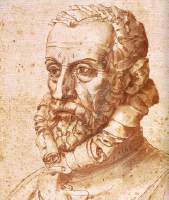
ARCIMBOLDO, Giuseppe
b. 1526 Milano · d. 1593 Milano
DEVELOPMENT BUILD — NOT FOR PUBLIC USE. CONTRIBUTE ON GITHUB.
02 — ARTIST
b. 1526 Milano · d. 1593 Milano
BIOGRAPHY
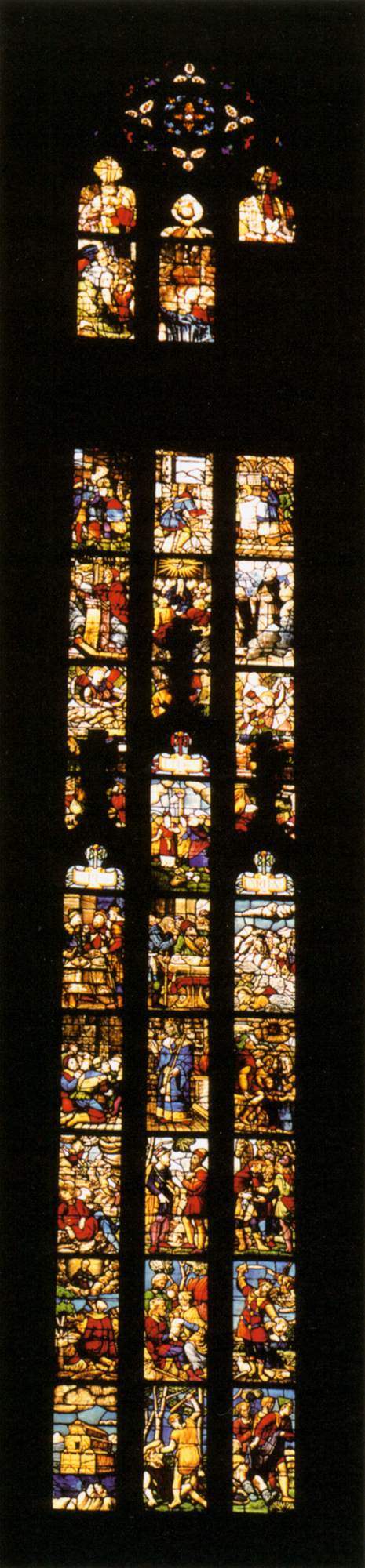
Italian painter, draughtsman and tapestry designer, active also in Austria and Bohemia. He came from a distinguished Milanese family that included a number of archbishops of the city; his father was the painter Biagio Arcimboldo. He is first documented in 1549, working with his father for Milan Cathedral; he received payments until 1558 for supplying paintings, designs for an altar baldachin and stained-glass windows for the cathedral.
In 1556 he worked with Giuseppe Meda on frescoes for the Cathedral of Monza, a work that must have been completed by 1562. In 1558, he drew the cartoon for a large tapestry of the Dormition of the Virgin Mary, which still hangs in the Como Cathedral today. On the basis of stylistic comparison with the windows in Milan and the frescoes in Monza, the design of a tapestry representing St John the Baptist Preaching and Baptizing (Monza, Museo e Tesoro del Duomo) can be attributed to Arcimboldo.
In 1562 he became court portraitist to Ferdinand I at the Habsburg court in Vienna, and later, to Maximilian II and his son Rudolf II at the court in Prague. A group of portraits representing persons at the Habsburg court can be attributed to Arcimboldo. At the Imperial Court his original and grotesque fantasy was almost immediately unleashed. He invented a portrait type consisting of painted animals, flowers, fruit, and objects composed to form a human likeness. Some are satiric portraits of court personages, and others are allegorical personifications.
Arcimboldo's conventional work, on traditional religious subjects, has fallen into oblivion, but his portraits of human heads made up of flowers, vegetables, fruit, animals, sea creatures and tree roots, were greatly admired by his contemporaries and remain a source of fascination today. Arcimboldo's most famous paintings had contemporary allegorical meanings and were unique compositions of edibles and culinary objects placed together in such a way as to represent the contours or heads of cooks, gardeners, waiters, and symbolic figures related to the world of sciences. He was not prolific, but his paintings of fantastic heads and social satirical subjects were popular.
There is a codex in the manuscript collection of the Österreichische Nationalbibliothek, Vienna, which contains original studies of animals drawn from nature. Some of these drawings can be related to Arcimboldo's painting Earth, and it was suggested that Arcimboldo was the author of a group of drawings to be found in this codex (Codex min. 42). The contents of the codex are representations of animals and plants.
Arcimboldo was also the court decorator and costume designer. He also created the illusionistic sceneries for the Habsburg court theater. His drawings for courtly pageants were included in the Habsburg imperial art collection. Emperor Rudolf II set him the task of researching and buying works of art and natural curiosities, as well as giving him countless commissions for paintings.
Arcimboldo's work became especially well known throughout Europe after the Austrian Holy Roman Emperor Rudolf II exhibited Arcimboldo's paintings in the many residences of the Habsburg imperial family. In fact Arcimboldo's bizarre pieces and grotesque portraits pleased the Habsburg emperor so much that he appointed the Italian painter Habsburg court painter at Vienna and Prague and also made him a count palatine.
Arcimboldo's style has been so often imitated over the centuries that it is sometimes difficult to make exact attributions. He has been seen by some as the forerunner of Surrealism in the 20th century, but, more to the point, he should be seen in his own context at the end of the Renaissance. This was a time when people (collectors and scientists alike) were beginning to pay more attention to nature.
In 1587 Arcimboldo went back to Milan but stayed in contact with the Emperor. Towards the end of his life, he sent the Emperor the idiosyncratic portrait of him in the guise of the Greek god Vertumnus. His Italian contemporaries honoured him with poetry and manuscripts celebrating his illustrious career. He died in Milan in 1593.
When the Swedish army invaded Prague in 1648, during the Thirty Years' War, many of Arcimboldo's paintings were taken from Rudolf II's collection.
23 SELECTED · 142 CATALOGUED
In the Summer of 1563 which belonged to a series of the Four Seasons, Arcimboldo composes heads for the first time from all kinds of objects, whose selection gives meaning to the allegory. As attested by, among others, a maiolica plate from 1536, this compositional method was certainly not invented by Arcimboldo, but the sophistication and imagination with which the painter applies the themes in the picture-puzzles are a very personal achievement, and the many later copies serve to reveal in their weaknesses and simplifications Arcimboldo's true originality.
The cycle of the seasons is also an allegorical representation of the for ages of life. In correspondence to the Four Seasons was the series created three years later in 1566, the Four Elements. Through a paired arrangement of the qualities in the objects, warm-cold and damp-dry, the elements correspond to the seasons. Thus the warm-dry summer corresponds to fire, the cold-damp winter to water, the warm-moist spring to air and the cold-dry autumn to earth. Thereby, through the arrangement of the heads, turn to the left or to the right, corresponding pairs face each other and form a unit. If desired, the allegories in the two series could be arranged into a paired-grouping in which each head in one series would face its corresponding head in the other, as follows: Spring - Air, Summer - Fire, Autumn - Earth, Winter - Water.
11 SELECTED · 142 CATALOGUED
Arcimboldo was originally appointed official portraitist to the emperor, which meant that he received duties such as copying ancient Habsburg portraits. He later abandoned the conventions of court portraiture and depicted his subjects in accordance with the same principles used in the series of Seasons and Elements.
Arcimboldo also took his figures from classical mythology: he depicted Rudolf II as Vertumnus, the ancient Roman god of vegetation, and painted several versions of Flora. He executed portraits made up of household equipments, such as the Cook and the Waiter. The Librarian and the Jurist are composed of books and manuscripts.
The reversible heads represents a special type of the composite heads. It was a fashion of the period to devise reversible image. In rhetoric such a figure is called a palindrome. Everything is still the same, says a true palindrome, whether you take things in one way or another. However, an Arcimboldo palindrome seems to say that everything can take on a different meaning. Arcimboldo's reversible heads allow for a dual interpretation when turned upside-down, delighting the viewer with their metamorphosis. Viewed in one direction, the picture shows a still-life, turned upside-down, the forms alchemically come to life to produce a face.
Three reversible heads by Arcimboldo are known: The Cook, The Vegetable Gardener and The Reversible Head with Basket of Fruit.
7 SELECTED · 142 CATALOGUED
Among the many tasks of a court artist featured the design and organization of festivals and tournaments, which Renaissance princes saw as their favourite means of political propaganda. The festive culture which developed in the Italian courts in the early modern period found its transalpine equivalent in the sumptuous tradition of pageant and tournaments of the Burgundian court. The Habsburgs, who claimed to be the heirs of the House of Burgundy, took over the legacy and introduced the tradition into their own court representations.
In addition to Arcimboldo's paintings, his drawings for courtly pageants were included in the Habsburg imperial art collection. A selection of sketches of various pageants and tournaments are now in the Gabinetto dei Disegni e delle Stampe of the Galleria degli Uffizi which were brought to Florence via the Tuscan branch of the Habsburg family. These drawings were originally gathered in a red Morocco portfolio. On the frontispiece there is a dedication to Emperor Rudolf II. Most of these sketches are in brown pen and blue wash.

ARCIMBOLDO, Giuseppe
VIEW WORK →
ARCIMBOLDO, Giuseppe
VIEW WORK →
ARCIMBOLDO, Giuseppe
VIEW WORK →
ARCIMBOLDO, Giuseppe
VIEW WORK →6 SELECTED · 142 CATALOGUED
Giuseppe Arcimboldo was the son of the painter Biagio Arcimboldo. He probably had learnt the rudiments of the craft in the workshop of his father, before moving on, in the early 1540s, to an apprenticeship with a master from outside the family. Probably his earliest work, executed together with his father, was the fresco decoration on the side walls of the chapel dedicated to St John the Baptist in the church of San Maurizio al Monastero Maggiore in Milan.
At the age of twenty he was engaged as a designer of stained-glass windows and as a painter of various decorations in the Milan Cathedral. These works were carried out between 1549 and 1558. Another artistic undertaking in this period was the design of tapestries.
Arcimboldo left his homeland in 1562 and went to the court of Emperor Maximilian II.
30 SELECTED · 142 CATALOGUED
In the middle of the sixteenth century the interest for natural sciences began to establish itself in European courts. Fascinated by the immeasurable wealth of new, hitherto unknown plants and animals from overseas and the New World, Grand Dukes Francesco I and Ferdinando I of Tuscany, Duke Francesco Maria II della Rovere, King Philip I of Spain, Duke Albrecht V of Bavaria and above all Maximilian II and Rudolf II all encouraged scientific research. Emperor Maximilian II, Arcimboldo's principal patron, recruited the most famous botanists of his time, and he had an equally large interest for animals.
There is a codex in the manuscript collection of the Österreichische Nationalbibliothek, Vienna, which contains original studies of animals drawn from nature. Some of these drawings can be related to Arcimboldo's painting Earth, and it was suggested that Arcimboldo was the author of a group of drawings to be found in this codex (Codex min. 42). The contents of the codex are representations of animals and plants.
Two other codices in the Österreichische Nationalbibliothek in Vienna, denoted as cod. min. 129 and 130 belonged to an ambitious undertaking which was later known as the "Museum of Emperor Rudolf II." They contain gouache paintings on parchment depicting mammals and birds. Most of the folios were created in the period between 1575 and 1611 with cooperation by Giuseppe Arcimboldo, Hans Hoffmann, Dirck de Quade van Ravesteyn and Daniel Fröschel. None of the folios are signed and only one is dated.
7 SELECTED · 142 CATALOGUED
From 1565, Arcimboldo was a long-tenured portraitist of Emperor Maximilian II, first in Vienna and later in Prague. In 1576, he was named "portraitist and painter" of the new emperor, Rudolf II. In 1587 he returned to his native city Milan.
Around the middle of the sixteenth century, court portraiture throughout Europe had a homogeneous form, wherein the full-figure portrait dominated as the most representative form. Accordingly, smaller-format portraits, half-figures and busts have more private character, in which case the demand for likeness predominates over the representative function.
Among the enormous quantity of anonymous portraits that were created at the Habsburg court and which have been preserved till today, a group of paintings can be attributed to Arcimboldo. The most important painting in this group is the family portrait of Emperor Maximilian II. A closely related series, depicting young girls, possibly the daughters of Ferdinand I, belongs to this group, too.
13 SELECTED · 142 CATALOGUED
The group of thirteen drawings by Arcimboldo representing the manufacture of silk and now in the Museum of Fine Arts in Boston is accompanied by a letter from the artist which allows us to understand that it is related to a plan of decoration proposed around 1587 to Baron Ferdinand Hoffmann, the new president of the imperial Hofkammer, for some rooms in his palace in Prague. The scenes of farming and handicraft would have been set in the middle of grotesques.
The thirteen drawings accompanied by their captions accurately illustrate the different stages in the production of silk.

ARCIMBOLDO, Giuseppe
VIEW WORK →
ARCIMBOLDO, Giuseppe
VIEW WORK →
ARCIMBOLDO, Giuseppe
VIEW WORK →
ARCIMBOLDO, Giuseppe
VIEW WORK →6 SELECTED · 142 CATALOGUED
Commentary is unavailable for this selection.
12 OF 142 RECORDS


@online{wga-arcimboldo-giuseppe,
  author       = {Krén, Emil and Marx, Daniel},
  title        = {ARCIMBOLDO, Giuseppe},
  organization = {{Web Gallery of Art}},
  date         = {2026-09-09},
  url          = {https://beta.wga.hu/artists/arcimboldo-giuseppe-rd57e72f2c81624},
  urldate      = {2026-09-09},
  langid       = {english}
}
ACCESSED 2026-09-09. REPLACE THE AUTHOR FIELD WITH THE COMMENTARY AUTHOR WHERE ONE IS NAMED.