03 — ARTWORK
Summer
- MEDIUM
- Oil on panel, 67 x 51 cm
- TYPE
- Mythological
PALETTE
HOVER OR TAP A SWATCH FOR NAME, SHARE AND HEX. SAMPLED FROM THE IMAGE — INDICATIVE, NOT A PIGMENT ANALYSIS.
DEVELOPMENT BUILD — NOT FOR PUBLIC USE. CONTRIBUTE ON GITHUB.
03 — ARTWORK
PALETTE
HOVER OR TAP A SWATCH FOR NAME, SHARE AND HEX. SAMPLED FROM THE IMAGE — INDICATIVE, NOT A PIGMENT ANALYSIS.
COMMENTARY
UNDERLINED TERMS ARE DEFINED IN THE GLOSSARY.
The painting is part of a cycle dedicated to the four seasons. Each one is symbolically represented by a startling and evocative juxtaposition of fruits and objects typical of that time of the year. Arcimboldo found this subject particularly congenial and often painted groups of pictures on a theme. Not only did he paint the four seasons, but also the four elements (Earth, Air, Water, and Fire).
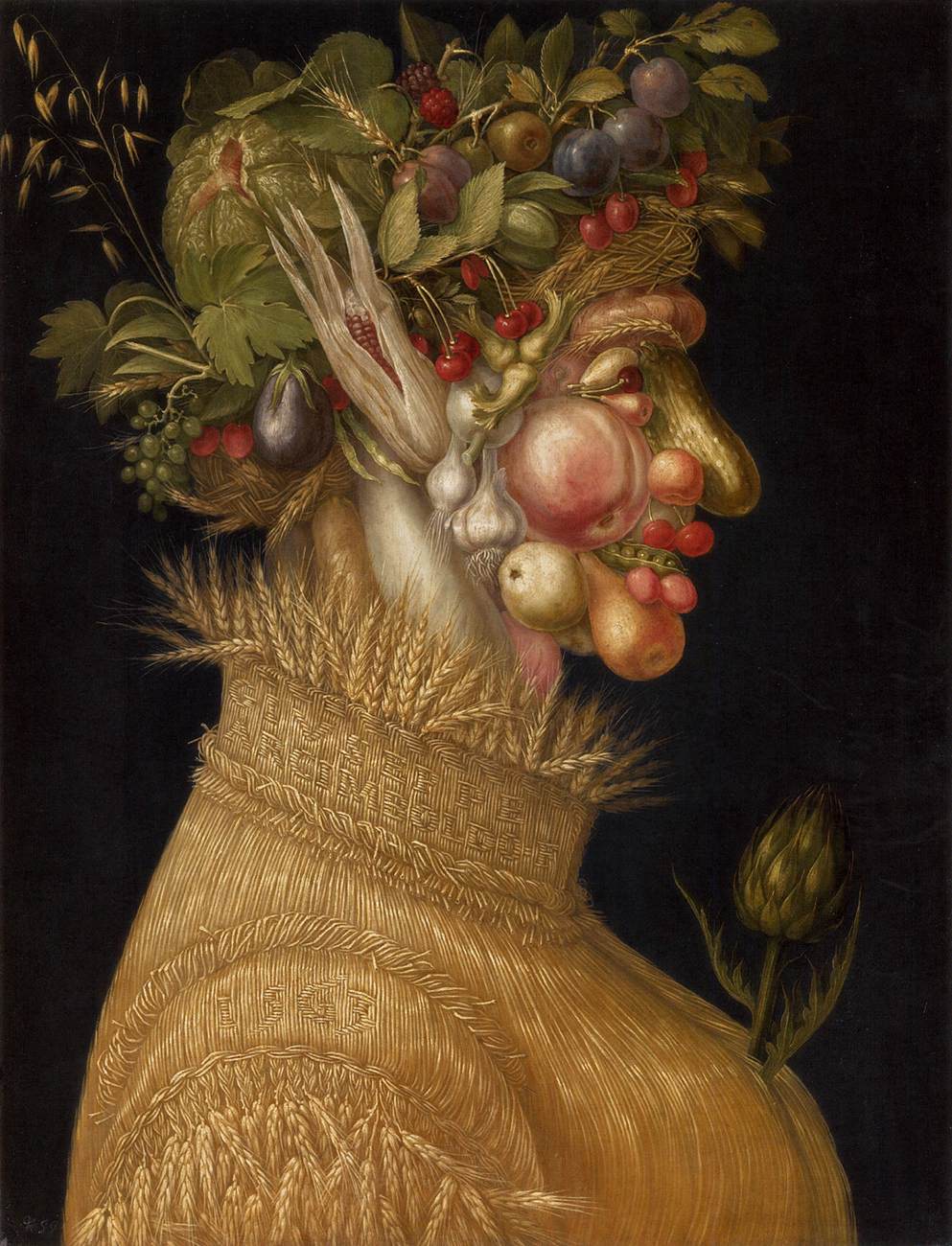
The painting originally belonged to a series of the Four Seasons. Summer, the only dated picture of the series, carries the date 1563. For the first time, Arcimboldo composes heads from all kinds of objects, whose selection gives meaning to the allegoryA work of art which represents some abstract quality or idea, either by means of a single figure (personification) or by grouping objects and figures together. Renaissance allegories make frequent allusions both to both Greek and Roman legends and literature, and also to the wealth of Christian allegorical stories and symbols developed during the Middle Ages.. As attested by among others, <A onclick="return OpenOther('/html/u/urbini/testa.html')" HREF="/html/u/urbini/testa.html">a maiolicaTin-glazed earthenware, particularly such ware produced in Italy. The term originally referred to the island of Majorca (or an alternate theory has it referring to Malaga), and designated only Hispano-Moresque lusterware; but since the 16th century it has been used to refer to Italian tin-glazed ware and imitations of the Italian ware. It is characterized by painted decoration of high quality executed in several colours on the dry but unfired tin glaze, generally with a final coating of clear lead glaze. The range of colours is typically limited to cobalt blue, copper green, manganese purple, antimony yellow, and iron red, with white provided by the tin-glaze material. When white is used for painting, it is applied onto a bluish-white glaze or blue ground. The luster is typically a golden colour derived from silver or a mother-of-pearl effect. plate</A> from 1536, this compositional method was certainly not invented by Arcimboldo, but the sophistication and imagination with which the painter applies the themes in the picture-puzzles are a very personal achievement, and the many later copies serve to reveal in their weaknesses and simplifications Arcimboldo's true originality.
In the profile bust of Summer, the cheek and neck area are composed of a large peach, quince, garlic, white young onions, yellow beets and white eggplant; the mouth and lips are formed of cherries and the open peapod within imitates a row of teeth. The nose is a young wild cucumber and the chin is a pear; the eye shines as a glassy sour cherry between two small pears. The bulge of the forehead seems to be made of brown-skinned onions; even the eyebrows - a curved grain-ear - are not overlooked. On the temple are three hazelnuts in their covers, and in the place of the ear is a dried corncob. The ensembleA combining of several media grouped together to form a composite art work. Chapels were among the most notable Renaissance ensembles, sometimes combining panel painting, fresco, sculpture, and architecture. is completed with a head covering, effectively a cap or a hat made of fruit and vegetables bedded in greenery, from which emerge oat spikes resembling a hat feather. The clothing in woven straw has a single artichoke and the woven signature and date sophisticatedly integrated into the composition as jewellery. <P> <TABLE ALIGN=LEFT CELLPADDING=5 BORDER=1 WIDTH=320 BGCOLOR="#99CCCC"> <TR VALIGN=MIDDLE><TD><IMG SRC="/support/gif/listen.gif" BORDER=0 VALIGN=MIDDLE> Suggested listening (streaming mp3, 10 minutes):<BR><A HREF="#" onClick="w=window.open ('/music1/18_cent/vivaldi_rv315_summer.html', 'newWin', 'scrollbars=yes,status=no,dependent=yes,screenX=0,screenY=0,width=350,height=350');w.opener=this;w.focus();return true"><B>Vivaldi: Concerto in G minor RV 315 op. 8. No. 2 (Summer)</B></A> </TD></TR></TABLE>
@online{wga-r675a6012b0c003,
  author       = {Krén, Emil and Marx, Daniel},
  title        = {Summer by ARCIMBOLDO, Giuseppe},
  organization = {{Web Gallery of Art}},
  date         = {2026-09-13},
  url          = {https://beta.wga.hu/artists/arcimboldo-giuseppe-rd57e72f2c81624/summer-r675a6012b0c003},
  urldate      = {2026-09-13},
  langid       = {english}
}
ACCESSED 2026-09-13. REPLACE THE AUTHOR FIELD WITH THE COMMENTARY AUTHOR WHERE ONE IS NAMED.


